
Introduction
A Private Pilot License (PPL) is the first major step for anyone who wants to learn how to fly an aircraft safely and confidently. It allows individuals to operate single-engine aircraft for personal and recreational purposes under aviation regulations. For beginners, the process may seem complicated at first because it includes medical checks, training hours, written exams, and practical tests. However, when broken down into clear requirements, the path becomes structured and achievable.
Understanding the Private Pilot License requirements helps students prepare better, avoid delays, and complete training smoothly. Whether someone is a student, career changer, recreational flyer, or parent researching aviation options, knowing what is required makes the journey into aviation more predictable and less overwhelming.
Real-world Use Cases
A beginner starting flight training from zero experience may want to understand what is needed before enrolling in a flight school. A student pilot may be confused about medical eligibility or flight hour requirements. A career changer may need clarity on how long the entire process will take.
A recreational flyer may want to understand requirements before committing time and money. A parent researching aviation for their child may want to know age limits, safety expectations, and training steps. A student preparing for their first solo flight may need clarity on instructor endorsements and skill requirements.
Evaluation Criteria for Meeting Private Pilot License Requirements
To successfully meet PPL requirements, beginners should evaluate:
- Age and eligibility readiness
- Medical fitness status
- Ability to understand English aviation communication
- Availability for consistent training
- Financial planning for training costs
- Ability to complete flight hours on schedule
- Ground school study discipline
- Instructor feedback and learning progress
- Weather and location constraints
- Readiness for exams and checkride
- Safety mindset and decision-making ability
Meeting these criteria ensures smoother progress through training.
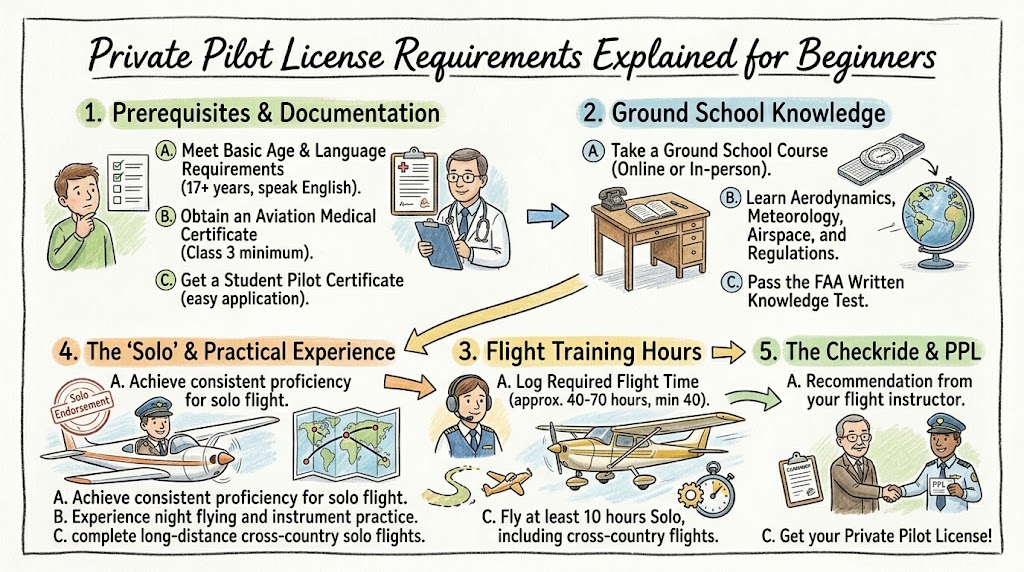
1. What Is a Private Pilot License
A Private Pilot License allows a person to fly aircraft for personal travel, recreation, and non-commercial purposes. It is the foundation of all aviation careers and recreational flying.
For example, a licensed private pilot can fly family members to another city for a weekend trip under safe weather conditions and regulatory limits.
2. Minimum Age Requirement
To begin training, a student must meet the minimum age requirement set by aviation authorities. This ensures physical and cognitive readiness for learning flight operations.
For example, younger students can begin training early but must meet the required age before obtaining the final license.
3. English Language Proficiency
Pilots must be able to understand and communicate in English because it is the international language of aviation.
For example, a student must be able to communicate with air traffic control clearly during takeoff, landing, and navigation.
4. FAA Medical Certificate Requirement
A medical certificate ensures that the student is physically and mentally fit to operate an aircraft safely.
For example, a student with good vision and no serious medical limitations can pass the medical exam and begin flight training confidently.
5. Student Pilot Certificate Requirement
Before solo flight, students must obtain a student pilot certificate to legally fly an aircraft under supervision rules.
For example, a beginner can fly alone for the first time only after receiving instructor approval and certification.
6. Flight School Enrollment Requirement
Students must enroll in a certified flight school or training program to begin structured learning.
For example, a student joins a flight school to receive both ground instruction and hands-on flight training.
7. Ground School Requirements
Ground school teaches theoretical knowledge such as weather, navigation, regulations, and aircraft systems.
For example, a student learns how weather patterns affect flight safety before planning a cross-country flight.
8. Flight Training Hour Requirements
Students must complete a minimum number of flight hours with a certified instructor and solo experience.
For example, a student practices takeoffs and landings repeatedly before being cleared for independent solo flight.
9. Solo Flight Eligibility Requirements
Before solo flight, students must demonstrate safe handling of the aircraft and receive instructor endorsement.
For example, a student may complete several successful practice flights before being allowed to fly alone.
10. Cross-Country Flight Requirements
Students must complete flights between different airports to build navigation and planning skills.
For example, a trainee may fly to a nearby city airport and return using visual navigation techniques.
11. Night Flying Requirements
In many training programs, students must gain basic experience in night flying under safe conditions.
For example, a student learns how runway lighting and night visibility affect approach and landing.
12. FAA Written Knowledge Test Requirement
Students must pass a written exam covering aviation theory and safety rules.
For example, preparation includes studying weather charts, airspace classifications, and navigation concepts.
13. Checkride Requirement
The checkride is the final practical test where a student demonstrates flying skills to an examiner.
For example, the student performs flight maneuvers, navigation tasks, and emergency procedures during evaluation.
14. Logbook and Flight Documentation
Students must maintain a logbook recording all flight hours, training sessions, and instructor endorsements.
For example, each training flight is recorded to ensure accurate tracking toward certification.
15. Instructor Endorsement Requirement
Instructors must approve students before solo flights, exams, and checkride attempts.
For example, a student receives endorsement only after demonstrating safe and consistent performance.
16. Aeronautical Knowledge Areas
Students must understand key topics like weather, navigation, airspace rules, and aircraft systems.
For example, understanding wind patterns helps pilots plan safer and more efficient routes.
17. Flight Proficiency Standards
Students must demonstrate consistent flying ability, including takeoff, landing, and maneuver control.
For example, a student must safely complete landing approaches without instructor intervention.
18. Aircraft Familiarity Requirement
Students must learn how aircraft systems work, including controls, instruments, and safety equipment.
For example, understanding fuel systems helps prevent operational mistakes during flight.
19. Safety and Decision-Making Expectations
Good judgment is essential in aviation training and is evaluated throughout the learning process.
For example, a student must decide to delay a flight if weather conditions are unsafe.
20. Common Beginner Mistakes
Many beginners delay training progress by misunderstanding requirements or skipping study time.
Common mistakes include:
- Not preparing for medical exams
- Irregular flight training schedules
- Ignoring instructor feedback
- Poor logbook management
- Underestimating study requirements
Benefits of Understanding PPL Requirements
Understanding requirements helps students:
- Plan training effectively
- Avoid delays in certification
- Save time and money
- Build confidence early
- Improve safety awareness
- Track learning progress
- Prepare for exams efficiently
- Reduce confusion during training
Private Pilot License vs Sport Pilot Requirements
| Factor | Private Pilot License | Sport Pilot |
|---|---|---|
| Aircraft Access | Wider range of aircraft | Limited light sport aircraft |
| Training Depth | More comprehensive | More basic |
| Medical Requirement | Standard medical certificate | Simplified requirements |
| Career Path | Supports advanced training | Limited progression |
| Flexibility | Higher | Lower |
Full-Time vs Part-Time Training
| Factor | Full-Time | Part-Time |
| Completion Speed | Faster | Slower |
| Cost Flow | Higher upfront intensity | Spread over time |
| Consistency | High | Varies |
| Learning Curve | Steady progress | May require repetition |
| Flexibility | Limited personal time | More flexible |
Beginner Confusion vs Structured Training
| Factor | Confused Approach | Structured Approach |
| Progress | Slower | Faster |
| Understanding | Unclear | Clear and guided |
| Confidence | Low | High |
| Training Efficiency | Poor | Strong |
| Stress Level | High | Controlled |
FAA Requirements vs Flight School Requirements
| Factor | FAA Requirements | Flight School Requirements |
| Purpose | Legal certification | Training support |
| Structure | Standardized rules | Flexible teaching methods |
| Flexibility | Fixed | Varies by school |
| Learning Approach | Exam-focused | Skill-focused |
| Outcome | License eligibility | Student readiness |
FAQs
1. What is a Private Pilot License?
A Private Pilot License allows individuals to fly aircraft for personal and recreational purposes under aviation regulations.
2. What is the minimum age requirement?
Students must meet the minimum age requirement before receiving final certification, although training may begin earlier.
3. Do I need a medical certificate?
Yes, a medical certificate is required to ensure the pilot is physically and mentally fit to fly safely.
4. How many flight hours are required?
Students must complete a minimum number of flight hours including solo and instructor-guided training.
5. What is the written exam?
It is a theory test covering navigation, weather, airspace, and aviation rules.
6. What is a checkride?
A checkride is a practical test where a student demonstrates flying skills to an examiner.
7. Do I need a student pilot certificate?
Yes, it is required before solo flight operations.
8. What is ground school?
Ground school teaches aviation theory and prepares students for exams and real flight operations.
9. Can I fly solo during training?
Yes, but only after instructor approval and meeting required skill standards.
10. How long does training take?
Training time varies depending on schedule, consistency, and learning pace.
Conclusion
Understanding Private Pilot License requirements is the first step toward becoming a confident and well-prepared pilot. When beginners clearly understand age limits, medical standards, training hours, exams, and skill expectations, the entire learning journey becomes more structured and less stressful. With proper planning, consistent training, and instructor guidance, students can meet all requirements efficiently and safely progress toward earning their Private Pilot License.
