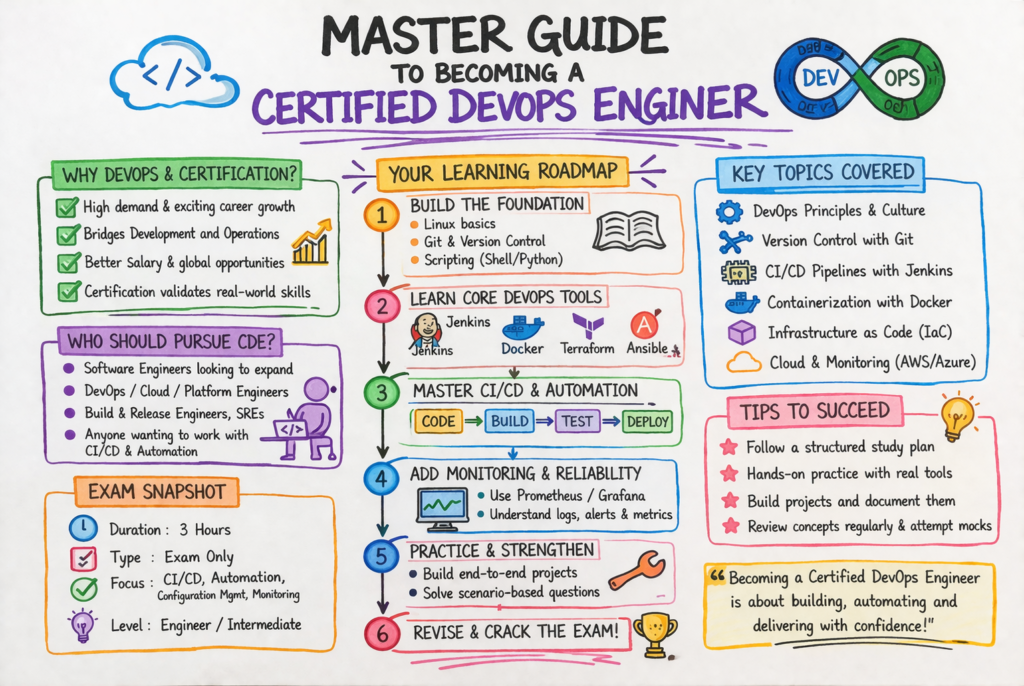
Modern software teams are under pressure to ship faster, reduce failures, recover quickly, and keep systems stable. That is exactly where DevOps becomes important. A strong DevOps engineer does not only automate deployment. They improve the full delivery lifecycle, connect teams, reduce manual work, and help the business move with confidence.
That is why the Certified DevOps Engineer program matters. It is built for professionals who want to validate practical skills in CI/CD, automation, configuration management, monitoring, and cloud-native delivery. On the official certification page, DevOpsSchool describes it as a program for professionals who want to prove knowledge and hands-on ability in core DevOps practices, with expected familiarity in Jenkins, Docker, Kubernetes, Git, and Ansible.
For working engineers and managers, this certification can serve two purposes. First, it gives structure to your learning. Second, it helps you present your DevOps capability in a more formal way. If you already work with build pipelines, infrastructure automation, release workflows, or cloud delivery, this certification helps organize that experience into a recognized path. DevOpsSchool lists DevOps Engineers, Cloud Engineers, and Site Reliability Engineers among the target audience.
This guide explains what the certification is, who should take it, how to prepare, what you can do after it, what role it fits, and how it connects with DevOps, DevSecOps, SRE, AIOps, MLOps, DataOps, and FinOps growth paths.
Why Certified DevOps Engineer matters
Many teams still think DevOps is just a tool stack. In reality, DevOps is a working model. It combines engineering practices, team collaboration, fast feedback, testing, automation, observability, and deployment discipline. A DevOps engineer is expected to understand how software moves from code to production and how that journey can be made safer, faster, and more reliable.
The official program outline reflects that broader view. The published agenda includes software development models, DevOps concepts and process, DevSecOps concepts, SRE concepts, best practices, CI/CD-related areas, and hands-on tooling topics such as Maven, JUnit, Selenium, Apache, NGINX, and Ansible. That makes it a useful certification for people who want more than a narrow tool-based badge.
For managers, the value is also practical. A certification like this helps create a shared language inside teams. It can help identify readiness for release engineering, automation ownership, platform work, and delivery transformation. For engineers, it helps turn scattered DevOps experience into a more complete and career-ready profile.
Certification overview
| Track | Level | Who it’s for | Prerequisites | Skills covered | Recommended order | Link |
|---|---|---|---|---|---|---|
| DevOps | Engineer | DevOps Engineers, Cloud Engineers, SREs, software engineers moving into automation and delivery roles | Strong foundation in Jenkins, Docker, Kubernetes, Git, and Ansible; the official page also lists the Master in DevOps Engineering training path as the prerequisite route | CI/CD, infrastructure automation, configuration management, monitoring, DevOps workflows, practical delivery concepts | After DevOps basics or after MDE-level preparation | https://www.devopsschool.com/certification/certified-devops-engineer.html |
What is Certified DevOps Engineer?
What it is
Certified DevOps Engineer is a role-focused certification for professionals who want to validate that they can work with real DevOps practices. According to the official page, it is designed to test expertise in CI/CD pipelines, infrastructure automation, configuration management, and monitoring tools, along with hands-on problem-solving in modern DevOps environments.
It is not just for theory-based learning. The published content suggests that candidates are expected to connect processes, tools, and delivery thinking in a practical way. That makes it useful for people who already do DevOps work or are preparing to move into that role.
Who should take it
This certification is a strong fit for professionals such as:
- DevOps Engineers
- Cloud Engineers
- Site Reliability Engineers
- Build and Release Engineers
- Platform-focused engineers
- Software engineers moving toward automation, CI/CD, and cloud delivery roles
The official page directly names DevOps Engineers, Cloud Engineers, and SREs as the core audience.
This is also helpful for managers who want to understand what a practical DevOps engineer should know. Even if they do not take the exam themselves, they can use the structure to guide team development and role mapping.
Skills you’ll gain
After preparing seriously for Certified DevOps Engineer, you should grow in these areas:
- Understanding of software delivery models and DevOps operating principles
- Stronger clarity around CI/CD flow from source control to deployment
- Better understanding of configuration management and automation discipline
- Working knowledge of common DevOps support tools and testing flow
- Better awareness of DevSecOps and SRE as connected practices
- More confidence in handling deployment pipelines, test automation, and environment setup
- Ability to think in terms of repeatability, reliability, and delivery speed
The official agenda supports these outcomes through its mix of DevOps concepts, DevSecOps, SRE, development models, and tools such as Maven, JUnit, Selenium, Apache, NGINX, and Ansible.
Real-world projects you should be able to do after it
A good certification should change what you can build, not just what you can describe. After preparing for this exam properly, you should be able to handle work like:
- Creating a simple CI pipeline for an application build and test flow
- Automating code validation and test execution before deployment
- Managing deployment preparation with repeatable scripts or configuration tools
- Setting up and supporting web-facing services with Apache or NGINX
- Using Ansible or similar automation logic for provisioning and deployment tasks
- Participating in release readiness checks and rollback thinking
- Supporting better team collaboration between development and operations
- Explaining how DevOps, DevSecOps, and SRE overlap in real delivery work
These project expectations are grounded in the official CDE scope and training agenda.
Preparation plan
7–14 days plan
This path is best for engineers who already work in DevOps or cloud delivery and only need focused revision. In this short window, review DevOps concepts, CI/CD flow, automation tools, configuration management basics, and the tooling areas listed in the official syllabus. Since the official page expects a strong base in Jenkins, Docker, Kubernetes, Git, and Ansible, a short plan works only if that base is already there.
30 days plan
This is the most balanced option for working professionals. Spend the first week on DevOps principles and SDLC models. Use the second week for CI/CD, build tools, testing, and version control flow. Use the third week for Apache, NGINX, automation, and configuration management. Use the fourth week for revision, mock tests, and one end-to-end mini project. This matches the breadth shown on the official agenda.
60 days plan
This plan works best for role changers, support engineers, fresh DevOps learners, or developers with limited operations exposure. Take more time to understand the full lifecycle instead of memorizing terms. Build one small practical project from code commit to deployment. A longer plan is especially useful because the certification covers both process understanding and practical tooling.
Common mistakes
Many candidates make avoidable mistakes while preparing. The most common ones are:
- Studying only definitions and ignoring delivery flow
- Focusing on one tool and missing the bigger DevOps picture
- Skipping testing and quality automation topics
- Ignoring server and web environment basics
- Not practicing deployment logic or configuration automation
- Treating DevSecOps and SRE as unrelated topics
- Underestimating the need for structured revision
These mistakes matter because the official program is broader than just a pipeline demo. It expects practical understanding across multiple connected areas.
Best next certification after this
Your next certification should depend on your direction, not just your current title.
Same track option: Certified DevOps Professional
This is the natural next step if you want more depth in DevOps delivery, maturity, and broader implementation capability. The Gurukul Galaxy guide lists CDE and CDP within the same DevOps certification family.
Cross-track option: DevSecOps Certified Professional or Site Reliability Engineering Certified Professional
Choose DevSecOps if you want security integrated into delivery. Choose SRE if your focus is reliability, uptime, incident reduction, and service performance. Both are listed in the software engineer certification guide as adjacent paths.
Leadership option: Certified DevOps Architect or Certified DevOps Manager
These are strong next steps for professionals moving from hands-on engineering into architecture, governance, or team leadership. Both appear in the same reference guide.
Choose your path
DevOps path
A practical DevOps growth sequence is:
Certified DevOps Engineer → Certified DevOps Professional → Certified DevOps Architect / Certified DevOps Manager
This is the most direct path for engineers who want to remain centered in software delivery, automation, and platform design. The reference guide groups these certifications together as part of the DevOps track.
DevSecOps path
A strong security-oriented progression is:
Certified DevOps Engineer → DevSecOps Certified Professional → Certified DevSecOps Engineer / Certified DevSecOps Architect
This path is useful for engineers who already understand delivery flow and now want to shift security left across build, deployment, and runtime processes. The Gurukul Galaxy guide includes these DevSecOps certifications in the wider software engineer certification map.
SRE path
A reliability-focused route can be:
Certified DevOps Engineer → Site Reliability Engineering Certified Professional → Certified Site Reliability Architect
This is a good match for engineers moving from automation ownership into service health, reliability engineering, observability, and operational excellence. CDE already includes SRE concepts in its own agenda, so this transition is natural.
AIOps / MLOps path
A future-focused route is:
Certified DevOps Engineer → AiOps Certified Professional or MLOps Certified Professional → architect-level specialization later
This path is useful when you want to move into intelligent operations, model lifecycle automation, or ML-supported platform engineering. The reference guide lists both AIOps and MLOps certifications as part of the broader software engineering growth landscape.
DataOps path
A data platform route can be:
Certified DevOps Engineer → DataOps Certified Professional / Engineer path → DataOps Architect or Manager
This path fits engineers involved in data pipelines, analytics delivery, or governed movement of data across environments. DataOps certifications are included in the software engineer certification roundup.
FinOps path
A cost and cloud governance route can be:
Certified DevOps Engineer → Certified FinOps Engineer → Certified FinOps Architect or Manager
This is valuable for engineers and managers who work on cloud usage efficiency, budgeting awareness, and cost-responsible platform operations. The guide includes FinOps certifications alongside the other engineering growth paths.
Role → Recommended certifications
| Role | Recommended certifications |
|---|---|
| DevOps Engineer | Certified DevOps Engineer, Certified DevOps Professional, Kubernetes Certified Administrator & Developer |
| SRE | Certified DevOps Engineer, Site Reliability Engineering Certified Professional, Certified Site Reliability Architect |
| Platform Engineer | Certified DevOps Engineer, Certified DevOps Architect, Kubernetes Certified Administrator & Developer |
| Cloud Engineer | Certified DevOps Engineer, AWS DevOps Engineer – Professional, Azure DevOps Engineer Expert, GCP Professional Cloud DevOps Engineer |
| Security Engineer | Certified DevOps Engineer, DevSecOps Certified Professional, Azure Security Engineer Associate, AWS Certified Security – Specialty |
| Data Engineer | Certified DevOps Engineer, DataOps Certified Professional, AWS Certified Data Engineer – Associate, Azure Data Engineer, GCP Professional Data Engineer |
| FinOps Practitioner | Certified DevOps Engineer, Certified FinOps Engineer, Certified FinOps Architect |
| Engineering Manager | Certified DevOps Engineer, Certified DevOps Manager, Certified DevOps Architect, Certified FinOps Manager |
These mappings are based on the certification families listed in the Gurukul Galaxy reference guide and the official positioning of CDE for DevOps, Cloud, and SRE-aligned professionals.
Next certifications to take
Same track
Certified DevOps Professional
Choose this when you want to go deeper into DevOps maturity and implementation depth after proving engineer-level readiness. It is one of the most natural same-track progressions from CDE.
Cross-track
DevSecOps Certified Professional or Site Reliability Engineering Certified Professional
Pick DevSecOps if you want stronger control over security integration in the delivery lifecycle. Pick SRE if you want to specialize in system reliability, service goals, and operational resilience.
Leadership
Certified DevOps Architect or Certified DevOps Manager
These options are best when your next role is expected to involve architecture decisions, team direction, process governance, or enterprise transformation thinking.
Top institutions which provide help in training cum certifications for Certified DevOps Engineer
DevOpsSchool is the main source for the Certified DevOps Engineer certification and training. The official page provides the exam duration, format, delivery model, training structure, target audience, and learning agenda. It is the most direct choice for learners who want certification plus a structured preparation path.
Cotocus and Scmgalaxy are widely recognized in the same broader learning and technical guidance ecosystem around DevOps upskilling. They are often useful for learners who want additional tutorials, ecosystem awareness, and career-oriented technical support around DevOps journeys. This is an ecosystem-level observation based on the mentoring and network positioning shown around the official certification source, not a claim that they award this exact certification.
BestDevOps can be useful for learners looking for broader certification awareness, practical learning orientation, and role-based understanding of modern delivery practices. It is often relevant to professionals comparing learning paths across DevOps-related tracks. This is a practical learning-context observation rather than a direct statement of the exact same exam delivery.
devsecopsschool.com, sreschool.com, aiopsschool.com, dataopsschool.com, and finopsschool.com become especially helpful after CDE when a learner wants to specialize further into security, reliability, AI/ML operations, data delivery, or cloud cost governance. These domains and their certifications are all represented in the reference guide used for role and path mapping.
FAQs focused on the certification journey
1. Is Certified DevOps Engineer hard for beginners?
It can feel challenging for beginners because the official page expects familiarity with multiple tools such as Jenkins, Docker, Kubernetes, Git, and Ansible. It is easier for people who already work in engineering or cloud environments.
2. How much time do most people need?
Most working professionals can prepare in about 30 days with steady study. People changing roles may need closer to 60 days to become comfortable with the full flow.
3. Is this certification useful only for DevOps Engineers?
No. The official page also lists Cloud Engineers and SREs as suitable candidates, and the knowledge is useful for platform engineers, release engineers, and experienced developers as well.
4. Do I need coding experience?
Basic scripting or engineering thinking helps a lot. You do not need to be an advanced developer, but you should be comfortable with practical automation logic.
5. Is Kubernetes mandatory?
A working foundation helps because Kubernetes is directly named among the expected tool foundations on the official page.
6. Is the exam only theoretical?
The certification is described as testing knowledge and hands-on skill areas, so preparation should be practical, not just theory-based.
7. What should I study first before starting?
Start with Git, Linux basics, CI/CD concepts, container basics, and one automation tool. Then move into the wider CDE syllabus.
8. Should I take DevOps or DevSecOps after this?
Choose DevOps if you want stronger platform and delivery mastery. Choose DevSecOps if you want to focus on integrating security into the lifecycle.
9. Can managers benefit from understanding this certification?
Yes. It helps managers understand delivery maturity, automation readiness, team skill gaps, and growth paths for engineers.
10. Does this certification improve job value?
It can strengthen your profile by giving structure and proof to your DevOps knowledge. That is especially useful when moving into delivery-focused engineering roles.
11. What is the ideal order after Certified DevOps Engineer?
A good sequence is CDE first, then DevOps Professional for deeper track growth, SRE or DevSecOps for specialization, or Architect/Manager for leadership direction.
12. Is this certification relevant outside India?
Yes. The official page presents it as a globally recognized certification program and offers remote online-proctored delivery in English.
FAQs on Certified DevOps Engineer
1. What is Certified DevOps Engineer?
It is a DevOpsSchool certification program that validates practical understanding of CI/CD, infrastructure automation, configuration management, monitoring, and modern DevOps implementation.
2. Who should take this certification?
The official page names DevOps Engineers, Cloud Engineers, and Site Reliability Engineers as the main audience.
3. What is the exam duration?
The official certification page lists the exam length as 3 hours.
4. What is the exam format?
It is listed as multiple choice and multiple select.
5. Is the exam online?
Yes. The page states that it is delivered as an online-proctored exam from a remote location.
6. Is there a training program also?
Yes. The official page shows both a certification program and a training program.
7. What is the prerequisite?
The page lists the Master in DevOps Engineering training route as the prerequisite path and also expects strong foundations in Jenkins, Docker, Kubernetes, Git, and Ansible.
8. What can I do after clearing it?
After clearing it, you can move toward deeper DevOps certifications, shift into SRE or DevSecOps, or prepare for architecture and leadership roles depending on your direction.
Conclusion
Certified DevOps Engineer is a strong choice for professionals who want to prove that they understand how modern software delivery works in the real world. It covers more than just one tool or one stage of deployment. It connects automation, CI/CD, testing, configuration management, monitoring, and broader DevOps thinking into one practical certification journey. For engineers, it can become a solid career checkpoint. For managers, it provides a useful benchmark for skill development and team readiness. If your goal is to build a serious DevOps foundation and open doors toward DevOps, DevSecOps, SRE, AIOps, MLOps, DataOps, or FinOps growth, this certification is a smart and practical starting point.