
Introduction
International students planning to pursue professional flight training in the United States need to understand two separate areas: immigration requirements and aviation-related training requirements. Choosing the correct school and visa category is important because the type of program, school authorization, length of study, and intended training pathway can affect the appropriate immigration process.
For many vocational flight-training programs, the M-1 student visa is the relevant category. Academic programs that lead to a qualifying U.S. degree may instead fall under the F-1 category. The U.S. Department of State explains that the appropriate student visa depends on the type of educational institution and program.
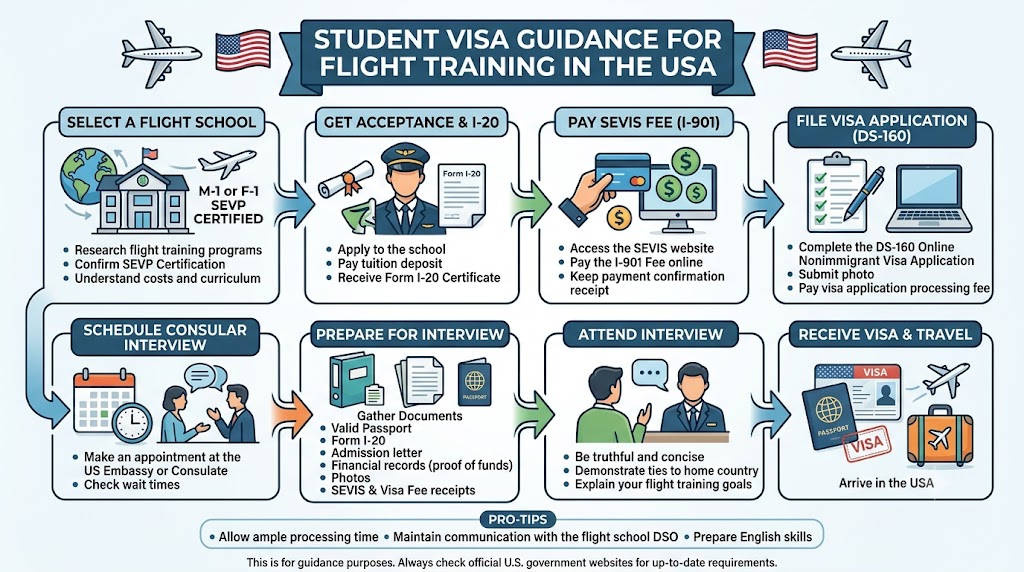
This guide explains the process at a practical level, including school selection, Form I-20, SEVIS, DS-160, visa interviews, financial documentation, aviation-security requirements, common mistakes, and planning considerations.
Important: Immigration and aviation requirements can change. Applicants should verify their individual circumstances with the relevant U.S. government authorities, the intended school, and, when necessary, a qualified immigration professional.
1. Understand Which Student Visa May Apply
The first step is determining whether the intended flight-training program is treated as vocational/nonacademic training or as part of an academic program.
M-1 Student Visa
The M-1 category is generally used for students attending qualifying vocational or other recognized nonacademic institutions. A flight school offering an eligible vocational flight-training program may therefore use the M-1 category.
The exact classification should come from the school’s authorized international-student officials and the documentation issued for the specific program.
F-1 Student Visa
An F-1 visa is generally associated with academic study, including qualifying college or university programs. If flight training is part of an eligible academic degree program, the immigration classification may be different from that of a standalone vocational flight school.
Why the distinction matters
The visa category is not something a student should simply choose based on preference.
It depends on factors such as:
- Type of institution
- Program structure
- Academic or vocational classification
- School’s SEVP authorization
- Program documented on the Form I-20
- Student’s intended course of study
A school should be able to explain which student status its international students normally use for the particular program.
2. Choose the Flight School Before Starting the Visa Process
A common mistake is to begin thinking about the visa before confirming whether the intended school can legally support the student’s planned course of study.
The U.S. Department of State states that students must first be accepted by a SEVP-approved school before applying for an F or M student visa. After acceptance, the school registers the student in SEVIS and issues the appropriate Form I-20.
Questions to ask a flight school
Before paying a significant amount toward training, ask:
- Is the school currently SEVP-certified?
- Does the school issue Form I-20 for the specific flight-training program?
- Which student visa category does the program normally use?
- What certificates or ratings are included in the program?
- What are the school’s published tuition and estimated living expenses?
- What documents are required for admission?
- What is the expected program duration?
- How are weather, aircraft maintenance, and scheduling delays handled?
- What international-student support is available?
- Which aviation-security procedures apply to non-U.S. citizen students?
The last question deserves particular attention because immigration approval and aviation-security clearance are separate issues.
3. Understand the Role of the Form I-20
The Form I-20 is one of the central documents in the student-visa process.
After an eligible student is accepted and registered in SEVIS, the school issues the Form I-20. The Department of State requires students applying for an F or M student visa to present the appropriate I-20.
The I-20 normally contains important information about:
- Student identity
- SEVIS information
- School information
- Program information
- Program dates
- Estimated educational expenses
- Financial information
- Student classification
Check the I-20 carefully
Before using it for the visa application, review:
- Name spelling
- Date of birth
- Passport information
- School name
- Program
- Start date
- Program duration
- Financial figures
- SEVIS identification information
Errors should be addressed with the school’s designated official rather than ignored.
4. Understand SEVIS and the I-901 Fee
International students in F or M status are registered in the Student and Exchange Visitor Information System (SEVIS).
The Department of State explains that, after acceptance by an SEVP-approved school, the student is registered in SEVIS and must pay the applicable SEVIS I-901 fee before proceeding with the student-visa application.
The important sequence is generally:
School acceptance → SEVIS registration → Form I-20 → applicable SEVIS fee → visa application
Keep documentation relating to the payment and your SEVIS information with your visa records.
5. Prepare the DS-160 Carefully
The DS-160 is the online Nonimmigrant Visa Application used for U.S. nonimmigrant visa applications.
Students should have their Form I-20 available because the DS-160 asks for information such as the SEVIS ID and the address of the intended school or program.
Information commonly needed
Depending on the applicant’s circumstances, the application may require information concerning:
- Passport
- Previous travel
- Education
- Employment history
- Family information
- Intended U.S. school
- SEVIS information
- U.S. travel plans
- Visa history
- Security and eligibility questions
Accuracy matters
Do not guess when completing immigration forms.
If information is uncertain, determine the correct information before submitting the application. Differences between the DS-160, I-20, passport, financial documents, and interview answers can create unnecessary questions.
6. Prepare for the Student Visa Interview
The visa interview is an opportunity for a consular officer to assess whether the applicant qualifies for the requested visa.
The Department of State states that applicants may be asked for evidence concerning:
- Academic preparation
- Intention to depart the United States after completing the course
- Ability to pay educational, living, and travel expenses
For a flight-training applicant, the explanation should therefore be clear and consistent.
Be prepared to explain
You should understand your own:
- Chosen school
- Program
- Training objective
- Educational background
- Funding plan
- Expected program duration
- Career or educational objective
- Reasons for selecting the particular program
The objective is not to memorize scripted answers. It is to provide truthful, concise answers that accurately describe your circumstances.
7. Financial Documentation Is a Major Planning Area
Flight training can involve substantial expenses beyond tuition.
A realistic financial plan may need to account for:
| Expense Area | What to Consider |
|---|---|
| Tuition | Published program charges |
| Flight training | Aircraft and instructional costs according to the school’s structure |
| Ground instruction | Classroom or related instructional costs |
| Housing | Rent or student accommodation |
| Food | Daily living expenses |
| Transportation | Local transportation |
| Insurance | Applicable coverage |
| Books and supplies | Training-related materials |
| Visa expenses | Applicable government and application costs |
| Travel | Transportation to and from the United States |
| Personal expenses | Day-to-day necessities |
| Contingency | Unexpected delays or additional expenses |
The school may provide an estimated cost of attendance for immigration documentation.
However, students should understand that an estimate is not necessarily the same as the maximum amount they might ultimately spend.
8. Plan for Training Delays
Flight training does not always progress according to a perfect calendar.
Operational factors can affect schedules, including:
- Weather
- Aircraft availability
- Maintenance
- Instructor availability
- Student progress
- Scheduling constraints
- Examination availability
SEVP’s flight-school documentation specifically recognizes factors such as weather, equipment maintenance, and differences in student ability when estimating instructional hours.
This has an important financial implication.
A student should avoid building a financial plan that assumes training will always proceed at the fastest possible pace.
Better planning approach
Create a budget containing:
Expected cost + reasonable contingency
rather than:
Minimum advertised cost only
9. Understand Aviation Security Requirements Separately
A student visa does not automatically mean that every aviation-training requirement has been satisfied.
Non-U.S. citizen flight-training candidates can be subject to Transportation Security Administration requirements.
The FAA explains that the TSA’s Flight Training Security Program (FTSP) applies to flight-training providers and non-citizen candidates under the applicable regulatory framework. The current program replaced the former Alien Flight Student Program structure.
For applicable candidates, the process can involve:
- Creating an appropriate account
- Providing required information
- Security threat assessment procedures
- Receiving a determination of eligibility
- Completing required steps before applicable training begins
The exact requirements depend on the candidate and training activity.
Important distinction
Think of the process as two separate tracks:
Immigration eligibility
and
Aviation-security/training eligibility
Receiving a student visa does not eliminate separate aviation-security obligations.
10. Understand the Relationship Between the FAA and TSA
Several organizations can be involved in the overall process, but they have different responsibilities.
| Organization | General Role |
|---|---|
| U.S. Department of State | Visa application and consular processing |
| DHS / ICE / SEVP | Student-school authorization and SEVIS framework |
| Flight School | Admission, program documentation, I-20 support, training administration |
| FAA | Federal aviation rules and pilot certification framework |
| TSA | Applicable aviation-security screening and security requirements |
| CBP | Admission decision when arriving at a U.S. port of entry |
This distinction helps prevent a common misunderstanding: a student can satisfy one part of the process without automatically satisfying every other requirement.
11. Do Not Assume a Visitor Visa Is Suitable for Full Flight Training
The purpose of the trip matters.
The Department of State states that students generally need an appropriate student visa to study in the United States. Visitor status is not a substitute for a student visa for ordinary qualifying study. Limited recreational study may be treated differently.
Therefore, someone planning a structured professional flight-training program should not assume that entering as a tourist is an acceptable way to complete the program.
The appropriate classification should be determined before travel, based on the actual purpose and structure of the program.
12. Build a Document Checklist
A practical document file can be organized into several sections.
Identity Documents
- Valid passport
- Previous passports where relevant
- Visa photographs if required
- DS-160 confirmation
- Appointment documentation
School Documents
- Admission letter
- Form I-20
- SEVIS information
- Program information
- School financial documentation
Financial Documents
Depending on the circumstances:
- Bank statements
- Sponsor documentation
- Scholarship documentation
- Education loan documentation
- Income evidence
- Financial sponsorship letters
Academic Documents
Potentially:
- School transcripts
- Diplomas
- Certificates
- Test results where applicable
- Previous training records
The Department of State specifically identifies academic preparation, financial ability, and intent to depart after the course among areas that may be relevant to the visa decision.
13. Keep the Story Consistent
One of the most practical preparation principles is consistency.
Your:
- School application
- I-20
- DS-160
- Financial documents
- Academic history
- Interview responses
should describe the same underlying situation.
For example, if the stated purpose is professional flight training, the applicant should understand the actual program structure and be able to explain why that program fits their educational objective.
Do not create an artificial story simply because it sounds more convincing.
Accuracy is more important than rehearsed language.
14. Explain Your Funding Clearly
A student should understand exactly who is paying for the education.
Possible funding arrangements can include:
- Personal savings
- Parent or family support
- Educational financing
- Scholarship assistance
- Other legitimate financial sponsorship
If someone else is funding the education, the student should understand the basic financial arrangement and be able to provide supporting documentation when appropriate.
Avoid vague answers
Instead of saying:
“My family will manage everything.”
A stronger factual explanation would identify:
- Who is funding the education
- Their relationship to the student
- The source of funds
- The approximate planned educational budget
The documentation should support the explanation.
15. Consider Your Post-Training Plans
Student-visa applicants may be asked about their plans after completing their program.
The Department of State identifies an applicant’s intention to depart the United States after completing the course as an area that may be considered during the visa process.
This does not mean that every student’s long-term career plan will look identical.
It means the applicant should understand the terms of the requested nonimmigrant status and answer questions truthfully about their circumstances and plans.
Do not claim an intention that is not genuine.
16. Understand Entry Into the United States
Having a visa does not itself guarantee admission.
The Department of State explains that a visa permits a foreign national to travel to a U.S. port of entry and request admission. CBP makes the admission decision at the port of entry.
Students should therefore travel with their important immigration documents organized and accessible.
This may include:
- Passport
- Valid student visa
- Form I-20
- Relevant school information
- Other supporting documents appropriate to the circumstances
17. Understand the 30-Day Entry Rule for New Students
For new F and M students, the Department of State states that student visas can be issued sufficiently in advance of the program start date, but new students generally may not enter the United States more than 30 days before the start date shown for the course of study.
This makes the I-20 program start date an important planning reference when arranging international travel.
Do not automatically assume that receiving a visa means you can arrive whenever convenient.
18. Understand Visa Validity Versus Authorized Stay
Two concepts are often confused:
Visa validity
The visa permits travel to a U.S. port of entry for the purpose associated with the visa.
Authorized stay
The period and conditions under which the student is admitted and permitted to remain in the United States are determined through the immigration process at entry and subsequent maintenance of status.
The visa itself is not a guarantee of admission and should not be treated as equivalent to an unlimited right to remain in the United States.
19. Maintain Student Status
Obtaining the visa is only the beginning.
Once in the United States, students must follow the conditions associated with their student status.
Important areas include:
- Maintaining the required course of study
- Following school reporting requirements
- Keeping immigration information current
- Following applicable travel procedures
- Communicating with the school’s designated official when circumstances change
- Avoiding unauthorized activities
A student should contact the school’s designated official before making significant changes to the program rather than assuming that a change is automatically permitted.
20. Common Mistakes to Avoid
Mistake 1: Choosing a School Without Checking SEVP Authorization
Not every flight school has the same ability to support international students.
Better approach: Verify the school’s eligibility for the intended program before committing significant funds.
Mistake 2: Assuming Every Flight School Uses the Same Visa
Programs can have different educational classifications.
Better approach: Ask the school which status applies to the exact program.
Mistake 3: Treating the Visa as the Entire Process
Immigration and aviation-security requirements are separate.
Better approach: Track both processes independently.
Mistake 4: Underestimating Costs
Minimum advertised prices may not capture every expense.
Better approach: Build a realistic budget with contingency.
Mistake 5: Giving Memorized Interview Answers
Over-rehearsed responses can create inconsistencies.
Better approach: Understand your own application and answer truthfully.
Mistake 6: Ignoring Training Delays
Weather and maintenance can affect schedules.
Better approach: Discuss realistic completion expectations with the school.
Mistake 7: Using the Wrong Visa Category
Entering for a substantial course of study under an inappropriate visitor classification can create immigration problems.
Better approach: Establish the correct status before traveling.
Mistake 8: Making Changes Without Asking the School
Changing programs, extending training, or making other significant changes can have immigration implications.
Better approach: Consult the school’s designated official before making material changes.
21. A Practical Planning Workflow
A sensible planning sequence is:
Step 1 — Define the training objective
Determine what type of aviation education you actually want.
↓
Step 2 — Identify suitable schools
Evaluate schools based on program structure, authorization, cost, location, and student support.
↓
Step 3 — Confirm immigration eligibility
Ask the school which student classification applies to the specific program.
↓
Step 4 — Apply to the school
Complete the school’s admission process.
↓
Step 5 — Receive Form I-20
After appropriate acceptance and SEVIS processing, obtain the required documentation.
↓
Step 6 — Complete SEVIS requirements
Handle the applicable SEVIS fee and retain confirmation.
↓
Step 7 — Complete DS-160
Use accurate information consistent with your school and immigration documents.
↓
Step 8 — Schedule the visa interview
Follow the instructions of the U.S. embassy or consulate where you are applying.
↓
Step 9 — Prepare supporting documentation
Organize academic, financial, identity, and school records.
↓
Step 10 — Prepare for aviation-security requirements
Determine whether applicable TSA FTSP procedures must be completed before training.
↓
Step 11 — Travel after appropriate approval
Do not make assumptions about entry requirements.
↓
Step 12 — Maintain status
Stay in contact with the school’s international-student officials throughout the program.
22. Decision Framework for Choosing a Flight School
Do not select a school solely because it advertises the lowest training price.
Evaluate it across several dimensions:
| Evaluation Area | Questions to Ask |
|---|---|
| Immigration | Can the school support the appropriate student status? |
| Program | Does the program match the intended training objective? |
| Cost | What is included and excluded? |
| Scheduling | How are aircraft and instructors scheduled? |
| Delays | How does the school handle weather and maintenance disruptions? |
| Student Support | Who handles international-student questions? |
| Training Structure | Is the progression clearly documented? |
| Location | Are housing and transportation practical? |
| Documentation | Are admission and immigration procedures clearly explained? |
| Security | How does the school handle applicable non-citizen training requirements? |
| Completion | What assumptions does the estimated completion timeline depend upon? |
The goal is not to find the school with the largest marketing claims. It is to find a program whose educational structure, immigration support, costs, and operational realities match the student’s circumstances.
23. What Students Should Ask Before Paying a Deposit
Before making a major financial commitment, request clear answers to:
- Is the school currently authorized to enroll international students in the intended program?
- Which visa classification applies?
- Will the school issue the appropriate Form I-20?
- What expenses are included in the quoted program cost?
- What expenses are excluded?
- How are additional training hours handled?
- What happens if weather or maintenance delays training?
- What are the school’s refund policies?
- What housing options are available?
- What happens if the student’s visa application is refused?
- Which TSA requirements apply to the intended training?
- Who should the student contact if immigration circumstances change?
Written answers are preferable to relying exclusively on verbal promises.
24. Current Screening and Vetting Considerations
Visa applicants should also be aware that U.S. visa screening practices can change.
The U.S. Department of State currently identifies F-1 and M-1 students among visa categories subject to expanded online-presence review and vetting procedures.
Applicants should therefore rely on the current instructions from the Department of State and the specific U.S. embassy or consulate handling their application rather than using an old checklist found online.
This is particularly important because immigration procedures can change independently of the underlying flight-training curriculum.
25. When Professional Immigration Advice May Be Appropriate
Many straightforward applicants can begin the process using official school and government guidance.
Additional professional advice may be useful when circumstances are complicated, such as:
- Previous visa refusals
- Previous immigration violations
- Status changes
- Unusual travel history
- Complex family circumstances
- Previous U.S. immigration history
- Questions about maintaining status
- Uncertainty about eligibility
- Significant changes to the planned program
A flight school can explain its own program and administrative process, but it should not be treated as a substitute for qualified legal advice on complex immigration matters.
26. Student Visa Preparation Checklist
School
- Confirm the school is appropriately authorized
- Confirm the specific program is eligible
- Confirm the expected visa category
- Review admission requirements
- Understand the complete cost structure
- Understand the expected program duration
Immigration
- Receive the appropriate Form I-20
- Verify personal information
- Confirm SEVIS information
- Complete applicable SEVIS requirements
- Complete DS-160 accurately
- Schedule the required appointment
- Review embassy/consulate-specific instructions
Financial
- Prepare evidence of funding
- Understand who is paying
- Account for living expenses
- Account for travel expenses
- Include a reasonable contingency
Interview
- Know your program
- Know your school
- Understand your funding
- Understand your educational objective
- Answer honestly
- Keep answers consistent with your documents
Aviation
- Ask the school about applicable TSA FTSP requirements
- Complete required security procedures when applicable
- Confirm what documentation is needed before training begins
- Follow the school’s instructions for aviation-related compliance
Travel
- Check visa validity
- Check program start date
- Confirm permitted entry timing
- Carry required immigration documents
- Be prepared for CBP inspection at arrival
27. Frequently Asked Questions
Q1. Which visa is normally used for flight training in the USA?
For a qualifying vocational or nonacademic flight-training program, the M-1 student visa may be appropriate. If flight training is part of an eligible academic program, the student may instead fall under F-1. The specific school and program determine the applicable classification.
Q2. Can I choose an M-1 visa simply because I want to become a pilot?
No. The visa classification is connected to the actual educational program and institution. Students should confirm the classification with the school before applying.
Q3. Does every flight school issue Form I-20?
No. Students should verify that the particular school and program are appropriately authorized to issue the required documentation.
Q4. Is a visitor visa appropriate for professional flight training?
A visitor visa is not a general substitute for the student visa required for qualifying study. Limited recreational study can be treated differently, so the actual nature of the program matters.
Q5. What documents are important for the visa application?
Commonly relevant documents include the passport, DS-160 confirmation, applicable fee documentation, Form I-20, and supporting evidence concerning academic preparation and finances. The consular officer may request additional documentation.
Q6. Do international flight students have aviation-security requirements in addition to the visa?
Potentially, yes. Non-U.S. citizen candidates can be subject to TSA Flight Training Security Program requirements depending on the applicable training activity and circumstances.
Q7. Does receiving a U.S. student visa guarantee entry?
No. A visa allows the traveler to request admission at a U.S. port of entry; CBP makes the admission decision.
Q8. Can I arrive in the USA whenever I want after receiving my student visa?
New students generally cannot enter more than 30 days before the program start date shown for their course of study.
Q9. What if flight training takes longer than expected?
Students should discuss delays and program extensions with their school’s designated official before assuming that additional training time is automatically permitted. Weather, maintenance, scheduling, and individual progress can affect training duration.
Q10. Should students use an immigration attorney?
Not every applicant needs one. However, professional immigration advice can be valuable when there are previous refusals, immigration-status complications, or other unusual circumstances.
Conclusion
Student visa planning for flight training in the USA requires more than obtaining an admission letter. Students should first identify the correct school and program, confirm the applicable F or M classification, obtain the appropriate Form I-20, complete SEVIS and DS-160 requirements, and prepare accurate financial and academic documentation. Aviation-security requirements should be treated as a separate compliance track, particularly for non-U.S. citizens. Careful budgeting is also important because weather, maintenance, scheduling, and individual progress can affect training timelines. Most importantly, students should rely on current government and school guidance and keep their immigration and training plans consistent from application through completion.
