
Introduction
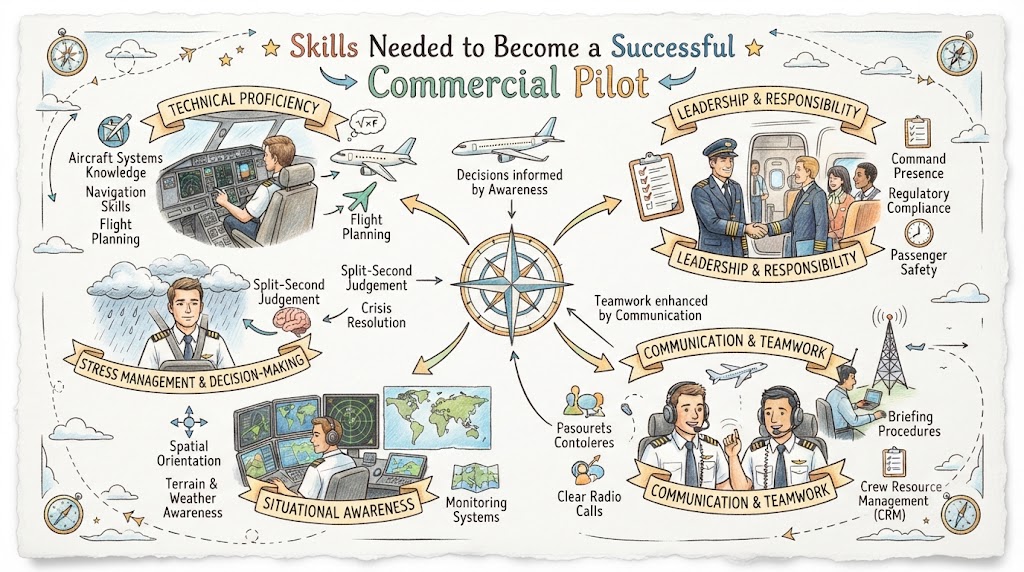
Becoming a successful commercial pilot requires much more than learning how to operate an aircraft. Professional aviation demands a combination of technical knowledge, practical flying abilities, strong decision-making, communication skills, discipline, and a continuous commitment to safety.
Many aspiring pilots begin their journey with a passion for aviation and the dream of flying professionally. However, becoming a commercial pilot requires developing a complete set of skills that help pilots manage aircraft, work with aviation teams, handle unexpected situations, and make responsible decisions.
A successful pilot is not defined only by flying ability. Professional pilots must understand aircraft systems, evaluate risks, communicate clearly, manage workloads, and maintain a strong safety mindset throughout their careers.
What Makes a Successful Commercial Pilot?
A successful commercial pilot combines technical expertise with strong personal and professional qualities.
Professional pilots need to:
- Operate aircraft safely
- Make accurate decisions
- Communicate effectively
- Work with aviation teams
- Manage complex situations
- Continue improving their skills
Commercial aviation requires lifelong learning because aircraft technology, regulations, and operational practices continue to evolve.
Essential Skills Needed to Become a Successful Commercial Pilot
1. Strong Aircraft Handling Skills
Aircraft control is one of the most important skills every pilot must develop.
Pilots need confidence in:
- Takeoffs
- Landings
- Flight maneuvers
- Aircraft control
- Navigation procedures
Flight training helps students understand how aircraft respond to different situations and conditions.
A skilled pilot must be able to control the aircraft smoothly while maintaining awareness of safety requirements.
2. Decision-Making Skills
Decision-making is one of the most critical abilities in aviation.
Pilots make decisions about:
- Weather conditions
- Flight routes
- Aircraft performance
- Safety concerns
- Operational challenges
Good decision-making involves analyzing information, considering risks, and selecting the safest option.
Training helps pilots develop judgment by exposing them to different flight scenarios and operational situations.
3. Communication Skills
Clear communication is essential in aviation.
Commercial pilots communicate with:
- Air traffic controllers
- Flight crews
- Ground personnel
- Maintenance teams
Strong communication helps ensure:
- Accurate information sharing
- Better teamwork
- Safer flight operations
Pilots must communicate clearly, especially during complex or changing situations.
4. Situational Awareness
Situational awareness means understanding everything happening around the aircraft.
Pilots continuously monitor:
- Aircraft systems
- Weather conditions
- Air traffic
- Navigation information
- Flight progress
Strong situational awareness helps pilots identify potential issues early and respond appropriately.
5. Problem-Solving Skills
Aviation requires pilots to think carefully when unexpected situations occur.
Problem-solving skills help pilots manage:
- Technical concerns
- Weather changes
- Operational challenges
- Flight adjustments
Successful pilots remain calm and use available information to make effective decisions.
6. Leadership and Teamwork Skills
Commercial aviation is a team-based environment.
Pilots work with:
- Co-pilots
- Cabin crew
- Air traffic professionals
- Maintenance teams
Leadership skills are especially important for pilots who take responsibility for flight operations.
Good aviation leaders:
- Communicate clearly
- Support teamwork
- Make responsible decisions
- Maintain professionalism
7. Discipline and Professionalism
Professional discipline separates recreational flying from commercial aviation.
Successful pilots develop habits such as:
- Proper preparation
- Following procedures
- Maintaining punctuality
- Respecting aviation standards
Professionalism includes taking responsibility for decisions and continuously improving performance.
8. Technical Knowledge
Pilots need strong knowledge of aviation concepts.
Important areas include:
Aircraft Systems
Understanding:
- Engines
- Controls
- Instruments
- Aircraft limitations
Aerodynamics
Understanding how aircraft generate lift and respond to control inputs.
Weather
Understanding how weather affects flight operations.
Navigation
Understanding flight planning and route management.
Aviation Regulations
Understanding operational rules and procedures.
9. Adaptability and Flexibility
Aviation environments constantly change.
Pilots must adapt to:
- Weather conditions
- Airport situations
- Aircraft systems
- Operational changes
Flexibility helps pilots manage unexpected situations while maintaining safety.
10. Stress Management Skills
Pilots often work in demanding environments where maintaining focus is essential.
Stress management helps pilots:
- Stay calm
- Prioritize tasks
- Maintain decision quality
- Manage workload effectively
Training helps students develop confidence and professional control.
How Flight Training Develops Commercial Pilot Skills
Ground School Training
Ground school builds the knowledge foundation required for professional flying.
Students learn:
- Aviation theory
- Weather principles
- Navigation
- Aircraft systems
- Aviation regulations
Strong theoretical knowledge supports better decision-making during flights.
Flight Practice
Practical flight training develops real-world abilities.
Students practice:
- Aircraft control
- Takeoffs and landings
- Flight procedures
- Navigation exercises
Regular practice improves confidence and skill development.
Simulator Training
Simulator sessions help pilots practice different situations in a controlled environment.
Training scenarios may include:
- Emergency procedures
- Decision-making exercises
- Crew coordination
Simulators allow students to improve responses before facing similar situations in actual operations.
Real Flight Experience
Experience plays an important role in developing professional skills.
Students gain experience through:
- Solo flights
- Cross-country flights
- Different weather conditions
- Operational practice
Each flight helps improve judgment and confidence.
Technical Skills vs Soft Skills in Aviation
| Technical Skills | Soft Skills |
|---|---|
| Aircraft handling | Communication |
| Navigation | Leadership |
| Flight planning | Teamwork |
| Aircraft systems knowledge | Decision-making |
| Aviation regulations | Problem-solving |
| Weather understanding | Adaptability |
| Emergency procedures | Stress management |
| Instrument skills | Professional attitude |
| Performance calculations | Situational awareness |
| Flight operations knowledge | Time management |
| Aircraft limitations | Responsibility |
| Technical procedures | Confidence |
| Safety procedures | Collaboration |
| Operational knowledge | Discipline |
| Aviation technology | Continuous learning |
Skills That Help Pilots Advance Their Careers
Continuous Learning
Aviation requires pilots to continue improving their knowledge and skills.
Professional pilots regularly learn about:
- New technologies
- Updated procedures
- Aircraft systems
Building Flight Experience
Experience improves:
- Confidence
- Decision-making
- Aircraft understanding
Every flight provides opportunities to develop professionally.
Developing Leadership Ability
Leadership becomes increasingly important as pilots take on greater responsibilities.
Improving Communication
Strong communication supports safer operations and better teamwork.
Maintaining Safety Focus
Safety must remain the highest priority throughout a pilot’s career.
Common Mistakes Aspiring Pilots Should Avoid
Focusing Only on Flying Skills
Flying ability is important, but pilots also need:
- Technical knowledge
- Communication skills
- Professional discipline
Ignoring Communication Practice
Poor communication can affect teamwork and operational efficiency.
Poor Preparation Habits
Professional pilots prepare carefully before every flight.
Preparation includes:
- Reviewing conditions
- Understanding procedures
- Planning properly
Not Learning From Mistakes
Reviewing experiences helps pilots improve their skills.
Neglecting Personal Readiness
Pilots need to maintain:
- Focus
- Discipline
- Physical readiness
- Mental awareness
How Students Can Improve Their Pilot Skills
Aspiring pilots can improve by:
- Practicing regularly
- Studying aviation concepts
- Learning from instructors
- Reviewing flight experiences
- Developing professional habits
- Improving communication
- Staying updated with aviation knowledge
Commercial Pilot Skills Checklist
| Skill | Why It Matters |
|---|---|
| Aircraft Handling | Supports safe aircraft operation |
| Decision-Making | Helps manage flight situations |
| Communication | Improves teamwork and safety |
| Leadership | Supports professional responsibility |
| Technical Knowledge | Builds aviation understanding |
| Safety Awareness | Encourages responsible operations |
| Teamwork | Improves crew coordination |
| Problem-Solving | Helps handle challenges |
| Adaptability | Supports changing conditions |
| Professional Discipline | Builds career readiness |
Beginner Pilot Skills vs Professional Pilot Skills
| Beginner Pilot Skills | Professional Pilot Skills |
|---|---|
| Basic aircraft control | Advanced aircraft management |
| Learning procedures | Applying judgment |
| Following instructions | Making operational decisions |
| Basic communication | Professional coordination |
| Understanding systems | Managing complex situations |
| Learning navigation | Advanced flight planning |
| Practicing maneuvers | Managing real operations |
| Developing confidence | Maintaining professionalism |
| Basic safety awareness | Strong safety culture |
| Learning regulations | Applying regulations correctly |
| Instructor guidance | Independent decision-making |
| Building experience | Using experience effectively |
| Basic teamwork | Leadership and coordination |
| Flight practice | Operational excellence |
| Learning skills | Continuous improvement |
Future Skills for Modern Commercial Pilots
Modern aviation continues changing with new technology.
Future pilots may need stronger skills in:
- Digital aviation systems
- Advanced aircraft technology
- Automation management
- Data interpretation
- Continuous professional development
Technology will continue supporting pilots, but human decision-making and safety awareness will remain essential.
Frequently Asked Questions
1. What skills are needed to become a commercial pilot?
Commercial pilots need aircraft handling skills, technical knowledge, decision-making ability, communication skills, and strong safety awareness.
2. Why are communication skills important for pilots?
Clear communication helps pilots coordinate with crews, controllers, and aviation teams.
3. How important is decision-making in aviation?
Decision-making is essential because pilots must evaluate situations and choose safe actions.
4. What technical skills do commercial pilots need?
Pilots need knowledge of aircraft systems, navigation, weather, regulations, and flight operations.
5. Do pilots need leadership skills?
Yes, leadership helps pilots manage responsibilities and work effectively with aviation teams.
6. How does flight training develop pilot skills?
Flight training combines classroom education, practical flying, and scenario-based learning.
7. Why is situational awareness important?
It helps pilots understand aircraft conditions, surroundings, and potential risks.
8. What personal qualities make a good pilot?
Professionalism, discipline, adaptability, communication, and responsibility are important qualities.
9. How can students improve aviation skills?
Students can improve through regular practice, study, instructor feedback, and continuous learning.
10. Is technical knowledge enough to become a successful pilot?
No. Successful pilots need both technical abilities and strong personal skills.
11. Why is teamwork important in aviation?
Pilots work with many professionals, so effective teamwork supports safer operations.
12. How does professionalism affect a pilot career?
Professional behavior builds trust, improves performance, and supports long-term aviation growth.
Conclusion
Becoming a successful commercial pilot requires a combination of technical expertise, personal discipline, communication ability, and strong decision-making skills. Flying an aircraft is only one part of professional aviation; pilots must also manage responsibilities, work with teams, and maintain a constant focus on safety.
The journey to becoming a commercial pilot requires dedication, continuous learning, and practical experience. Students who develop both flying skills and professional qualities are better prepared to handle the challenges of modern aviation.
