
Introduction
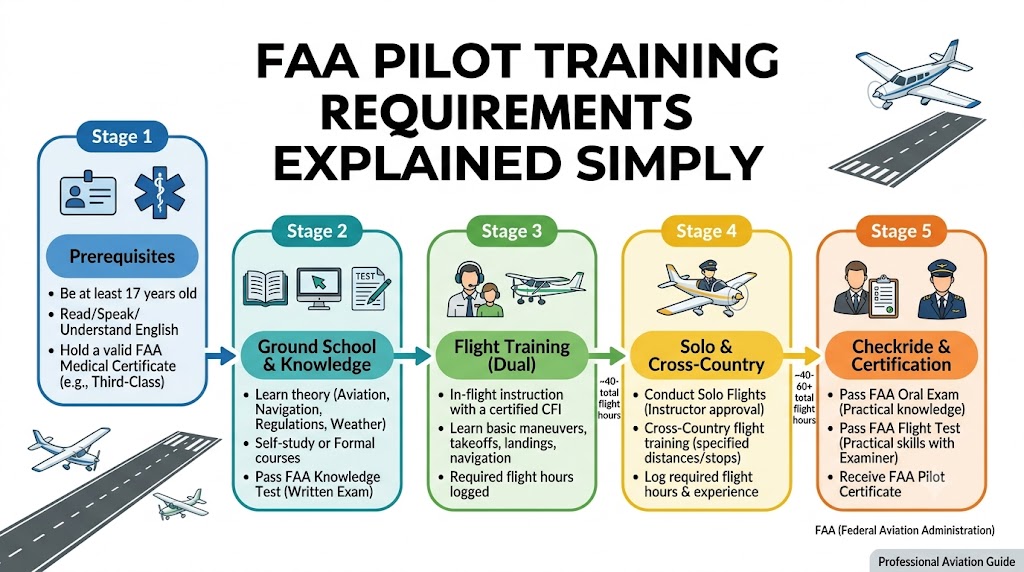
FAA pilot training requirements can look complicated because they combine age rules, medical eligibility, flight experience, knowledge testing, practical testing, instructor endorsements, and certificate-specific requirements. The good news is that the overall pathway becomes much easier to understand when it is broken into stages.
For most airplane pilots, the progression begins with student training, continues to a Private Pilot Certificate, and may then proceed through an Instrument Rating, Commercial Pilot Certificate, and eventually an Airline Transport Pilot Certificate (ATP). Each step has its own eligibility, knowledge, aeronautical experience, and practical-test requirements. The FAA’s current Airman Certification Standards provide the performance standards used for several of these certification tests.
FAA Pilot Training at a Glance
The FAA does not have one single set of requirements called “pilot training requirements.” Requirements depend on the certificate, rating, aircraft category/class, and training pathway involved.
A simplified airplane pathway looks like this:
Student Pilot → Private Pilot → Instrument Rating → Commercial Pilot → Flight Instructor / Other Ratings → ATP
Not every pilot follows this exact sequence. Someone flying recreationally may stop at the private level, while someone pursuing an airline career generally continues through additional ratings, experience, and ATP requirements.
The FAA recognizes several pilot certificates, including student, recreational, private, commercial, and airline transport pilot certificates. Each provides different privileges and limitations.
1. What Does the FAA Actually Require?
FAA pilot certification requirements generally fall into several categories:
- Age
- English-language ability
- Medical eligibility
- Aeronautical knowledge
- Flight training
- Solo experience
- Cross-country experience
- Night experience
- Instrument experience
- Total flight time
- Instructor endorsements
- Knowledge examination
- Practical examination
The exact requirements vary depending on what certificate or rating you are pursuing.
One of the most important distinctions is between minimum regulatory requirements and actual proficiency.
For example, a regulation may establish a minimum number of flight hours. Meeting that number does not automatically mean a student is ready for a practical test. The instructor must determine whether the student has achieved the required knowledge and proficiency.
2. Student Pilot Requirements
A student pilot is someone in the initial stage of flight training.
A student pilot certificate is not required simply to begin flight lessons. However, it is required before a student can fly solo. The FAA states that applicants for a student pilot certificate must generally be at least 16 years old, or at least 14 when the planned aircraft is a glider or balloon. Applicants must also be able to read, speak, and understand English.
The important point is that taking flying lessons and acting as a solo student pilot are different stages.
Before solo flight
A student must receive appropriate instruction and authorization from a flight instructor.
The instructor evaluates whether the student understands relevant:
- Regulations
- Aircraft characteristics
- Operating limitations
- Emergency procedures
- Airspace requirements
- Communications
- Preflight procedures
- Normal and abnormal operations
The FAA also requires a student to demonstrate knowledge of applicable rules and aircraft characteristics before the instructor endorses the student for solo flight.
3. Medical Requirements
Medical eligibility is an important part of the pilot certification process.
For many airplane training situations, the appropriate FAA medical certificate is required before the first solo flight. FAA guidance states that student pilots generally need at least a third-class medical certificate before their first solo, with specific exceptions such as glider and balloon operations.
The medical requirements can become more demanding depending on the type of flying and certificate being pursued.
Why this matters
A common mistake is waiting until significant training has been completed before checking medical eligibility.
For someone planning a professional aviation career, resolving medical questions early can prevent major disruptions later.
Medical certification is handled through an FAA-designated Aviation Medical Examiner rather than simply being an administrative formality.
4. Private Pilot Certificate
For many people, the private pilot certificate is the foundation of their aviation training.
A private pilot can generally carry passengers and exercise the privileges associated with private operations, subject to FAA limitations. It does not, however, automatically authorize a pilot to conduct operations for compensation or hire.
Minimum Flight Experience
For an airplane private pilot certificate under the standard Part 61 pathway, the FAA requires at least 40 hours of flight time.
That includes specified combinations of:
- Flight training with an authorized instructor
- Solo flight
- Cross-country training
- Night training
- Instrument training
- Other category/class-specific experience
The FAA notes that the regulatory minimum is not the same as the amount of training many students actually need. Its published guidance indicates that students often require substantially more than the minimum before completing certification.
Minimum does not mean typical
This distinction is critical.
A student who reaches the minimum number of hours has not necessarily completed all of the learning required to pass the practical test.
Flight proficiency depends on factors such as:
- Training frequency
- Weather
- Aircraft availability
- Instructor consistency
- Student preparation
- Learning pace
- Complexity of the local airspace
- Individual skill development
5. What Is Covered During Private Pilot Training?
Private pilot training is broader than simply learning to take off and land.
A student needs to develop competence across multiple areas.
Ground knowledge
Training generally covers topics such as:
- Federal aviation regulations
- Aeronautical decision-making
- Weather
- Airspace
- Navigation
- Aircraft systems
- Performance
- Weight and balance
- Flight planning
- Human factors
- Emergency procedures
- Radio communications
Flight proficiency
Practical training includes areas such as:
- Preflight inspection
- Airport operations
- Takeoffs and landings
- Aircraft control
- Climbs and descents
- Turns
- Navigation
- Emergency procedures
- Slow-flight operations
- Stall-related training
- Instrument-reference flying
- Cross-country operations
The precise areas and standards are defined through the applicable FAA certification requirements and Airman Certification Standards.
6. Knowledge Test and Practical Test
Pilot certification is not based solely on flight hours.
A typical certification process includes both a knowledge test and a practical test.
The knowledge examination evaluates the applicant’s understanding of relevant aviation subjects.
The practical test is conducted by an authorized examiner and evaluates both:
- Oral knowledge
- Flight performance
The FAA explains that practical testing measures an applicant’s flying ability against published standards.
Why the practical test matters
A pilot certificate is intended to demonstrate more than memorized information.
The applicant must demonstrate the ability to apply knowledge while operating an aircraft.
That includes judgment, procedures, aircraft control, navigation, communication, and responses to realistic operating situations.
7. Part 61 vs. Part 141 Training
One of the most important decisions in FAA flight training is understanding the difference between Part 61 and Part 141.
These are not simply two different names for the same type of school.
Part 61
Part 61 provides a regulatory framework for pilot certification and allows considerable flexibility in how training is organized.
Training can be conducted through an instructor or training provider without necessarily being part of an FAA-certificated Part 141 pilot school.
This can work well for students who:
- Train part-time
- Need flexible scheduling
- Have access to a local instructor
- Prefer a less structured training environment
Part 141
Part 141 pilot schools operate under an FAA-approved framework with structured curricula and syllabi.
The FAA states that Part 141 schools are required to use structured training programs and syllabi and may provide dedicated facilities, training aids, instructor oversight, and FAA-approved course curricula.
One important difference is that certain certificate requirements can involve lower minimum flight-hour requirements under approved Part 141 programs.
For example, the FAA notes that the normal private-pilot minimum is 40 hours, while an approved Part 141 course can reduce the regulatory minimum to 35 hours.
However, that does not mean every student will finish in 35 hours.
The regulatory minimum and the student’s actual training requirement are separate concepts.
8. Choosing Between Part 61 and Part 141
There is no universal answer for every student.
| Consideration | Part 61 | Part 141 |
|---|---|---|
| Structure | More flexible | More structured |
| Curriculum | Instructor-based | Approved syllabus |
| Scheduling | Often flexible | Usually more organized |
| Training environment | Can be highly individualized | Formal school environment |
| Minimum-hour advantages | Standard Part 61 requirements | Some courses may have reduced minimums |
| Good fit for | Flexible/part-time students | Structured or career-oriented training |
| Instructor consistency | Depends on provider | Often integrated into school system |
| Documentation | Individual training records | Formal school program records |
The FAA itself advises students to evaluate training providers rather than choosing solely on financial considerations. Factors such as training quality, instructors, equipment, scheduling, and the intended certificate should be considered.
9. Instrument Rating Requirements
An instrument rating allows a qualified pilot to operate under instrument flight rules when the applicable requirements are met.
It is an important progression for pilots who want to expand their capabilities beyond basic visual-flight operations.
The FAA’s current Instrument Rating Airman Certification Standards specify the knowledge, risk-management, and skill expectations associated with the rating.
For an airplane instrument rating, applicants generally need:
- Appropriate pilot certificate
- Required aeronautical knowledge
- Required instrument training
- Required instrument experience
- Required endorsements
- Knowledge test
- Practical test
The FAA identifies specific prerequisites for the instrument practical test, including the applicable pilot certificate status, English-language ability, knowledge test, required training and experience, and other eligibility conditions.
10. Why the Instrument Rating Matters
The instrument rating is not simply another checkbox.
It changes the type of decision-making and aircraft-control skills a pilot must develop.
Instrument training emphasizes:
- Flight by reference to instruments
- Navigation systems
- Instrument procedures
- Weather interpretation
- Air traffic control procedures
- Instrument approaches
- Holding procedures
- En-route operations
- Risk management
It also introduces a more structured approach to managing situations in which outside visual references are limited.
For professional pilots, instrument proficiency becomes particularly important because many commercial operations involve instrument procedures and instrument flight rules.
11. Commercial Pilot Certificate
The commercial pilot certificate represents another major step.
The FAA states that a commercial pilot certificate permits certain operations for compensation or hire, subject to the applicable regulations and limitations.
A commercial certificate should not be confused with an airline transport pilot certificate.
Commercial pilot
A commercial certificate establishes commercial pilot privileges within the applicable regulatory framework.
Airline transport pilot
The ATP represents a higher level of certification and is associated with operations requiring ATP-level qualifications.
12. Commercial Pilot Flight Experience
For a standard airplane commercial pilot certificate under Part 61, the FAA specifies 250 hours of total flight time as the regulatory minimum.
However, 250 hours does not mean that someone automatically qualifies for an airline job.
This is one of the most important distinctions in professional pilot training.
An airline may establish experience requirements that are significantly higher than the FAA certification minimum.
The FAA specifically notes that airlines can require substantially more flight experience and may also consider factors such as particular types of flight experience and other qualifications.
13. Instrument Rating and Commercial Certification
For an unrestricted commercial airplane certificate, the instrument rating is particularly important.
FAA certification guidance explains that applicants for an airplane commercial certificate who do not hold or concurrently obtain the appropriate instrument rating can receive a limitation restricting certain passenger-carrying operations.
For students pursuing professional airplane flying, this is why the commercial and instrument training stages are normally viewed as closely connected.
14. Building Experience After Commercial Training
Obtaining a commercial certificate does not automatically provide the flight experience required for an airline cockpit.
A common professional pathway involves continuing to build aeronautical experience through eligible flying activities.
Depending on qualifications and employment, pilots may pursue roles such as:
- Flight instructor
- Instrument flight instructor
- Multi-engine instructor
- Charter-related flying
- Other commercial aviation positions
The exact pathway depends on the certificate, ratings, employment opportunity, aircraft, and applicable operating regulations.
The important principle is that certification and career readiness are not the same thing.
15. Airline Transport Pilot Certificate
The ATP is the highest-level FAA pilot certificate for many professional aviation pathways.
The FAA’s ATP framework includes specific eligibility, experience, training, testing, and rating requirements.
For many airline-oriented airplane pathways, the commonly recognized benchmark is 1,500 hours of qualifying flight experience, although FAA rules provide specific pathways and restricted-privilege provisions in certain circumstances.
The FAA also recognizes ATP pathways involving approved aviation-degree programs that can permit qualifying graduates to obtain restricted ATP privileges with reduced aeronautical experience.
This is an area where students should pay close attention to the exact regulatory pathway rather than relying on a simple “1,500-hour rule.”
16. ATP Certification Training Program
Certain ATP applicants must complete an ATP Certification Training Program (CTP).
The FAA states that the ATP CTP applies to applicants seeking an ATP certificate with an airplane multiengine class rating or an ATP certificate issued concurrently with an airplane type rating, subject to the applicable rules.
The program is designed to prepare applicants for operations requiring ATP-level certification.
This illustrates an important principle:
Flight-hour requirements are only one part of professional pilot qualification.
Advanced certification also involves structured knowledge and competency requirements.
17. Airman Certification Standards
The FAA’s Airman Certification Standards are central to modern pilot certification.
The ACS combines:
- Knowledge
- Risk management
- Skill
This is important because aviation proficiency is not simply about performing maneuvers mechanically.
A competent pilot must also recognize hazards, make appropriate decisions, and manage operational risks.
The FAA currently publishes separate ACS documents for certificates and ratings including:
- Private Pilot
- Instrument Rating
- Commercial Pilot
- ATP
- Flight Instructor
- Rotorcraft certificates and ratings
- Powered-lift certificates and ratings
18. The Difference Between Hours and Proficiency
One of the most common misunderstandings among new aviation students is:
“If I have the required hours, I am ready.”
That is not how pilot certification works.
Flight hours provide experience, but proficiency must still be demonstrated.
Two students can have the same number of logged hours and very different skill levels.
Factors affecting proficiency include:
- Training frequency
- Quality of instruction
- Aircraft availability
- Weather exposure
- Solo practice
- Ground preparation
- Navigation experience
- Decision-making development
- Retention between lessons
This is one reason consistent training is valuable. The FAA recommends obtaining ground and flight training regularly and frequently because this can improve retention and help students achieve proficiency efficiently.
19. Common FAA Pilot Training Mistakes
Mistake 1: Treating the minimum hours as a target
Minimum hours are regulatory thresholds, not guaranteed completion times.
Better approach: Focus on proficiency and certification standards.
Mistake 2: Ignoring medical eligibility
A student can invest significant time and money before discovering a medical issue that affects the intended aviation pathway.
Better approach: Address medical eligibility early, particularly when professional flying is the goal.
Mistake 3: Choosing a school only because it is cheap
The cheapest hourly rate may not produce the lowest overall training cost.
Consider:
- Aircraft availability
- Maintenance delays
- Instructor availability
- Scheduling
- Aircraft type
- Training continuity
- Cancellation frequency
Mistake 4: Training inconsistently
Long gaps between lessons can reduce retention and increase the amount of review required.
Better approach: Maintain a consistent training rhythm when practical.
Mistake 5: Studying only before the written test
Passing the knowledge test does not replace operational understanding.
A pilot should be able to apply concepts to actual flight decisions.
Mistake 6: Focusing exclusively on maneuver performance
A student may become comfortable performing maneuvers while neglecting:
- Weather
- Airspace
- Navigation
- Risk management
- Communications
- Decision-making
The ACS approach makes clear that certification involves more than physical aircraft control.
Mistake 7: Confusing FAA certification with airline hiring
The FAA establishes regulatory certification requirements.
Airlines and other employers may impose additional requirements.
The FAA explicitly notes that airline minimum experience requirements can be substantially higher than the minimum needed for a commercial certificate.
20. How to Evaluate a Flight School
Before selecting a training provider, examine more than the advertised hourly rate.
Aircraft
Ask:
- How many training aircraft are available?
- How often are aircraft unavailable for maintenance?
- Are multiple aircraft types used?
- Is the fleet appropriate for the intended training path?
Instructors
Consider:
- Instructor availability
- Instructor turnover
- Scheduling flexibility
- Experience
- Communication style
- Continuity of instruction
Scheduling
Ask how easily lessons can be scheduled and how cancellations are handled.
Training structure
Determine whether the provider operates under:
- Part 61
- Part 141
- Another applicable training arrangement
Career pathway
If professional flying is the objective, determine whether the school’s curriculum and progression support the certificates and ratings you intend to pursue.
The FAA recommends evaluating training providers based on overall training quality rather than financial considerations alone.
21. FAA Pilot Training Pathway
A simplified professional airplane pathway can look like this:
Initial Flight Training
        ↓
Student Pilot Stage
        ↓
Private Pilot Certificate
        ↓
Instrument Rating
        ↓
Commercial Pilot Certificate
        ↓
Additional Ratings / Experience
        ↓
Flight Experience Building
        ↓
ATP Requirements
        ↓
Professional Pilot Operations
This is a conceptual pathway rather than a mandatory sequence for every pilot.
Different pilots may take different routes depending on their goals, aircraft category, training provider, military experience, education, and regulatory eligibility.
22. Simple FAA Requirements Table
| Stage | Main Purpose | Major Requirements |
|---|---|---|
| Student Pilot | Initial flight training | Eligibility, instruction, endorsements |
| Private Pilot | Personal flying and passenger privileges | Knowledge, flight experience, practical test |
| Instrument Rating | Instrument operations | Instrument training, knowledge and practical tests |
| Commercial Pilot | Certain compensated operations | Required experience, knowledge and practical testing |
| Flight Instructor | Teaching other pilots | Additional certification and practical standards |
| ATP | Advanced professional qualification | Experience, knowledge, training and practical requirements |
Exact requirements vary by aircraft category, class, rating, regulatory pathway, and applicant circumstances.
23. A Practical Decision Framework
Before beginning FAA pilot training, work through these questions.
Step 1: Define the goal
Are you interested in:
- Recreational flying?
- Private aircraft ownership?
- Professional flying?
- Airline operations?
- Flight instruction?
- Specialized aviation?
Your destination affects the training pathway.
Step 2: Confirm eligibility
Check:
- Age
- Language requirements
- Medical considerations
- Identification and citizenship-related requirements where applicable
- Training eligibility
Step 3: Choose the training framework
Compare appropriate Part 61 and Part 141 options.
Step 4: Evaluate the school
Look at:
- Fleet
- Instructors
- Availability
- Maintenance
- Curriculum
- Scheduling
- Training environment
Step 5: Understand the complete pathway
Do not plan only for the first certificate.
If professional flying is the objective, understand how private, instrument, commercial, experience-building, and ATP stages fit together.
Step 6: Track proficiency
Monitor more than flight hours.
Track:
- Training objectives
- Areas needing improvement
- Knowledge gaps
- Recurrent skills
- Instructor feedback
- Practical-test readiness
24. How to Keep Training Efficient
Efficiency in pilot training does not mean rushing through the minimum number of hours.
A better definition is:
Achieve the required competency with the least avoidable repetition.
Several habits can help.
Prepare before each lesson
Know:
- What you will practice
- What standards apply
- What procedures are involved
- What questions you need answered
Review after each lesson
Write down:
- What went well
- What needs improvement
- What was confusing
- What to practice next
Maintain ground knowledge
Do not separate “book knowledge” from flying.
Connect regulations, weather, aircraft performance, navigation, and decision-making to actual operations.
Train consistently
Long interruptions can increase the amount of relearning required.
25. Risk Management Is Part of Pilot Training
A technically competent pilot can still make poor operational decisions.
For that reason, aviation training increasingly emphasizes risk management alongside aircraft control.
A pilot should develop the habit of asking:
- What could go wrong?
- What information am I missing?
- What has changed?
- What alternatives do I have?
- What is my backup plan?
- What conditions would make me discontinue the flight?
This mindset becomes increasingly important as aircraft, routes, weather, passengers, and operational complexity become more demanding.
26. What Happens If You Fail a Practical Test?
Failing a practical test does not automatically end a pilot-training pathway.
However, the applicant must comply with the applicable retest requirements and receive whatever additional training or endorsements are required.
The practical lesson is more important than the administrative detail:
Use the failed areas as a diagnostic tool.
A student should identify:
- Knowledge weaknesses
- Procedural mistakes
- Skill deficiencies
- Decision-making problems
- Preparation gaps
Then address those areas before attempting the test again.
27. FAA Pilot Training Checklist
Before beginning training:
- Define your aviation objective
- Understand the certificate you are pursuing
- Review applicable FAA eligibility requirements
- Address medical eligibility early
- Compare Part 61 and Part 141 options
- Evaluate aircraft availability
- Evaluate instructor availability
- Understand the training syllabus
- Review expected training progression
- Understand knowledge-test requirements
- Understand practical-test requirements
- Review the applicable Airman Certification Standards
- Plan for more than the regulatory minimum where appropriate
- Maintain consistent training
- Track progress by proficiency, not only hours
- Understand the next certificate or rating before completing the current one
28. Frequently Asked Questions
Q1. What is the minimum age to become a student pilot?
For a student pilot certificate, the FAA generally requires an applicant to be at least 16 years old, while glider and balloon applicants can qualify at a younger age.
Q2. How many hours are required for a private pilot certificate?
Under the standard Part 61 airplane pathway, the regulatory minimum is generally 40 flight hours. The actual number of hours needed can be higher depending on the student’s progress and proficiency.
Q3. Can I start flight lessons before getting a student pilot certificate?
Yes. The FAA states that a student pilot certificate is not required simply to take flying lessons. It is required before solo flight.
Q4. Is a medical certificate required for pilot training?
Medical requirements depend on the operation and certificate involved. For many airplane students, an appropriate FAA medical certificate is required before the first solo flight.
Q5. What is the difference between Part 61 and Part 141?
Part 61 provides a flexible regulatory framework for pilot certification, while Part 141 schools operate structured FAA-approved training programs and syllabi. Certain Part 141 courses may also have reduced regulatory flight-hour minimums.
Q6. Do I need an instrument rating to become a commercial pilot?
An instrument rating is highly relevant to unrestricted commercial airplane privileges. Without the appropriate instrument rating, applicable limitations can be placed on a commercial certificate.
Q7. How many hours are required for a commercial pilot certificate?
For the standard Part 61 airplane commercial certificate pathway, the FAA specifies 250 hours of total flight time as the regulatory minimum.
Q8. Does 250 hours mean I can become an airline pilot?
No. The commercial certificate requirement and airline hiring requirements are different. Airlines may require substantially more flight experience and may establish additional qualification standards.
Q9. What is the Airman Certification Standards document?
The ACS establishes the knowledge, risk-management, and skill standards used for applicable FAA pilot certification and rating practical tests.
Q10. Is the minimum number of flight hours enough to pass the checkride?
Not necessarily. Minimum hours establish regulatory experience thresholds, while practical-test readiness depends on whether the applicant has achieved the required knowledge and proficiency.
Q11. What is the ATP?
The Airline Transport Pilot certificate is an advanced FAA pilot certificate associated with operations requiring ATP-level qualifications. Its requirements include specific experience, training, knowledge, and practical-testing provisions.
Q12. What should I consider when choosing a flight school?
Look beyond hourly price. Consider aircraft availability, maintenance, instructor continuity, scheduling, curriculum, training structure, facilities, and whether the provider fits your intended aviation pathway. The FAA specifically recommends evaluating training quality rather than relying on financial considerations alone.
Final Recommendation
FAA pilot training becomes much easier to understand when it is treated as a progression of certificates, ratings, experience, and demonstrated proficiency, rather than simply a list of required flight hours.
For a prospective professional pilot, planning the entire pathway early can prevent expensive changes later.
The distinction between Part 61 and Part 141, regulatory minimums and actual proficiency, and FAA certification versus employer requirements is particularly important.
Students should use the applicable FAA regulations and Airman Certification Standards as the reference point for their training decisions.
Most importantly, successful pilot development is about building sound judgment and repeatable skills—not simply reaching a number in a logbook.
