
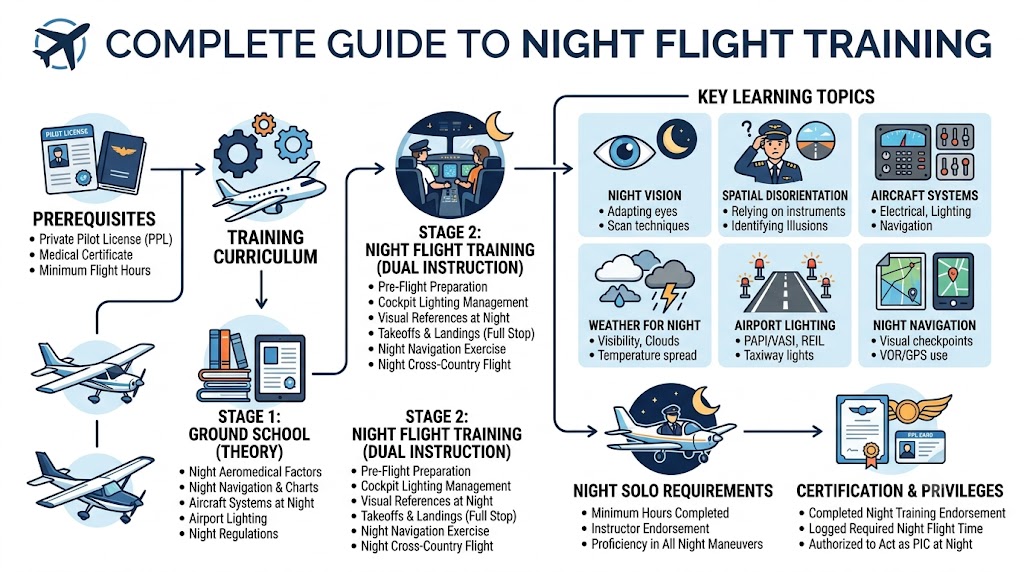
Night flight training introduces student pilots to a different flying environment where darkness changes visual references, airport surroundings, workload, and situational awareness. It gives pilots an opportunity to develop skills that complement their daytime training.
For a student pilot, night flying involves more than simply operating an aircraft after sunset. It requires thoughtful preparation, familiarity with the aircraft, awareness of weather and airport conditions, and effective coordination with a flight instructor.
This guide explains the fundamentals of night flight training, what students can expect, how to prepare, common challenges, safety considerations, and what to look for when choosing a flight school.
What Is Night Flight Training?
Night flight training is flight instruction conducted during nighttime conditions as part of a pilot’s broader training program.
The training introduces students to an environment where natural outside visual references become more limited. Airport lighting, aircraft instruments, navigation awareness, weather, traffic, and cockpit organization can all become important parts of the learning experience.
A night lesson may involve several training objectives depending on the student’s experience, aircraft, training program, and instructor.
The goal is not simply to accumulate nighttime experience. Students should develop appropriate awareness, preparation habits, decision-making skills, and confidence under instructor supervision.
Why Is Night Flight Training Important?
Daytime flying gives student pilots valuable experience, but nighttime operations present a different visual environment.
Night training can help students understand how their flying habits need to adapt when outside references change.
Key learning benefits include:
- Developing nighttime visual awareness
- Improving instrument cross-checking
- Understanding airport lighting environments
- Building situational awareness
- Practicing structured flight preparation
- Developing weather awareness
- Managing cockpit workload
- Becoming familiar with nighttime navigation
- Improving communication and decision-making
- Building experience under instructor supervision
Night training should form part of a broader pilot-development process rather than serve as an isolated skill.
What Do Student Pilots Learn During Night Training?
The exact lesson content varies between training programs, aircraft, instructors, and applicable requirements. However, several learning areas commonly receive attention.
Night Visual Awareness
Darkness changes the amount and type of information available outside the aircraft.
Students learn to recognize that distant objects, terrain, airports, and other visual references may appear differently at night.
This makes proper preparation and awareness especially important.
Instrument Awareness
When outside visual references become less informative, the aircraft’s instruments become an important source of information.
Students learn to maintain an appropriate instrument cross-check while continuing to manage the aircraft, communication, navigation, and other tasks.
Airport Awareness
Airports can look significantly different after dark.
Students become familiar with features such as:
- Runway lighting
- Taxiway lighting
- Airport signs
- Markings
- Lighted facilities
- Surrounding darkness
- Local airport layout
Familiarity with the airport environment can reduce unnecessary workload during training.
Situational Awareness
Night training also develops awareness of the broader operating environment.
Students need to consider:
- Aircraft position
- Other traffic
- Weather
- Airport environment
- Aircraft condition
- Navigation information
- Instructor guidance
How Night Flight Training Differs From Daytime Training
Night and daytime flying share many fundamental principles, but the visual environment differs considerably.
| Factor | Day Flight Training | Night Flight Training |
|---|---|---|
| Visual environment | More natural illumination | Reduced natural illumination |
| Outside references | Generally easier to identify | Can become less obvious |
| Airport environment | Primarily visible through daylight | Lighting becomes more prominent |
| Instrument awareness | Important | Can become especially important |
| Weather perception | Visual conditions are often easier to interpret | Darkness can make some conditions harder to assess visually |
| Preparation | Important | Requires careful attention to nighttime conditions |
| Situational awareness | Depends on multiple information sources | Requires effective use of available visual and instrument information |
| Workload | Depends on lesson and conditions | May change because of reduced outside references |
Neither environment should be treated as universally easier or harder. Each requires appropriate preparation and training.
Preparing for a Night Flight Lesson
Good preparation starts before the aircraft leaves the ground.
Students should review the lesson objectives with their instructor and understand what the training session intends to accomplish.
Weather Review
Weather deserves careful attention before a night lesson.
Review relevant information concerning:
- Visibility
- Clouds
- Fog
- Haze
- Wind
- Precipitation
- Forecast changes
- Other conditions that could affect the training environment
Actual weather decisions should follow the instructor’s guidance and applicable aviation requirements.
Aircraft Preparation
Students should understand the aircraft they will fly.
Review relevant aircraft systems, equipment, limitations, and documentation before the lesson.
The exact equipment available for night operations varies by aircraft.
Airport Familiarity
Understanding the airport layout can help students focus on the lesson rather than trying to learn the airport environment during the flight.
Review relevant airport information and discuss any unfamiliar areas with the instructor.
Personal Readiness
Fatigue can affect attention and decision-making.
Students should arrive prepared, rested, and mentally focused on the training objective.
Aircraft Considerations for Night Training
Different aircraft provide different equipment and cockpit environments.
Depending on the aircraft, students may encounter:
- Exterior lighting
- Cockpit lighting
- Instrument illumination
- Navigation equipment
- Communication equipment
- Electrical systems
- Emergency equipment
- Aircraft-specific limitations
Students should learn the specific aircraft’s systems from their instructor and approved aircraft documentation.
Never assume that equipment, procedures, or limitations from one aircraft automatically apply to another.
Understanding the Airport Environment at Night
A familiar airport can look surprisingly different after dark.
Runways and taxiways may rely heavily on lighting and signs for visual identification. Surrounding areas may appear much darker, while lighted areas can draw attention.
Students should understand the airport environment before beginning the lesson.
Important areas to review include:
- Runway layout
- Taxiway layout
- Airport signs
- Markings
- Lighting environment
- Nearby terrain and obstacles
- Relevant airport information
The objective is to build familiarity rather than depend entirely on visual recognition during a busy training situation.
Weather and Night Flight Training
Weather remains one of the most important considerations for any flight, and nighttime conditions can create additional visual challenges.
Visibility
Reduced visibility can become more difficult to assess when natural lighting is limited.
Fog
Fog can significantly reduce visual references and may change the suitability of a planned training flight.
Haze
Haze can reduce the clarity of distant visual references and affect the overall nighttime environment.
Clouds
Cloud coverage can change the visual environment and influence the training conditions.
Wind and Turbulence
Wind and turbulence can affect workload and aircraft handling regardless of the time of day.
Students should discuss changing conditions with their instructor and follow appropriate aviation guidance rather than relying on assumptions.
Night Vision and Visual Adaptation
Human vision behaves differently in darkness.
After sunset, the eyes require time to adapt to lower light levels. Bright sources of light can also affect nighttime visual adaptation.
This makes cockpit lighting management and awareness of the visual environment important parts of nighttime training.
Students should learn how their visual perception changes through instructor-led training rather than assuming that nighttime vision works exactly like daytime vision.
Common Challenges Student Pilots May Experience
Night training can introduce challenges that students may not encounter in exactly the same way during daytime lessons.
Common examples include:
Reduced Outside References
Darkness can make distant visual references harder to identify.
Difficulty Judging Distance
Some visual cues may become less obvious at night, which can make distance and spatial relationships more difficult to interpret.
Increased Instrument Awareness
Students may need to pay closer attention to aircraft instruments while maintaining overall situational awareness.
Lighting Distractions
Bright lights can attract attention or affect nighttime visual adaptation.
Higher Perceived Workload
Students may initially feel that more information requires attention at once.
Fatigue
Evening or nighttime lessons may occur when students are naturally becoming tired.
Weather Uncertainty
Certain weather conditions can become more challenging to interpret visually in darkness.
These challenges normally become easier to understand as students gain structured experience and receive instructor feedback.
Night Flying and Pilot Workload
A student pilot manages multiple tasks during a flight.
These may include:
- Aircraft control
- Instrument monitoring
- Communication
- Navigation awareness
- Traffic awareness
- Weather monitoring
- Aircraft systems
- Airport awareness
At night, the reduced visual environment can change how the student manages these tasks.
Preparation helps reduce unnecessary workload. Knowing the lesson objectives, understanding the aircraft, and becoming familiar with the airport can allow students to concentrate more effectively on the training itself.
Safety Practices for Night Flight Training
Safety should remain the central consideration throughout flight training.
Students should develop habits such as:
- Preparing thoroughly before each lesson
- Reviewing weather conditions
- Understanding the aircraft
- Following instructor guidance
- Maintaining situational awareness
- Managing fatigue
- Communicating concerns clearly
- Respecting personal limitations
- Following approved procedures
- Avoiding unnecessary rushing
Students should never treat this article as a substitute for flight instruction.
Aircraft-specific procedures should come from the instructor, aircraft flight manual or approved documentation, training materials, and applicable aviation authorities.
Common Mistakes During Night Training
1. Treating Night Flying Exactly Like Day Flying
Although many basic flying principles remain the same, the visual environment changes substantially.
Students should recognize those differences and adapt their preparation accordingly.
2. Ignoring Fatigue
Late lessons can occur when a student’s concentration is already declining.
Students should take personal readiness seriously.
3. Becoming Too Dependent on Outside References
Students should develop appropriate awareness of instruments and other available information instead of relying exclusively on what they see outside.
4. Arriving Without Preparation
An unfamiliar airport, aircraft system, or lesson objective can increase workload.
Preparation before the lesson helps students use training time more effectively.
5. Ignoring Weather Changes
Weather can change during a training session.
Students should maintain awareness and communicate concerns with their instructor.
6. Being Afraid to Ask Questions
Students should ask their instructor whenever something is unclear.
Good communication supports better learning and safer decision-making.
7. Rushing Progress
Every student develops skills at a different pace.
The focus should remain on developing sound habits and understanding rather than simply completing lessons quickly.
How to Build Confidence During Night Flight Training
Confidence should come from knowledge, preparation, repetition, and appropriate instructor feedback.
Students can support their development by:
- Reviewing each lesson before flying
- Studying aircraft systems
- Understanding airport layouts
- Preparing questions
- Reviewing instructor feedback
- Reflecting on challenging parts of each lesson
- Practicing relevant knowledge outside the aircraft
- Maintaining consistent training habits
- Recognizing personal limitations
Confidence should never replace preparation.
A student who understands why a task matters can usually approach training more deliberately than someone who simply tries to memorize actions.
Choosing a Flight School for Night Training
Not every flight school operates in exactly the same environment.
Students comparing schools should examine the complete training experience.
Instructor Support
Ask whether instructors provide structured preparation and meaningful feedback.
Aircraft Availability
Find out how easily students can schedule suitable aircraft for training.
Airport Environment
Consider whether the school’s operating environment provides an appropriate setting for the student’s training goals.
Scheduling
Evening availability can matter because night training naturally depends on suitable times and conditions.
Safety Culture
Look for clear communication, professional standards, proper aircraft management, and a training culture that encourages students to discuss concerns.
Training Resources
Ask about ground-school support, briefing materials, aircraft information, and other resources available to students.
Communication
A flight school should clearly explain scheduling, training expectations, cancellations, and student responsibilities.
Questions to Ask a Flight School About Night Training
Before enrolling or beginning nighttime lessons, consider asking:
- How is night training incorporated into the overall curriculum?
- Which aircraft are normally used for night lessons?
- What airports are commonly used?
- How do instructors prepare students for nighttime operations?
- How are weather cancellations handled?
- How flexible is evening scheduling?
- How do instructors assess student readiness?
- What ground-training resources are available?
- How does the school manage aircraft availability?
- What should students bring to a night lesson?
The answers can help students understand whether the training environment matches their goals and expectations.
Night Flight Training Preparation Checklist
Before the Flight
- Review the lesson objectives
- Check relevant weather information
- Review airport information
- Study the aircraft systems
- Confirm the lesson schedule
- Prepare required documents
- Discuss questions with the instructor
- Make sure you are adequately rested
During Training
- Follow instructor guidance
- Maintain appropriate situational awareness
- Monitor instruments
- Communicate clearly
- Ask questions when uncertain
- Focus on the lesson objectives
After the Flight
- Review instructor feedback
- Record appropriate training information
- Identify areas that need additional practice
- Review relevant knowledge
- Prepare for the next lesson
Night Flight Training Compared With Other Training
| Training Area | Primary Learning Focus |
|---|---|
| Day VFR Training | Aircraft control, visual flying, traffic awareness, navigation, and fundamental skills |
| Night Flight Training | Nighttime visual awareness, airport environment, instrument awareness, and nighttime decision-making |
| Instrument Training | Flying with primary reliance on instruments and instrument procedures |
| Cross-Country Training | Navigation, planning, and managing longer flights between locations |
| Emergency Training | Developing appropriate responses to abnormal and emergency situations under instructor guidance |
| Advanced Flight Training | Building more complex skills according to the applicable training program |
These areas complement one another rather than replacing one another.
Cost Considerations for Night Flight Training
The cost of night training varies significantly depending on the flight school, aircraft, location, lesson duration, instructor rates, and training program.
Potential cost factors include:
- Aircraft rental
- Instructor time
- Ground instruction
- Airport fees where applicable
- Aircraft type
- Flight duration
- Scheduling
- Weather-related cancellations
- Additional lessons when more practice is needed
Students should ask for a clear explanation of the school’s pricing structure rather than assuming that every night lesson will cost the same.
Actual prices vary by flight school and location.
How to Make Night Flight Training More Efficient
Efficiency should mean better preparation and better learning, not simply completing training as quickly as possible.
Students can improve their training experience by:
Study Before the Lesson
Review relevant concepts before arriving at the airport.
Understand the Objective
Know what the instructor intends to teach during the lesson.
Review Aircraft Systems
Become familiar with the aircraft before getting into the cockpit.
Prepare Questions
Write down anything that remains unclear from previous lessons.
Arrive Prepared
Avoid using valuable training time to handle tasks that could have been completed earlier.
Review Feedback
After every lesson, identify what went well and what requires additional attention.
Maintain Consistency
Regular training can help students retain knowledge and skills more effectively.
Night Flight Training for Future Professional Pilots
Students planning professional aviation careers can view night training as one component of broader pilot development.
Night operations can expose students to:
- Different visual environments
- Workload management
- Instrument awareness
- Airport operations
- Decision-making
- Communication
- Situational awareness
However, night training alone does not determine a pilot’s professional readiness.
Professional development involves many other areas, including knowledge, flight skills, experience, judgment, communication, and continued training.
Myths About Night Flight Training
Myth 1: Night Flying Is Just Day Flying After Sunset
Fact: The fundamental principles of flight remain the same, but the visual environment changes significantly. Students need to understand how reduced outside references affect their awareness and workload.
Myth 2: Night Training Is Only About Airport Lights
Fact: Night training can involve visual awareness, instrument monitoring, weather considerations, airport familiarity, workload management, and decision-making.
Myth 3: Beginners Cannot Learn Night Flying
Fact: Students can receive night instruction as part of an appropriate training program under qualified instructor supervision.
Myth 4: More Night Hours Automatically Make Someone a Better Pilot
Fact: Experience matters, but meaningful learning depends on preparation, quality instruction, reflection, and development of sound habits.
Myth 5: Confidence Develops Without Instructor Feedback
Fact: Instructor feedback helps students identify weaknesses, understand mistakes, and develop appropriate skills.
Practical Decision Guide for Night Flight Training
When evaluating a night-training program, consider the following:
| Factor | Questions to Consider |
|---|---|
| Instructor support | Do instructors provide clear preparation and feedback? |
| Aircraft availability | Can students access appropriate aircraft when needed? |
| Airport environment | Is the operating environment suitable for the training objectives? |
| Scheduling | Does the school offer practical evening scheduling? |
| Safety culture | Does the school encourage careful decision-making? |
| Training resources | Are useful ground and aircraft resources available? |
| Weather planning | Does the school communicate clearly about weather-related changes? |
| Cost transparency | Are aircraft, instructor, and other applicable charges explained clearly? |
| Student support | Can students easily communicate questions or concerns? |
| Training goals | Does the program align with the student’s broader pilot-development plans? |
This framework helps students evaluate a training environment based on their own circumstances rather than relying on a generic ranking.
A Simple Night Flight Training Checklist
Before starting night training, students can review this checklist:
- Understand the lesson objective
- Review relevant weather information
- Know the aircraft being used
- Review aircraft-specific information
- Understand the airport environment
- Confirm scheduling
- Arrive adequately rested
- Prepare questions
- Discuss concerns with the instructor
- Review feedback after the lesson
- Identify areas for additional practice
Frequently Asked Questions
Q1. What is night flight training?
Night flight training is flight instruction conducted during nighttime conditions. It helps students understand how darkness changes visual references, airport environments, workload, and situational awareness.
Q2. Why do student pilots train at night?
Night training exposes students to a different operating environment and helps them develop appropriate nighttime visual awareness, preparation, instrument awareness, and decision-making skills.
Q3. Is night flying different from daytime flying?
Yes. Many fundamental flying principles remain the same, but darkness changes outside visual references, airport lighting, visibility perception, and the way pilots manage available information.
Q4. What skills are developed during night flight training?
Students may develop nighttime visual awareness, instrument cross-checking, airport familiarity, workload management, situational awareness, communication, and decision-making.
Q5. How should a student prepare for a night flight lesson?
Students should review the lesson objective, relevant weather information, aircraft information, airport environment, and any instructor-provided preparation materials.
Q6. What aircraft equipment matters during night flying?
Relevant equipment can include exterior lighting, cockpit lighting, instrument illumination, communication equipment, navigation equipment, electrical systems, and other aircraft-specific equipment.
Q7. How does weather affect night flight training?
Weather can affect visibility, visual references, workload, and the suitability of a training flight. Students should evaluate conditions with their instructor and follow applicable requirements.
Q8. Is night flight training difficult for beginners?
Night training can feel unfamiliar at first because the visual environment differs from daytime flying. Structured instruction and preparation can help students gradually understand the differences.
Q9. How can students improve confidence during night flying?
Students can improve through preparation, repetition, instructor feedback, aircraft familiarity, airport knowledge, and consistent study.
Q10. How much does night flight training cost?
There is no single cost that applies to every student. Pricing varies according to the flight school, aircraft, location, instructor rates, lesson duration, and other applicable charges.
Q11. How should I choose a flight school for night training?
Consider instructor support, aircraft availability, airport environment, scheduling, training resources, safety culture, communication, and transparent pricing.
Q12. What are common mistakes during night flight training?
Common challenges include inadequate preparation, fatigue, overreliance on outside visual references, insufficient instrument awareness, poor weather planning, and rushing through training.
Q13. Does night training help future professional pilots?
Night training can contribute to broader pilot development by providing experience with different visual conditions, workload, communication, and decision-making.
Q14. Can night flight training be combined with other flight training?
Night training can form part of a broader pilot-training program. The exact sequence and combination depend on the training program, instructor, aircraft, and applicable requirements.
Q15. What should I ask a flight instructor before starting night training?
Ask about lesson objectives, preparation, aircraft systems, airport environment, expected training activities, scheduling, weather considerations, and how the instructor will provide feedback.
Conclusion
Night flight training introduces student pilots to a different visual and operational environment.
It helps develop awareness, preparation, instrument-monitoring habits, and sound decision-making.
Good preparation can make nighttime lessons more productive and easier to understand.
Students should work closely with qualified instructors and follow approved aircraft and training documentation.
Choosing a suitable flight school can also support consistent and structured learning.
Ultimately, night training should become another step toward developing a knowledgeable, prepared, and responsible pilot.
