
Introduction
Becoming a commercial pilot is a journey that requires much more than learning how to operate an aircraft. Flying skills are important, but professional aviation also demands discipline, consistency, responsibility, and a strong commitment to continuous improvement.
Commercial pilots operate in an environment where preparation, accuracy, and decision-making directly influence flight operations. Every successful pilot develops professional habits through structured training, regular practice, and dedication to learning.
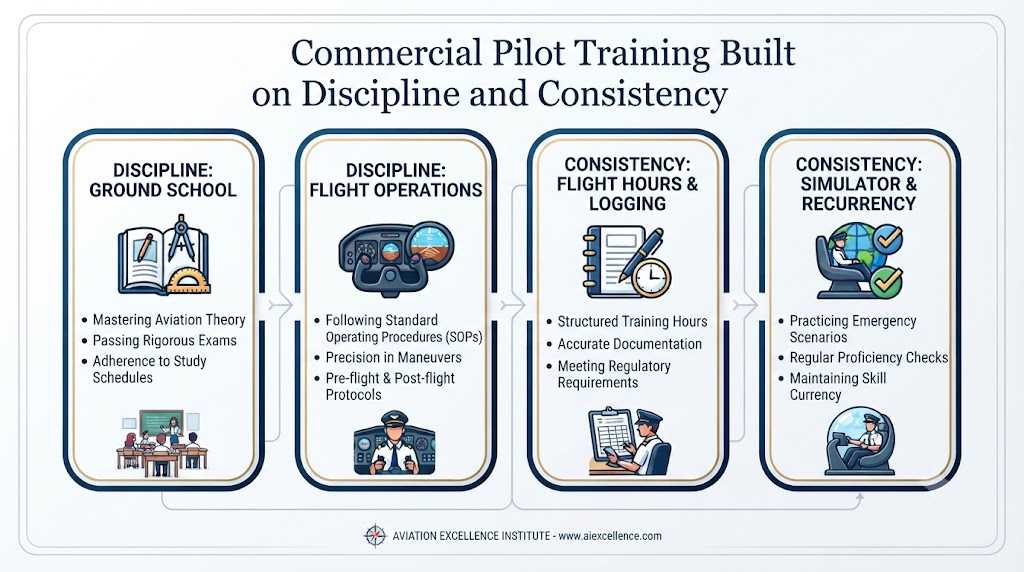
Commercial pilot training is built around discipline because aviation requires pilots to follow procedures, manage responsibilities, and maintain safety-focused thinking at all times. Consistency plays an equally important role because flying skills, technical knowledge, and confidence improve through regular practice and repeated experience.
Why Discipline Matters in Commercial Pilot Training
Discipline is one of the most important qualities in aviation. A disciplined pilot follows procedures, prepares carefully, and takes responsibility for every decision.
In flight training, discipline means:
- Arriving prepared for lessons
- Studying aviation concepts regularly
- Following instructor guidance
- Respecting safety procedures
- Maintaining professional behavior
Unlike many professions, aviation does not allow shortcuts. Pilots must develop reliable habits because every flight requires careful planning and attention to detail.
How Discipline Builds Professional Pilot Habits
Following Aviation Procedures
Commercial aviation depends heavily on standard procedures.
During training, students learn the importance of:
- Pre-flight inspections
- Aircraft checklists
- Communication procedures
- Safety protocols
- Flight planning processes
Following procedures consistently helps pilots reduce mistakes and maintain operational awareness.
Developing Responsibility
A commercial pilot has responsibility for:
- Aircraft operation
- Passenger safety
- Crew coordination
- Decision-making
Training helps students understand that professionalism begins from the first day of flight school.
Creating Strong Study Habits
Pilot training includes extensive theoretical learning.
Students must understand:
- Aerodynamics
- Aircraft systems
- Weather
- Navigation
- Aviation regulations
Regular study habits help students build the knowledge required for safe and effective flying.
How Consistency Improves Pilot Skills
Flying is a skill that improves through repetition and experience.
Consistent training helps students develop:
- Better aircraft control
- Stronger confidence
- Improved decision-making
- Better understanding of flight operations
A student who practices regularly is more likely to maintain progress and build reliable flying abilities.
The Role of Regular Flight Practice
Flight training requires continuous practice because aircraft operation involves coordination between:
- Hands
- Eyes
- Communication
- Decision-making
Regular flight lessons help students improve:
Aircraft Handling
Students develop skills in:
- Takeoffs
- Landings
- Turns
- Climbs
- Descents
Navigation Skills
Consistent practice improves:
- Route planning
- Position awareness
- Flight monitoring
Emergency Response
Repeated training helps students understand how to respond appropriately during challenging situations.
Key Areas Where Discipline Shapes Pilot Development
1. Consistent Ground School Learning
Ground school provides the theoretical foundation for professional aviation.
Students study important subjects such as:
Aerodynamics
Understanding how aircraft generate lift and respond to control inputs.
Weather
Learning how weather conditions affect flight decisions.
Navigation
Understanding route planning and aircraft positioning.
Aircraft Systems
Learning how different aircraft components work together.
Aviation Regulations
Understanding operational rules and safety requirements.
Consistent learning helps students apply classroom knowledge during actual flights.
2. Regular Flight Training
Flight training develops practical skills through structured practice.
Students gradually learn:
- Aircraft control techniques
- Flight procedures
- Communication skills
- Operational decision-making
Progress depends on regular practice and continuous improvement.
3. Following Checklists and Procedures
Checklists are an essential part of aviation safety.
Professional pilots use checklists to ensure important steps are completed correctly.
Students learn:
- Pre-flight procedures
- Aircraft preparation
- Emergency processes
- Post-flight responsibilities
Discipline in following procedures becomes a lifelong aviation habit.
4. Time Management Skills
Commercial pilots must manage time effectively.
Training teaches students to organize:
- Flight schedules
- Study sessions
- Preparation activities
- Personal responsibilities
Good time management helps pilots remain organized and prepared.
5. Developing Safety-Focused Thinking
Safety is the foundation of aviation.
Disciplined training helps students develop:
- Risk awareness
- Careful decision-making
- Responsible actions
- Professional judgment
A safety-focused mindset continues throughout a pilot’s career.
6. Building Professional Attitude
Professional pilots need more than technical ability.
They must demonstrate:
- Respect
- Reliability
- Communication skills
- Teamwork
- Responsibility
Training environments help students develop these qualities early.
The Role of Consistency in Flight Training Progress
Skill Improvement Through Repetition
Many aviation skills become stronger through repeated practice.
Examples include:
- Aircraft control
- Radio communication
- Flight planning
- Decision-making
Consistent practice helps students become more comfortable and confident.
Building Confidence
Confidence in aviation comes from preparation and experience.
Students build confidence by:
- Practicing regularly
- Learning from instructors
- Reviewing previous flights
- Improving weak areas
Professional confidence is based on knowledge and preparation, not overconfidence.
Maintaining Aviation Knowledge
Pilots must continue learning throughout their careers.
Consistency helps students maintain knowledge about:
- Aircraft technology
- Aviation procedures
- Safety practices
- Industry developments
Preparing for Professional Operations
Commercial pilot training prepares students for real aviation environments.
Through consistent training, students learn how to:
- Work with aviation teams
- Manage responsibilities
- Follow operational standards
- Make informed decisions
Commercial Pilot Training Process and Discipline Requirements
Ground Training
Ground training develops aviation knowledge.
Students learn:
- Flight theory
- Aircraft systems
- Weather analysis
- Navigation principles
- Aviation regulations
Discipline is required to understand and retain complex information.
Flight Instruction
Flight instruction allows students to apply knowledge practically.
Students practice:
- Aircraft operations
- Flight procedures
- Communication techniques
- Safety practices
Solo Flight Training
Solo flights help students develop:
- Confidence
- Responsibility
- Independent decision-making
Students learn to apply their training while managing aircraft operations independently.
Advanced Flight Training
Advanced training develops professional-level abilities, including:
- Instrument flying
- Complex flight operations
- Advanced procedures
Certification Preparation
Before earning professional qualifications, students prepare through:
- Knowledge examinations
- Practical evaluations
- Continued skill development
Preparation and consistency play an important role during this stage.
Discipline vs Talent in Aviation
| Discipline-Based Training | Talent-Based Approach |
|---|---|
| Regular practice | Depends mainly on natural ability |
| Strong preparation habits | Less structured learning |
| Continuous improvement | May rely on existing skills |
| Better procedure following | May overlook details |
| Safety-focused mindset | Skill-focused approach |
| Long-term development | Short-term performance |
| Consistent progress | Variable improvement |
| Professional habits | Informal approach |
| Strong knowledge foundation | May lack theory focus |
| Better adaptability | Limited preparation |
| Improved decision-making | Experience-dependent |
| Responsible behavior | Skill-dependent confidence |
| Career-focused mindset | Performance-focused mindset |
| Better training outcomes | Less predictable results |
| Lifelong learning approach | Limited development |
Daily Habits of Successful Pilot Students
Reviewing Flight Lessons
Successful students analyze every training session.
They review:
- What went well
- Areas needing improvement
- Instructor feedback
Preparing Before Every Flight
Preparation includes:
- Reviewing weather conditions
- Understanding flight plans
- Studying aircraft information
Maintaining a Study Routine
Regular academic preparation improves understanding of aviation concepts.
Learning From Feedback
Instructor feedback helps students:
- Correct mistakes
- Improve techniques
- Develop better habits
Maintaining Professional Standards
Successful pilots develop professionalism through:
- Discipline
- Respect
- Responsibility
- Continuous improvement
Common Challenges During Commercial Pilot Training
Managing Training Pressure
Pilot training can be demanding.
Students must balance:
- Flight practice
- Academic study
- Personal commitments
Consistency helps manage challenges effectively.
Balancing Theory and Practical Flying
Both knowledge and flying skills are important.
Students must dedicate time to:
- Classroom learning
- Flight experience
Handling Mistakes
Mistakes are part of learning.
Professional pilots improve by:
- Accepting feedback
- Understanding errors
- Applying lessons
Maintaining Motivation
Pilot training requires long-term commitment.
Students can stay motivated by:
- Setting goals
- Tracking progress
- Remembering career objectives
How Students Can Develop Aviation Discipline
Aspiring pilots can improve by:
- Creating a structured learning schedule
- Practicing consistently
- Preparing before flights
- Following procedures carefully
- Learning from instructors
- Staying updated with aviation knowledge
- Maintaining professional habits
Skills Developed Through Disciplined Pilot Training
| Skill | How Training Develops It |
|---|---|
| Aircraft Handling | Regular flight practice |
| Decision-Making | Scenario-based learning |
| Communication | Radio and teamwork practice |
| Safety Awareness | Procedure-based training |
| Leadership | Responsibility development |
| Problem-Solving | Flight situation management |
| Time Management | Training scheduling |
| Professionalism | Aviation discipline |
| Adaptability | Exposure to different conditions |
| Confidence | Experience and preparation |
Why Professional Aviation Values Pilot Discipline
Airlines and aviation organizations value pilots who demonstrate:
- Reliability
- Responsibility
- Safety awareness
- Teamwork
- Professional behavior
Technical skills are important, but professional habits help pilots perform effectively in real aviation environments.
Future of Pilot Training
Modern pilot training continues evolving with:
- Advanced flight simulators
- Digital learning tools
- Improved aircraft technology
- Data-based training methods
However, discipline and consistency will remain essential because aviation depends on human decision-making and responsibility.
Frequently Asked Questions
1. Why is discipline important in commercial pilot training?
Discipline helps students develop professional habits, follow procedures, and maintain safety-focused behavior.
2. How does consistency improve flying skills?
Regular practice helps students improve aircraft control, confidence, and decision-making.
3. What habits should pilot students develop?
Students should develop preparation, study routines, professionalism, and safety awareness.
4. Why are checklists important in aviation?
Checklists help pilots complete important tasks accurately and consistently.
5. How does regular practice help pilots?
Regular practice strengthens skills and improves confidence.
6. What role does preparation play in flight training?
Preparation helps students understand flights better and make informed decisions.
7. Can anyone develop pilot discipline?
Yes, discipline can be developed through consistent habits and commitment.
8. Why is safety culture important for pilots?
Safety culture helps pilots make responsible decisions and reduce operational risks.
9. How does flight training build confidence?
Experience, practice, and instructor feedback help students become more confident.
10. What qualities make a successful commercial pilot?
Successful pilots demonstrate discipline, communication, responsibility, technical knowledge, and adaptability.
Conclusion
Commercial pilot training is built on discipline and consistency because professional aviation requires reliable skills, strong decision-making, and responsible habits. Flying ability develops through regular practice, while professional qualities are created through dedication and structured learning. Aspiring pilots who focus on preparation, continuous improvement, and safety awareness build a stronger foundation for their aviation careers. Discipline helps students become better learners, and consistency helps transform training experiences into professional capabilities.
