
Introduction
Becoming a commercial pilot is a dream for many aviation enthusiasts who want to build a professional career in the skies. However, turning that dream into reality requires more than just a passion for flying. Aspiring pilots need proper training, aviation knowledge, practical flying experience, medical fitness, and successful completion of required examinations.
A Commercial Pilot License (CPL) is an important milestone for individuals who want to operate aircraft professionally. It demonstrates that a pilot has developed the skills and knowledge needed to perform advanced flight operations under approved aviation standards.
Understanding CPL requirements before beginning training helps students prepare better, choose the right flight school, manage expectations, and create a clear aviation career pathway.
What Is a Commercial Pilot License?
A Commercial Pilot License is a professional pilot certification that allows qualified pilots to operate aircraft for commercial purposes according to the privileges provided by the applicable aviation authority.
In simple terms, a CPL shows that a pilot has moved beyond basic flying skills and has completed advanced training required for professional aviation operations.
Commercial Pilot License training focuses on developing:
- Advanced aircraft handling skills
- Professional flight discipline
- Navigation abilities
- Weather decision-making
- Aviation safety knowledge
- Operational planning skills
A CPL is commonly considered an important step for pilots who want to explore professional aviation opportunities.
Why Is a Commercial Pilot License Important?
A Commercial Pilot License is important because professional flying requires a higher level of knowledge and responsibility compared with recreational flying.
CPL training helps pilots develop:
Professional Flying Skills
Pilots learn advanced techniques required for operating aircraft safely and efficiently.
Better Decision-Making
Commercial pilots must evaluate:
- Weather conditions
- Aircraft performance
- Flight planning factors
- Operational risks
Aviation Knowledge
Students gain deeper understanding of:
- Aircraft systems
- Aerodynamics
- Regulations
- Navigation
- Safety procedures
Career Preparation
A CPL provides the foundation for many aviation career pathways, although additional qualifications and experience may be required for specific roles.
Who Can Apply for a Commercial Pilot License?
CPL eligibility requirements vary depending on the aviation authority and country, but applicants generally need to meet several important conditions.
Common areas include:
- Age eligibility
- Educational background
- Language proficiency
- Medical fitness
- Flight training completion
- Knowledge examination requirements
Before starting training, students should confirm the current requirements with the relevant aviation authority or approved flight school.
Educational Requirements for CPL Training
Education provides the foundation for understanding aviation concepts.
Basic Academic Background
Students should have a strong understanding of subjects that support aviation learning, including:
- Mathematics
- Physics
- Science fundamentals
These subjects help students understand aircraft performance, navigation, and flight principles.
Aviation Knowledge Requirements
Commercial pilots must understand many theoretical concepts.
Important subjects include:
Aerodynamics
Students learn how aircraft generate lift, maintain stability, and respond to control inputs.
Aircraft Systems
This includes understanding:
- Engines
- Flight controls
- Electrical systems
- Instruments
Meteorology
Pilots learn how weather affects flight operations and safety decisions.
Navigation
Students learn:
- Route planning
- Position awareness
- Navigation techniques
Aviation Regulations
Understanding aviation rules helps pilots operate safely and professionally.
Medical Requirements for Commercial Pilots
Medical fitness is an important part of becoming a professional pilot.
Pilots must meet aviation medical standards established by the applicable aviation authority.
Medical evaluations generally focus on areas such as:
- Vision
- Hearing
- Overall health
- Physical fitness
The purpose of medical certification is to ensure pilots can safely perform their responsibilities.
Students should consult approved aviation medical professionals for specific requirements.
Flight Training Requirements
Practical flight training is one of the most important parts of CPL preparation.
The training process usually includes several stages.
Student Pilot Stage
The student pilot stage introduces beginners to aviation.
Students learn:
- Aircraft controls
- Basic flight procedures
- Safety practices
- Communication procedures
This stage builds the foundation for future training.
Ground School Training
Ground school develops the theoretical knowledge required for safe flight.
Students study:
- Aviation regulations
- Aerodynamics
- Weather
- Navigation
- Aircraft systems
- Flight planning
- Human factors
Ground knowledge supports better decision-making during actual flight operations.
Flight Instruction
Flight lessons help students apply classroom learning in real aircraft.
Training commonly includes:
- Aircraft familiarization
- Preflight inspections
- Takeoffs and landings
- Flight maneuvers
- Navigation exercises
- Emergency procedures
- Advanced aircraft handling
Solo Flight Experience
Solo flying is an important milestone during pilot training.
It allows students to develop:
- Confidence
- Independence
- Decision-making ability
- Aircraft management skills
Students complete solo flights only after demonstrating sufficient preparation and instructor approval.
Cross-Country Training
Cross-country training introduces students to longer flights and more complex planning.
Students practice:
- Route selection
- Navigation
- Weather evaluation
- Airport procedures
- Fuel planning
This experience helps prepare pilots for real-world operations.
Knowledge Test Requirements
Commercial pilot applicants generally need to demonstrate their aviation knowledge through written examinations.
Topics may include:
- Regulations
- Weather
- Navigation
- Aircraft systems
- Aerodynamics
- Flight operations
Preparing consistently through study and practice helps students perform successfully.
Practical Flight Test Requirements
The practical evaluation assesses whether a pilot can safely perform required flight operations.
The evaluation may include:
- Aircraft control
- Flight procedures
- Navigation skills
- Decision-making
- Safety practices
- Professional flying standards
The goal is to confirm that the pilot can operate an aircraft safely within the required standards.
Skills Required Before Becoming a Commercial Pilot
Aircraft Handling Skills
Commercial pilots must confidently control aircraft during different flight situations.
Communication Skills
Clear communication is essential when working with:
- Air traffic services
- Other pilots
- Aviation teams
Navigation Skills
Pilots must understand route planning and position management.
Weather Decision-Making
Professional pilots evaluate weather conditions before and during flights.
Emergency Management
Pilots must understand how to respond appropriately during abnormal situations.
Risk Assessment
Good pilots identify potential risks and make safe decisions.
Professional Discipline
Commercial aviation requires:
- Responsibility
- Preparation
- Checklist usage
- Continuous learning
Documents Required for CPL Training
Documentation requirements vary, but students commonly need:
- Identification documents
- Educational records
- Medical certification documents
- Training records
- Flight experience records
Maintaining organized documents helps students manage their training process effectively.
CPL Training Journey Overview
A typical CPL pathway may include:
Step 1: Research Aviation Requirements
Understand eligibility, training options, and career goals.
Step 2: Complete Medical Evaluation
Confirm medical eligibility before significant training investment.
Step 3: Select a Flight School
Choose a school based on instructors, aircraft, safety culture, and training support.
Step 4: Complete Ground Training
Develop aviation knowledge.
Step 5: Complete Flight Training
Build practical flying skills.
Step 6: Gain Required Experience
Complete necessary flight experience requirements.
Step 7: Pass Knowledge Examinations
Demonstrate theoretical understanding.
Step 8: Complete Practical Evaluation
Show safe and professional flying skills.
Common Mistakes Students Should Avoid
Starting Without Understanding Requirements
Researching requirements early prevents confusion later.
Ignoring Medical Preparation
Students should understand medical requirements before beginning serious training.
Choosing a Flight School Only by Price
Training quality, safety, aircraft condition, and instructor experience are equally important.
Inconsistent Training
Regular practice helps students maintain and improve flying skills.
Neglecting Ground Studies
Strong theoretical knowledge supports better flight performance.
Poor Record Management
Keeping accurate training records helps maintain a smooth certification process.
How to Prepare for CPL Training
Students can improve their preparation by:
- Studying aviation basics early
- Developing strong learning habits
- Practicing communication skills
- Maintaining physical fitness
- Researching flight schools carefully
- Staying consistent with training
- Building a safety-focused mindset
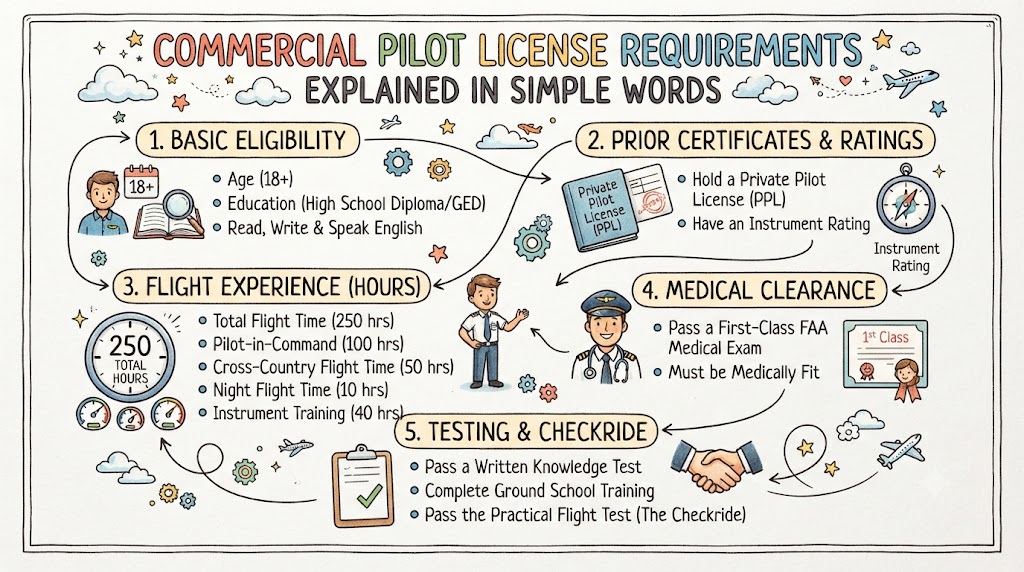
Commercial Pilot License Requirements Checklist
| Requirement | Purpose |
|---|---|
| Age Eligibility | Confirms applicant qualification |
| Educational Background | Supports aviation learning |
| Medical Certification | Confirms pilot fitness |
| Ground Training | Builds aviation knowledge |
| Flight Training | Develops practical flying skills |
| Knowledge Test | Evaluates theoretical understanding |
| Practical Test | Evaluates flight performance |
| Documentation | Maintains training records |
Private Pilot License vs Commercial Pilot License
| Feature | Private Pilot License | Commercial Pilot License |
|---|---|---|
| Main Purpose | Personal flying | Professional flying |
| Career Use | Limited | Supports aviation careers |
| Training Level | Basic | Advanced |
| Flight Skills | Foundational | Professional standards |
| Knowledge Depth | Moderate | More extensive |
| Aircraft Operations | Personal use focus | Commercial operations focus |
| Decision-Making | Developing | Advanced |
| Training Complexity | Lower | Higher |
| Flight Planning | Basic | Detailed |
| Safety Responsibility | Important | Greater responsibility |
| Career Pathway | Recreational aviation | Professional aviation |
| Professional Standards | Limited | Strong emphasis |
| Experience Requirements | Lower | Higher |
| Training Commitment | Moderate | Significant |
| Future Opportunities | Additional training possible | More professional pathways |
Frequently Asked Questions
1. What is a Commercial Pilot License?
A Commercial Pilot License is a professional certification that allows qualified pilots to perform commercial flight operations according to applicable aviation rules.
2. What are the basic CPL requirements?
Requirements generally include age eligibility, medical fitness, flight training, aviation knowledge, examinations, and practical evaluation.
3. Is a medical certificate required for CPL?
Yes, commercial pilots must meet aviation medical requirements established by the relevant aviation authority.
4. What subjects are studied during CPL training?
Students study aerodynamics, weather, navigation, aircraft systems, regulations, and flight planning.
5. How much flight training is required?
Flight training requirements vary depending on aviation authority, country, and training pathway.
6. Is CPL training difficult?
CPL training requires dedication, consistent study, and regular practice, but structured training helps students progress.
7. Can CPL holders become airline pilots?
A CPL is an important step toward professional aviation, but airlines usually require additional qualifications, experience, and training.
8. How do I choose a flight school?
Consider instructor experience, aircraft quality, safety standards, training facilities, and student support.
9. What skills does a commercial pilot need?
Commercial pilots need aircraft handling skills, communication ability, decision-making, discipline, and safety awareness.
10. Can students continue training after CPL?
Yes, many pilots continue their education through additional ratings, advanced training, and professional development.
Conclusion
Understanding Commercial Pilot License requirements is the first step toward building a successful aviation training plan. CPL training involves much more than learning how to control an aircraft. It develops professional skills, aviation knowledge, safety awareness, and decision-making abilities required for responsible flight operations.
Aspiring pilots who prepare properly, choose quality training programs, and maintain consistent learning habits can build a strong foundation for their aviation journey. While requirements may vary by location and aviation authority, understanding the overall CPL pathway helps students make better decisions before beginning flight training.
