
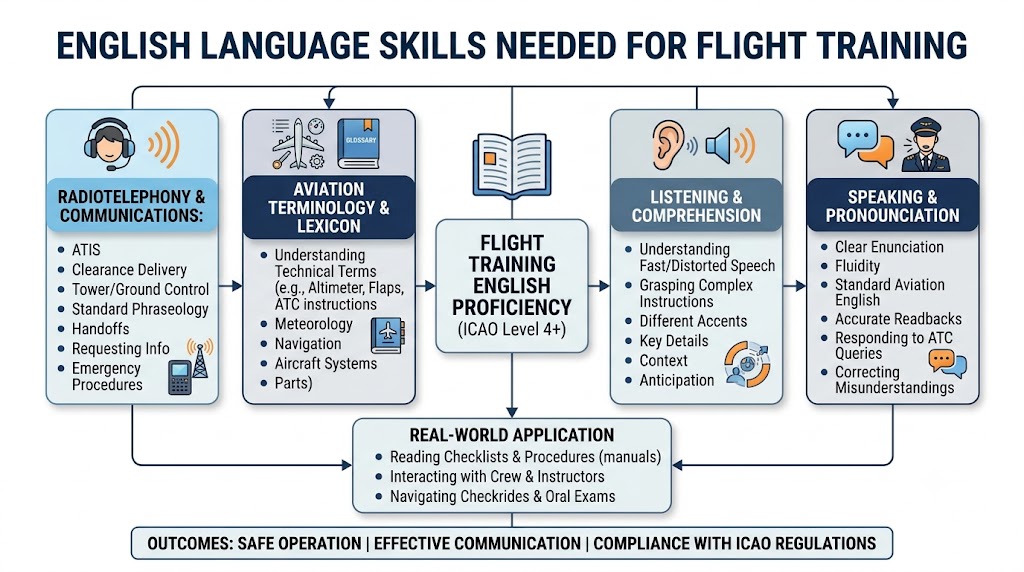
English plays an important role in flight training because student pilots must communicate with instructors, understand aviation terminology, follow operational instructions, and participate in radio communications. For many aspiring pilots, especially international students, developing aviation-focused English is an important part of preparing for flight school.
Being a pilot does not require perfect conversational English. However, students need to communicate information clearly, understand relevant instructions, and become comfortable with the specialized vocabulary used in aviation.
Why English Language Skills Matter in Flight Training
Flight training involves much more communication than simply speaking with a flight instructor.
Students may need to understand and communicate information during:
- Ground school
- Pre-flight briefings
- Flight lessons
- Post-flight debriefings
- Radio communication
- Air traffic control interactions
- Flight planning
- Weather discussions
- Aircraft system training
- Safety briefings
- Aviation documentation
Clear communication helps students understand what they are being taught and communicate relevant information during training.
For this reason, aspiring pilots should develop both general English skills and aviation-specific communication skills.
General English vs. Aviation English
A student can have reasonable everyday English skills and still need additional practice with aviation communication.
General English
General English covers communication used in everyday situations, including:
- Everyday vocabulary
- Basic grammar
- Conversation
- Reading
- Writing
- Listening
- General pronunciation
These skills provide the foundation for communication during flight training.
Aviation English
Aviation English is more specialized and focuses on communication related to aviation operations.
It can include:
- Aviation terminology
- Aircraft systems vocabulary
- Weather terminology
- Navigation terminology
- Airport terminology
- Radio communication
- Operational instructions
- Standard aviation phraseology
The important difference is context. Aviation communication requires students to understand technical information and communicate it clearly in operational situations.
Essential English Language Skills for Flight Training
Listening Skills
Listening is one of the most important language skills for student pilots.
During training, students may need to understand information from:
- Flight instructors
- Air traffic controllers
- Other pilots
- Ground personnel
- Training materials
A student who understands written English well may still need practice with spoken aviation communication.
Listening practice can help students become familiar with technical vocabulary, different speaking patterns, and aviation-related terminology.
Students should focus on understanding the meaning and operational relevance of communication rather than trying to understand every conversation in exactly the same way as everyday English.
Speaking Skills
Pilots need to communicate information clearly and efficiently.
Speaking skills are useful when:
- Answering an instructor
- Describing an aircraft situation
- Communicating with ATC
- Making requests
- Participating in briefings
- Discussing flight planning
Good aviation communication is generally focused on clarity and relevance.
Students should practice communicating information without unnecessary wording.
For example, when discussing a flight-related situation with an instructor, the student should be able to explain the relevant information in a logical and understandable way.
Pronunciation and Intelligibility
Pronunciation is important because aviation communication must be understandable.
Student pilots should work on:
- Speaking clearly
- Using an appropriate pace
- Pronouncing important terms correctly
- Avoiding unnecessarily rushed speech
- Making important information understandable
The objective is not to eliminate every accent. Different people naturally speak with different accents.
The more important goal is clear and intelligible communication.
Students can improve this skill through repeated speaking practice and feedback from qualified instructors.
Reading Skills
Flight training involves reading a variety of aviation-related information.
Depending on the training program and operation, students may encounter:
- Training manuals
- Aircraft documentation
- Checklists
- Weather information
- Aviation charts
- Operational information
- Safety material
- Training instructions
Strong reading comprehension allows students to understand technical information more effectively.
Students should become comfortable with technical vocabulary rather than relying entirely on general English knowledge.
Writing Skills
Writing may not receive as much attention as speaking and listening, but it remains useful during flight training.
Students may need writing skills for:
- Taking training notes
- Recording important information
- Completing training-related documentation
- Communicating with instructors
- Preparing flight-related information
- Writing reports where required
The level of writing required can vary depending on the training program and pilot activity.
The key objective is to communicate information accurately and clearly.
Aviation Vocabulary Every Student Pilot Should Understand
Building aviation vocabulary is an important part of preparing for flight training.
Students should gradually become familiar with terminology related to different areas of aviation.
Aircraft Terminology
Learn terms associated with:
- Aircraft structure
- Flight controls
- Engines
- Instruments
- Aircraft systems
- Cockpit equipment
Airport Terminology
Become familiar with terms related to:
- Runways
- Taxiways
- Aprons
- Gates
- Hangars
- Airport operations
Weather Terminology
Students should understand common aviation weather concepts and terminology used during training and flight planning.
Navigation Terminology
Useful vocabulary can include terminology associated with:
- Headings
- Altitude
- Airspeed
- Position
- Navigation
- Frequencies
- Routes
Communication Terminology
Students should become comfortable with language associated with:
- Requests
- Instructions
- Clearances
- Readbacks
- Frequency changes
- Traffic information
The goal is not to memorize a huge list of words without context. Students should learn terminology as it is used during actual aviation training.
English Skills for Pilot Radio Communication
Radio communication is an important area of flight training.
Student pilots need to learn how to listen carefully and communicate relevant information clearly.
Important skills include:
- Listening before responding
- Understanding the communication
- Speaking clearly
- Using appropriate terminology
- Keeping transmissions concise
- Confirming important information
- Asking for clarification when necessary
Students should learn radio communication according to the procedures and training provided by their flight instructor and applicable aviation authority.
Rather than memorizing phrases without understanding them, students should learn the meaning and context behind the communication.
Communicating With Air Traffic Control
Communication with air traffic control can involve several types of information.
Student pilots may encounter communication related to:
- Initial calls
- Position information
- Requests
- Clearances
- Readbacks
- Frequency changes
- Traffic information
- Airport instructions
Understanding these communications requires both listening ability and aviation vocabulary.
Students should pay close attention during training and practice communication under instructor supervision.
If a communication is not understood, students should follow their training and applicable procedures for requesting clarification rather than guessing at the meaning.
Understanding Aviation Instructions in English
Flight training involves many instructions that must be understood accurately.
Examples of information can include:
- Taxi instructions
- Runway information
- Altitude information
- Heading information
- Frequency changes
- Traffic information
- Weather information
- Flight planning details
Students should develop the ability to listen carefully and identify the information that directly affects the flight.
This skill develops through classroom instruction, practical training, repetition, and feedback.
English Communication During Abnormal and Emergency Situations
Communication becomes particularly important when a pilot encounters an unexpected situation.
Student pilots should learn how to communicate important information clearly and calmly during training.
Relevant communication may involve:
- Describing the situation
- Communicating aircraft position
- Explaining intentions
- Responding to questions
- Understanding instructions
- Using appropriate emergency terminology
Formal emergency communication should always be learned through approved flight training and applicable aviation procedures.
A blog article cannot replace practical instruction, simulator training, or official procedures.
English Language Skills for International Flight Students
International students may face additional language challenges when beginning flight training in an English-speaking environment.
Common areas requiring additional practice can include:
- Aviation vocabulary
- Radio communication
- Listening comprehension
- Technical terminology
- Different accents
- Speaking confidence
- Classroom communication
These challenges do not necessarily mean that a student cannot succeed in flight training.
A structured approach to language development can help students become more comfortable with aviation communication.
Common English Challenges Student Pilots May Face
Limited Aviation Vocabulary
A student may understand everyday English but have difficulty with specialized aviation terminology.
The solution is to gradually build an aviation vocabulary through training and regular review.
Difficulty Understanding Radio Calls
Radio communication can initially feel challenging because students are listening to technical information in an operational environment.
Regular listening practice can help students become more familiar with aviation communication.
Speaking Too Quickly
Some students may speak quickly when they feel nervous.
Speaking at a controlled pace can make communication easier to understand.
Translating Mentally
Students who learned English as another language may sometimes translate information mentally before responding.
This can slow communication.
Learning common aviation terminology in context can gradually make communication more natural.
Fear of Making Mistakes
Students may hesitate to speak because they are worried about making English mistakes.
Flight training provides an opportunity to practice communication with instructor feedback.
Students should focus on improving clarity and understanding rather than expecting perfect English from the beginning.
Confusing Similar Terms
Aviation contains many technical terms that may initially sound similar or unfamiliar.
Learning these terms in context and reviewing them regularly can help reduce confusion.
How Student Pilots Can Improve Their English Skills
Improving aviation English is an ongoing process.
1. Build a Strong General English Foundation
Work on:
- Listening
- Speaking
- Reading
- Vocabulary
- Grammar
A strong general foundation makes specialized aviation communication easier to learn.
2. Learn Aviation-Specific Vocabulary
Create vocabulary groups based on:
- Aircraft
- Weather
- Navigation
- Airports
- Communication
- Flight operations
- Safety
Learning words by category can make technical terminology easier to remember.
3. Practice Aviation Listening
Students can use legitimate aviation training materials to become more familiar with aviation communication.
The objective should be understanding how information is communicated rather than simply listening passively.
4. Practice Speaking Clearly
Students can practice explaining aviation concepts aloud.
For example, they can describe:
- An aircraft component
- A weather condition
- A flight-planning concept
- A basic navigation concept
Speaking practice can improve both confidence and clarity.
5. Learn Standard Aviation Phraseology Through Approved Training
Students should learn applicable aviation phraseology from qualified instructors and appropriate official training materials.
This helps ensure that communication practice reflects the procedures relevant to their training environment.
6. Participate in Instructor Briefings
Pre-flight and post-flight discussions provide useful opportunities to develop aviation vocabulary.
Students should ask questions whenever a technical term or instruction is unclear.
7. Review Communication Mistakes
After training, students can review unfamiliar words and communication challenges.
Keeping a simple vocabulary notebook can make it easier to track areas that need additional practice.
8. Read Aviation Materials Regularly
Reading aviation-related educational materials can gradually increase familiarity with technical vocabulary and sentence structures.
Students should focus on understanding the meaning rather than attempting to memorize every technical expression.
How to Prepare Your English Before Starting Flight Training
Preparing before flight school can make the transition easier.
Build Everyday English
Work on basic listening, speaking, reading, and vocabulary.
Learn Basic Aviation Terms
Become familiar with common aviation concepts before beginning formal lessons.
Practice Aviation Listening
Use appropriate aviation learning materials to become familiar with technical communication.
Practice Clear Speaking
Focus on pronunciation, pace, and understandable communication.
Create a Technical Vocabulary Notebook
Organize new terms into categories such as:
- Aircraft
- Weather
- Navigation
- Airports
- Communication
- Safety
Review the vocabulary regularly rather than trying to learn everything at once.
English Proficiency and Pilot Licensing
English language requirements can depend on the applicable aviation authority, pilot license, operating environment, and type of aviation activity.
It is important to distinguish between general English ability and formal language proficiency requirements.
Students planning flight training should verify the current requirements applicable to their specific training and licensing pathway with the relevant aviation authority and flight school.
Requirements vary by license, aviation authority, and operating context.
Meeting a formal language requirement and being comfortable with everyday aviation communication are related but not necessarily identical concepts.
English Skills Needed in the Flight School Environment
English may be used throughout the flight-training experience, not only on the radio.
Students may need English for:
Ground School
Understanding lessons, technical explanations, and training materials.
Instructor Briefings
Discussing the objectives and procedures of a flight.
Pre-Flight Discussions
Reviewing aircraft, weather, navigation, and other relevant information.
Post-Flight Debriefings
Discussing what happened during the flight and identifying areas for improvement.
Safety Discussions
Understanding safety-related information and asking questions when something is unclear.
Training Documentation
Reading and completing applicable training-related information.
Developing communication skills across these areas can make the overall training environment easier to navigate.
English Communication Mistakes Student Pilots Should Avoid
Student pilots should be careful about several common communication habits.
Speaking Unnecessarily Quickly
Fast speech can make communication harder to understand.
Using Unnecessary Words
Operational communication should remain focused and relevant.
Guessing When Something Is Unclear
If a student does not understand an important communication, guessing can create confusion. Students should follow their training and applicable procedures for requesting clarification.
Memorizing Without Understanding
Memorizing aviation expressions without understanding their meaning can create problems when the situation changes.
Ignoring New Vocabulary
Unfamiliar technical terms should be reviewed rather than ignored.
Assuming Conversational English Is Enough
Everyday English provides an important foundation, but aviation communication has its own vocabulary and context.
Aviation English Skills Checklist for Student Pilots
Use this checklist to identify areas that may need additional practice:
- Understand common aviation vocabulary
- Follow spoken instructions
- Understand basic technical terminology
- Speak clearly
- Communicate information concisely
- Understand aviation radio communication
- Read aviation-related materials
- Ask for clarification when appropriate
- Understand common weather terminology
- Communicate relevant information
- Participate in instructor briefings
- Understand applicable communication procedures
- Practice aviation listening regularly
General English Skills vs. Aviation English Skills
| Skill Area | General English | Aviation English |
|---|---|---|
| Vocabulary | Everyday terms | Aviation terminology |
| Listening | Everyday conversations | Radio and operational communication |
| Speaking | General conversation | Clear and concise operational communication |
| Reading | General documents | Aviation materials and documentation |
| Writing | General writing | Training and operational documentation |
| Pronunciation | General intelligibility | Clear aviation communication |
| Context | Daily situations | Flight operations |
Both areas are valuable. General English provides the foundation, while aviation English adds the specialized communication skills required in flight-related environments.
Is Your English Ready for Flight Training?
Before starting flight training, ask yourself:
- Can I understand normal spoken English?
- Can I explain information clearly?
- Can I understand technical instructions?
- Can I read aviation-related material?
- Can I learn specialized vocabulary?
- Can I ask questions when I do not understand something?
- Can I communicate information concisely?
- Am I willing to practice aviation terminology regularly?
If some answers are no, that does not automatically mean you are unprepared for flight training. Instead, it can identify areas where additional preparation may be useful.
This checklist is a preparation tool and not a substitute for an official language proficiency assessment or regulatory requirement.
Frequently Asked Questions
Q1. Do student pilots need English language skills?
Yes. English skills can be important for understanding instruction, aviation terminology, training materials, and operational communication. Specific formal requirements depend on the applicable aviation authority and licensing pathway.
Q2. Why is English important in flight training?
English may be used for flight instruction, radio communication, technical training, aviation documentation, and communication with other aviation personnel.
Q3. Is general English enough for flight school?
General English provides an important foundation, but students also need to become familiar with aviation terminology and communication practices.
Q4. What aviation English skills should student pilots learn?
Students should develop listening, speaking, reading, pronunciation, aviation vocabulary, and communication skills relevant to their training environment.
Q5. Do pilots need to understand ATC communication?
Pilots operating in environments involving ATC need to understand applicable communications and follow the procedures taught during their training.
Q6. How can international students improve their aviation English?
They can build general English skills, study aviation terminology, practice aviation listening, participate actively in flight training, and seek feedback from qualified instructors.
Q7. Is pronunciation important for pilots?
Yes. Clear and intelligible pronunciation helps make aviation communication easier to understand.
Q8. What English vocabulary should student pilots learn?
Students should gradually learn terminology related to aircraft, airports, weather, navigation, communication, flight operations, and safety.
Q9. Can I start flight training if my English is not perfect?
Perfect English is not the objective. Students should have sufficient communication ability for their training environment and meet any applicable formal requirements. Additional aviation English practice can help develop confidence and clarity.
Q10. How can I practice aviation English before flight school?
You can study aviation terminology, read appropriate training materials, practice listening, work on clear speaking, and become familiar with aviation communication through legitimate learning resources.
Q11. Do English requirements vary between aviation authorities?
Yes. Formal language requirements can vary according to the applicable aviation authority, license, operation, and regulatory framework.
Q12. What should I do if I do not understand an aviation instruction?
Students should follow the communication and clarification procedures taught by their flight instructor and applicable aviation authority. They should not simply guess the meaning of important operational information.
Conclusion
English is an important part of flight training because pilots need to understand instructions and communicate clearly in aviation environments. Strong listening, speaking, reading, pronunciation, and aviation vocabulary skills can support effective training. Students should also become familiar with radio communication and the terminology used in their specific training environment. International students may benefit from additional aviation English practice before and during flight school. Most importantly, language development should be treated as an ongoing part of professional pilot training.
