
Introduction
Starting flight training is a major commitment involving education, aviation regulations, finances, medical eligibility, documentation, and long-term career planning. A well-prepared admission process can prevent avoidable delays and help a student choose a flight school that genuinely matches their goals.
For a new student, the challenge is not simply getting accepted. The more important task is confirming that the school, training program, aircraft, instructors, documentation requirements, medical pathway, and financial expectations all align before enrollment.
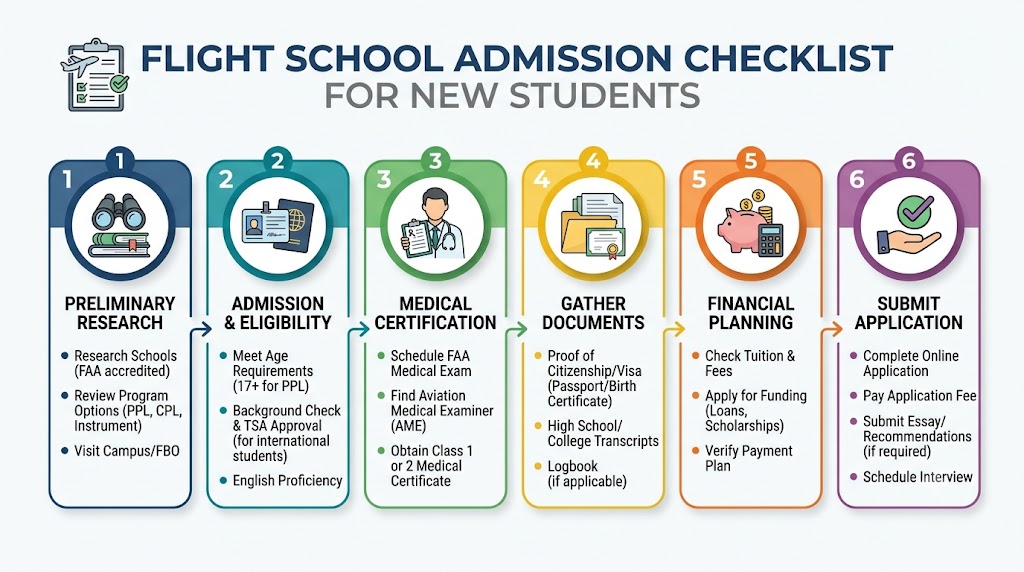
This checklist provides a practical framework for preparing for flight school admission, from defining your training objective to completing enrollment and preparing for the first lesson.
1. Define Your Flight Training Goal
Before contacting flight schools, identify what you actually want to accomplish.
Your requirements may differ significantly depending on whether you want to:
- Learn to fly recreationally
- Earn a Private Pilot Licence
- Pursue commercial pilot training
- Build toward an airline career
- Add additional ratings later
- Become an instructor and build flight experience
- Complete only part of your training before transferring to another school
Why this matters
A school that is suitable for recreational training may not provide the structure, aircraft availability, instructor capacity, or progression required by someone pursuing commercial aviation.
Write down your intended training path before comparing schools.
A simple planning document might include:
| Planning Item | Your Requirement |
|---|---|
| Primary goal | Private / Commercial / Airline pathway |
| Initial licence | Applicable licence |
| Ratings | As required |
| Training location | Preferred region |
| Expected training pace | Full-time / Part-time |
| Budget | Defined range |
| Accommodation | Required / Not required |
| Financing | Self-funded / Other |
| Target completion | Personal target |
| Long-term plan | Further ratings / Employment / Recreational |
2. Confirm Basic Eligibility
Flight schools normally have eligibility requirements that depend on the country, licence, training program, and regulatory authority.
Before paying an enrollment fee, confirm:
- Minimum age requirements
- Educational requirements
- Language requirements
- Identification requirements
- Citizenship or immigration requirements where applicable
- Medical eligibility
- Any school-specific admission criteria
- Additional requirements for international students
Do not assume that meeting a school’s general admission requirements automatically means you satisfy the requirements for the pilot licence you intend to obtain.
A useful distinction
There are usually three different layers of requirements:
- Regulatory requirements — established by the aviation authority.
- School requirements — established by the individual flight school.
- Course-specific requirements — applicable to a particular training program.
Check all three separately.
3. Complete the Appropriate Aviation Medical Examination
Medical eligibility should be addressed early rather than treated as an administrative formality at the end of the admission process.
The required medical certificate depends on the licence and regulatory system you are pursuing.
Before enrolling, determine:
- Which medical certificate is required
- Which aviation medical examiner you need to visit
- What documents are required for the examination
- Whether additional medical tests may be necessary
- How long the examination process may take
- How medical certification affects your intended career pathway
Why completing this early is sensible
A student can spend significant time and money preparing for flight training before discovering that a medical issue requires additional evaluation.
For students pursuing professional aviation, confirming medical eligibility early is particularly important because the medical standard may be more demanding than the standard associated with private flying.
4. Prepare Your Personal Documents
Create a dedicated digital and physical folder for aviation documents.
Depending on the school and jurisdiction, you may need documents such as:
- Passport or government-issued identification
- Birth certificate or equivalent age documentation
- Passport-size photographs
- Academic certificates
- School transcripts
- Proof of address
- Medical certificate
- Visa or immigration documents, where applicable
- English-language documentation, where required
- Previous aviation licences
- Previous ratings
- Logbook, if you already have flight experience
- Transfer documents if continuing training from another school
5. Review Your Educational Background
Some flight programs have specific educational requirements, while others may have additional academic expectations for international or professional applicants.
Review:
- Highest completed qualification
- Required subjects
- Mathematics requirements
- Physics requirements where applicable
- Academic transcripts
- English-language qualifications where required
- Any gaps in education that may need explanation
Do not assume that a strong academic record alone guarantees successful flight training.
Flying also requires practical skills involving:
- Situational awareness
- Communication
- Decision-making
- Procedural discipline
- Spatial understanding
- Time management
- Technical comprehension
Academic preparation is useful, but it is only one part of pilot development.
6. Check English-Language Requirements
Aviation relies heavily on standardized communication, and language requirements can form an important part of pilot training and licensing.
Before admission, determine:
- Whether the school conducts training in English
- Whether an English-language assessment is required
- Whether the aviation authority has specific language requirements
- Whether additional language testing applies to international students
- Whether your existing qualification is accepted
Do not confuse general conversational English with aviation communication proficiency.
A student should be comfortable understanding:
- Instructions
- Technical explanations
- Weather information
- Operational terminology
- Radio communication
- Safety-related communication
7. Research the Flight School’s Regulatory Status
One of the most important admission checks is confirming that the organization is properly authorized to provide the training you intend to receive.
Check:
- Regulatory approval
- Approved training organization status where applicable
- Approved courses
- Licence types offered
- Aircraft categories supported
- Instructor qualifications
- Examination arrangements
- Training records and documentation procedures
Do not rely exclusively on advertising material.
Verify important claims against the relevant aviation authority or official regulatory documentation whenever possible.
8. Understand Exactly What the Course Includes
A course title can be misleading if you do not examine the actual scope.
Ask the school for a detailed breakdown of:
- Ground school
- Flight training
- Simulator training
- Required examinations
- Skill tests
- Check rides
- Instructor briefings
- Training materials
- Administrative charges
- Licence application costs
- Examination fees
- Aircraft-related charges
Ask one particularly important question
What is included in the advertised course price, and what is not included?
This can reveal significant differences between schools that initially appear similar.
9. Examine the Aircraft Fleet
Aircraft availability directly affects training continuity.
Ask:
- What aircraft types are used?
- How many training aircraft are operational?
- How many are currently available for students?
- How old are the aircraft?
- How frequently are aircraft maintained?
- What happens when an aircraft becomes unavailable?
- Are backup aircraft available?
- Is simulator training available?
- Are aircraft equipped appropriately for the training program?
A large advertised fleet does not necessarily mean every aircraft is available for student training.
The relevant question is the usable training fleet.
10. Evaluate Instructor Availability
Instructors are central to the training experience.
Ask how the school handles:
- Instructor allocation
- Instructor absences
- Instructor turnover
- Student-to-instructor ratios
- Instructor scheduling
- Progress reviews
- Remedial training
- Instructor changes
A practical question to ask
If my assigned instructor is unavailable for two weeks, how will my training continue?
The answer can reveal how resilient the school’s scheduling system actually is.
11. Investigate Training Scheduling
Flight training depends on more than aircraft and instructors.
Ask about:
- Booking procedures
- Cancellation policies
- Weather cancellations
- Aircraft maintenance downtime
- Instructor availability
- Peak training periods
- Weekend availability
- Early-morning and evening operations
- Rescheduling procedures
A student who expects rapid, continuous training should understand how frequently lessons can realistically be scheduled.
Watch for a common mismatch
A school may quote a theoretical training timeline while actual progress depends on:
- Weather
- Aircraft availability
- Instructor availability
- Student availability
- Maintenance
- Airspace restrictions
- Examination scheduling
Ask how the school handles these constraints in practice.
12. Understand the Full Cost of Training
The advertised course price is rarely the only financial consideration.
Build a complete training budget covering:
Direct Training Costs
- Aircraft rental
- Instructor fees
- Ground school
- Simulator sessions
- Examination fees
- Skill tests
- Licence fees
Supporting Costs
- Medical examinations
- Books and training materials
- Headset and other required equipment
- Uniform, if required
- Accommodation
- Food
- Local transportation
- Insurance
- Visa-related expenses where applicable
Contingency
Include a reserve for additional training.
Students do not all progress at exactly the same rate, and additional flight time may be required before meeting the applicable training standard.
13. Ask How Flight Hours Are Charged
Do not assume that every school calculates flight costs in the same way.
Clarify:
- Aircraft hourly rate
- Instructor hourly rate
- Tach time versus other billing methods
- Minimum billing periods
- Ground briefing charges
- Simulator charges
- Cancellation fees
- Positioning charges
- Landing or airport fees
- Fuel-related charges, if applicable
Request a written explanation of the billing structure.
A low hourly aircraft rate can become less attractive if other charges are added separately.
14. Review the School’s Refund and Cancellation Policy
Before paying a substantial deposit, read the financial terms carefully.
Check:
- Enrollment fee
- Deposit requirements
- Refund eligibility
- Cancellation charges
- Course-transfer conditions
- Training interruption rules
- Accommodation refund rules
- Conditions for withdrawing from the program
- Expiration of prepaid balances
Avoid relying on verbal promises regarding refunds.
If a financial commitment is significant, obtain the terms in writing.
15. Understand Training Records
A professional flight school should maintain appropriate records of your training and progress.
Ask how the school documents:
- Flight lessons
- Ground training
- Instructor feedback
- Progress checks
- Examinations
- Skill tests
- Training deficiencies
- Corrective training
- Licence milestones
You should know who is responsible for keeping your records accurate and how you can access them.
16. Review the School’s Safety Culture
Safety should not be evaluated simply by asking whether a school is “safe.”
Look at how safety is integrated into everyday operations.
Consider:
- Maintenance procedures
- Pre-flight procedures
- Weather decision-making
- Operational risk management
- Instructor briefings
- Incident reporting
- Safety meetings
- Aircraft dispatch procedures
- Student safety briefings
- Emergency procedures
A mature safety culture is visible in ordinary operations, not just in promotional statements.
17. Ask About Maintenance and Aircraft Downtime
Aircraft maintenance is unavoidable in aviation.
The important issue is how effectively the school manages it.
Ask:
- Who performs maintenance?
- How is scheduled maintenance managed?
- What happens when an aircraft becomes unserviceable?
- How quickly are common problems resolved?
- Are replacement aircraft available?
- How are students notified about cancellations?
A school should not encourage students to treat maintenance interruptions as something that can simply be ignored.
Proper maintenance takes priority over maintaining a student’s schedule.
18. Check Airport and Airspace Conditions
The training environment affects what a student experiences.
Consider:
- Airport congestion
- Controlled versus uncontrolled airspace
- Runway configuration
- Weather patterns
- Nearby training areas
- Navigation opportunities
- Cross-country routes
- Air traffic complexity
- Noise restrictions
- Operating hours
A busy airport may provide valuable exposure to complex operations, but it can also increase training costs or reduce the amount of time spent actually practicing certain maneuvers.
A quieter airport may provide efficient practice but offer less exposure to complex traffic environments.
Neither environment is automatically superior for every student.
19. Ask About Simulator Training
If simulator training is part of the program, determine:
- Simulator type
- Training purpose
- Instructor involvement
- Whether simulator time counts toward applicable requirements
- Availability
- Additional fees
- Scenarios practiced
A simulator is most useful when it supports specific learning objectives rather than being used merely as a cheaper substitute for aircraft time.
20. Understand Examination and Testing Procedures
Ask how the school prepares students for:
- Knowledge examinations
- Oral examinations where applicable
- Practical tests
- Skill tests
- Stage checks
- Internal progress assessments
Also ask what happens if a student does not pass a particular assessment.
A strong training organization should have a defined process for identifying weaknesses and providing additional instruction.
21. Confirm Accommodation and Daily Logistics
For students relocating to another city or country, daily logistics can have a significant effect on training.
Check:
- Accommodation options
- Distance from school
- Transportation
- Food availability
- Internet access
- Laundry facilities
- Local living costs
- Emergency contacts
- Healthcare access
- School transportation, if offered
The objective is not luxury. It is creating stable conditions that allow you to focus on training.
22. International Students Need Additional Checks
If you are training outside your home country, admission involves additional considerations.
Verify:
- Passport validity
- Visa requirements
- Training authorization
- Immigration restrictions
- Medical requirements
- Identification requirements
- Language requirements
- Financial documentation
- Accommodation documentation
- Licence conversion requirements if you later return home
Do not assume that a licence earned in one country will automatically convert into another country’s licence without additional requirements.
If international licensing or conversion is central to your career plan, investigate that pathway before committing substantial funds.
23. Ask About Licence Conversion
This is particularly important for students planning an international aviation career.
Determine:
- Which authority issues the licence
- Where you intend to work afterward
- Whether licence conversion may be necessary
- Whether additional examinations are required
- Whether additional flight checks are required
- Whether medical certification must be repeated
- Whether training records must meet particular standards
A flight school should be able to explain the training it provides, but the final licensing and conversion requirements are determined by the applicable aviation authorities.
24. Understand the Student Support System
Ask what happens when a student encounters difficulties.
A useful support system may include:
- Academic support
- Flight-progress reviews
- Instructor feedback
- Scheduling assistance
- Administrative support
- Examination guidance
- Visa assistance for international students
- Career guidance
- Training remediation
You should know whom to contact when a problem occurs.
25. Review the Student Agreement Before Signing
Read the complete enrollment agreement.
Pay particular attention to:
- Training obligations
- Payment schedules
- Refund provisions
- Cancellation provisions
- Training interruptions
- Academic requirements
- Conduct rules
- Attendance requirements
- Insurance responsibilities
- Accommodation terms
- Dispute procedures
Never sign an agreement simply because an admissions representative says that the terms are “standard.”
Read the document yourself.
26. Prepare Your Personal Flight Training Equipment
The school should tell you exactly what is required before purchasing equipment.
Potential items may include:
- Aviation headset
- Flight bag
- Logbook
- Flight computer
- Navigation tools
- Charts or approved electronic resources
- Kneeboard
- Appropriate clothing
- Sunglasses suitable for cockpit use
Do not purchase expensive equipment simply because another student recommends it.
First determine:
- What the school requires.
- What your instructor recommends.
- What is compatible with the aircraft and training environment.
- What equipment you will continue using later.
27. Learn the School’s Attendance Expectations
Flight training is skill-based, so inconsistent attendance can create problems.
Ask about:
- Ground-school attendance
- Flight lesson attendance
- Minimum attendance requirements
- Late cancellation rules
- Make-up lessons
- Medical absences
- Extended leave
- Training interruptions
If you are planning to train part-time, confirm that the school supports your schedule before enrolling.
28. Establish a Personal Training Schedule
Before your first lesson, decide how much time you can realistically dedicate to training.
Consider:
- Flight lessons
- Ground study
- Examination preparation
- Travel time
- Rest
- Weather-related schedule changes
- Personal commitments
Trying to compress training into an unrealistic schedule can create unnecessary stress.
Consistency is generally more useful than simply accumulating occasional long training sessions.
29. Ask About Student Progress Reviews
A school should have a way of identifying whether you are progressing appropriately.
Ask:
- How often is progress formally reviewed?
- Who conducts the review?
- What happens if progress is below expectations?
- How are training deficiencies documented?
- How are corrective lessons planned?
- When is a student considered ready for the next stage?
Regular progress reviews help prevent small weaknesses from becoming larger problems later.
30. Verify What Happens if You Leave the School
This is often overlooked during admission.
Ask whether you can obtain:
- Training records
- Logbook entries
- Examination records
- Progress documentation
- Course completion records
- Other required transfer documentation
You may never need to transfer, but understanding the process protects you if circumstances change.
Flight School Admission Checklist
Use this condensed checklist before enrollment.
Personal Eligibility
- Training objective identified
- Age requirement confirmed
- Educational requirements confirmed
- Language requirements confirmed
- Identity documents prepared
- Medical requirements understood
- Aviation medical examination completed or scheduled
Flight School
- Regulatory approval verified
- Correct training course confirmed
- Aircraft fleet reviewed
- Instructor availability discussed
- Training schedule understood
- Maintenance procedures reviewed
- Safety procedures discussed
- Airport and airspace environment evaluated
Financial Planning
- Tuition/course cost confirmed
- Aircraft rates understood
- Instructor charges understood
- Examination fees identified
- Medical costs included
- Equipment costs included
- Accommodation budget calculated
- Transportation costs considered
- Additional-training contingency included
- Refund policy reviewed
Documentation
- Passport/ID ready
- Academic records ready
- Medical certificate ready
- Photographs prepared if required
- Visa documents completed where applicable
- Training agreement reviewed
- Copies of submitted documents retained
Training Operations
- Booking system understood
- Weather cancellation policy understood
- Aircraft downtime process understood
- Instructor absence policy understood
- Progress reviews explained
- Examination process explained
- Training records access confirmed
- Transfer procedure understood
Questions to Ask the Flight School Before Enrollment
Before making a financial commitment, ask direct questions.
Training
- What exactly is included in the advertised training package?
- What additional costs should I budget for?
- How are aircraft and instructor hours billed?
- How frequently can students realistically fly?
- What happens when weather prevents a flight?
- What happens when an aircraft is unavailable?
- How are instructors assigned?
- How is student progress evaluated?
Aircraft
- Which aircraft will I train on?
- How many aircraft are normally available for students?
- What happens during scheduled maintenance?
- Are backup aircraft available?
Administration
- What documents are required for enrollment?
- What are the payment milestones?
- What are the refund conditions?
- Can I access my training records?
- What happens if I need to pause or leave the program?
Career Planning
- Which licence and ratings does this course lead toward?
- What additional training will I need afterward?
- If I intend to work in another country, what licence-conversion issues should I investigate?
Common Flight School Admission Mistakes
Choosing Based Only on Advertised Price
A low headline price does not necessarily mean a lower total cost.
Aircraft availability, additional flight hours, instructor fees, examination charges, accommodation, and delays can materially change the final expense.
Paying a Large Amount Before Verifying the Program
Understand the school’s regulatory status, course structure, payment terms, and refund policy before making a substantial financial commitment.
Ignoring Medical Eligibility
Medical eligibility should be addressed early, particularly when professional aviation is the intended career path.
Comparing Schools Using Only Fleet Size
A school may advertise a large fleet, but what matters operationally is how many suitable aircraft are actually available when students need them.
Assuming the Advertised Completion Time Is Guaranteed
Training timelines depend on weather, aircraft availability, instructor availability, student progress, testing, maintenance, and other operational factors.
Buying Equipment Too Early
Wait until you understand the school’s requirements and receive guidance from your instructor before making significant equipment purchases.
Failing to Read the Contract
Verbal explanations are not a substitute for understanding the written enrollment agreement.
Ignoring Licence Conversion
Students planning international careers should investigate the licensing requirements of the country where they ultimately expect to operate.
A Practical Decision Framework
When comparing flight schools, evaluate each one across several categories rather than relying on a single factor.
| Category | Questions to Consider |
|---|---|
| Regulatory status | Is the training properly authorized? |
| Training quality | Is there a structured training program? |
| Aircraft availability | Can students consistently access suitable aircraft? |
| Instructor availability | Are instructors available when needed? |
| Safety | Is safety integrated into normal operations? |
| Cost transparency | Are charges clearly explained? |
| Training environment | Does the airport support your objectives? |
| Student support | Is help available when problems arise? |
| Progress tracking | Are students regularly evaluated? |
| Career pathway | Does the training fit your longer-term plans? |
| Documentation | Are records properly maintained? |
| Flexibility | Can the school handle interruptions or changes? |
The purpose of this framework is not to find a universally “best” flight school. It is to determine whether a particular school fits your training objective, financial situation, schedule, and career plan.
What a Well-Prepared Student Looks Like
A prepared new student does not need to know how to fly before starting flight school.
They should, however, arrive with:
- A clear training objective
- Confirmed eligibility
- Appropriate medical planning
- Complete documentation
- A realistic financial plan
- An understanding of the school’s training structure
- Awareness of scheduling realities
- A willingness to study independently
- A commitment to safety and procedures
- A realistic understanding that pilot training is a progressive skill-development process
The goal of admission preparation is to remove avoidable administrative and financial surprises so that the student’s attention can remain focused on learning.
Final Pre-Enrollment Checklist
Before signing the enrollment agreement, make sure you can confidently answer yes to the following:
- I know which licence or training pathway I am pursuing.
- I understand the applicable eligibility requirements.
- I have addressed the required aviation medical certification.
- My identity and academic documents are ready.
- I understand the school’s regulatory status.
- I know exactly what the course includes.
- I understand how aircraft and instructor time are charged.
- I have calculated the realistic total training budget.
- I have planned for additional training if required.
- I understand the school’s scheduling and cancellation procedures.
- I have reviewed aircraft availability.
- I understand the school’s maintenance arrangements.
- I have reviewed the student agreement.
- I understand the refund and withdrawal terms.
- I know how training records are maintained.
- I understand the examination and testing process.
- I have considered accommodation and transportation.
- I understand any international licensing or conversion implications.
- I know who to contact when I need administrative or training support.
Conclusion
A successful flight school admission starts well before the first flight lesson. The strongest preparation combines eligibility checks, medical planning, document readiness, financial planning, regulatory verification, and careful evaluation of the school’s actual training operation.
New students should look beyond advertised prices and course durations and examine aircraft availability, instructors, scheduling, maintenance, safety, records, and support.
For international students, licensing and future conversion requirements deserve particular attention before committing to a training pathway.
A written checklist also makes it easier to compare schools objectively and identify unanswered questions before signing an agreement.
The goal is simple: enter training with clear expectations, complete documentation, realistic finances, and a training plan that fits your long-term aviation objective.
