
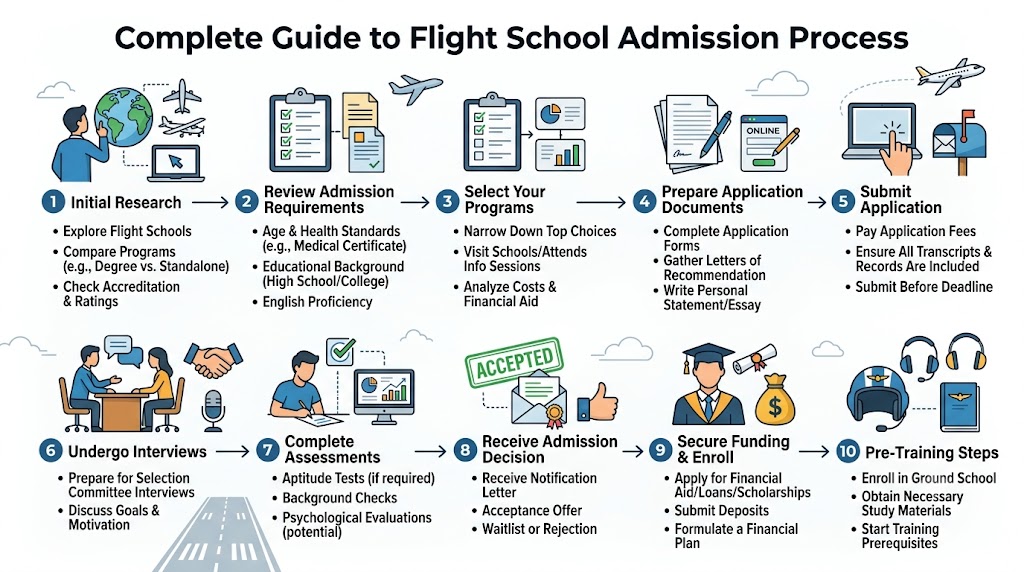
Choosing a flight school is one of the first major decisions in an aviation career. It is also a decision that should not be made from a brochure, a fee advertisement, or a promise of fast completion alone.
The admission process involves several connected decisions: identifying the right pilot licence, checking regulatory eligibility, confirming medical requirements, reviewing academic qualifications, evaluating flight schools, understanding the true cost of training, preparing documentation, completing admission formalities, and establishing a realistic training plan.
A student can be academically eligible but medically unsuitable for a particular pathway. A school can be properly authorized but still be a poor operational fit for a particular student. A program can advertise an attractive package while leaving important expenses outside the quoted fee.
The purpose of this guide is to explain the complete process from the initial decision to join a flight school through the beginning of formal flight training.
What Is the Flight School Admission Process?
Flight school admission is the process through which a prospective student determines eligibility, selects a suitable training organization, submits the required documentation, completes the school’s admission requirements, satisfies applicable regulatory requirements, and begins pilot training.
It is useful to separate the process into four different layers:
- Personal eligibility — Can you meet the basic requirements?
- Regulatory eligibility — Does the aviation authority permit you to pursue the intended licence?
- School admission — Will the selected flight school accept you?
- Training progression — Can you successfully complete the required ground and flight training?
These four layers overlap, but they are not interchangeable.
For example, being accepted by a flight school does not automatically mean that you have satisfied every requirement for a professional pilot licence.
The exact requirements depend on the country, aviation authority, licence category, aircraft category, and training organization.
1. Start With Your Aviation Goal
Before selecting a flight school, decide what you actually want to accomplish.
Possible objectives include:
- Private flying
- Commercial pilot training
- Airline pilot career
- Flight instructor career
- Helicopter flying
- Corporate aviation
- Recreational flying
- Building experience for a later professional licence
This decision affects almost every subsequent step.
Private Pilot Path
A private pilot pathway is generally intended for personal flying rather than employment as a professional pilot.
Commercial Pilot Path
A commercial pathway is designed for applicants who want professional flying privileges, subject to the applicable regulations.
Airline-Oriented Path
Students planning an airline career normally need a much longer training pathway involving multiple qualifications, experience-building stages, and potentially additional airline-specific requirements.
The important point is that you should select the training pathway before selecting the school.
A school should fit your objective rather than your objective being changed to fit whatever program a school happens to sell.
2. Identify the Aviation Authority
The next question is:
Which aviation authority will govern my training and licence?
Examples include:
- FAA in the United States
- DGCA in India
- UK CAA in the United Kingdom
- CASA in Australia
- Transport Canada in Canada
- Other national aviation authorities
Requirements can differ significantly.
For example, FAA guidance states that the requirements for becoming a pilot vary according to the type of aircraft and certificate being pursued.
In India, DGCA maintains a dedicated flight-crew examination and registration system, with specific qualification requirements for different categories.
Therefore, never assume that a requirement described by one country’s flight school automatically applies to another country’s licensing system.
3. Check Your Basic Eligibility
Before submitting an application, create an eligibility checklist.
Review:
- Age
- Education
- Mathematics
- Physics
- English/language requirements
- Medical eligibility
- Identification documents
- Citizenship or residency requirements
- Immigration requirements if training overseas
- Regulatory registration requirements
Why This Comes First
Suppose a student spends money on:
- Application fees
- Accommodation
- Travel
- Training materials
- Enrollment
- Initial lessons
and only afterward discovers that a fundamental licensing requirement has not been satisfied.
That is an avoidable problem.
The better sequence is:
Career Goal → Regulatory Requirements → Medical Eligibility → Academic Eligibility → School Selection → Financial Commitment
4. Check Academic Requirements
Academic requirements depend on the intended licence and jurisdiction.
For example, DGCA’s current flight-crew examination FAQ states that applicants other than the PPL category must have passed 10+2 with Physics and Mathematics from a recognized board or university, or an equivalent qualification.
The important lesson is that students should verify the exact educational requirement applicable to their chosen licence rather than relying on general statements such as “12th pass is enough.”
Check These Items
- Highest completed qualification
- Examination board or university
- Physics qualification
- Mathematics qualification
- Required marks or pass status where applicable
- Equivalency requirements
- Supporting certificates
- Mark sheets
- Name consistency across documents
If a required subject is missing, obtain clarification about acceptable alternatives before paying for professional training.
5. Deal With Medical Eligibility Early
Aviation medical certification deserves serious attention.
A normal medical checkup and an aviation medical assessment are not necessarily the same thing.
The required medical standard depends on:
- Licence category
- Country
- Aviation authority
- Intended privileges
- Type of operation
For U.S. student pilots, FAA guidance states that a student pilot certificate is required before solo flight, and medical certification requirements apply as specified by the applicable regulations.
Why Medical Assessment Should Be an Early Step
Medical eligibility can affect whether you can continue toward a particular professional pathway.
Therefore, prospective professional pilots should avoid treating the medical as an administrative formality to be completed after committing substantial money.
A sensible sequence is:
Identify Required Medical Standard → Consult Appropriate Aviation Medical Examiner → Understand Result → Continue With Major Financial Commitment
Do not attempt to interpret a complex medical issue solely from general internet information. Use the aviation authority’s applicable process and an authorized aviation medical professional.
6. Build a Flight School Shortlist
Once your basic eligibility is clear, create a shortlist rather than choosing the first school you find.
Consider several schools and compare them using the same criteria.
Core Evaluation Areas
| Area | What to Examine |
|---|---|
| Regulatory status | Applicable approval or authorization |
| Training program | Licence and ratings supported |
| Aircraft | Fleet size, availability and suitability |
| Instructors | Qualifications and availability |
| Ground school | Structure and instructor support |
| Scheduling | Frequency and predictability of flying |
| Maintenance | Aircraft maintenance arrangements |
| Safety | Safety management and reporting culture |
| Location | Weather, airport and operating environment |
| Cost | Complete estimated cost |
| Accommodation | Availability and expense |
| Student support | Administrative and academic support |
| Contract | Refund, withdrawal and transfer terms |
| Career pathway | Compatibility with long-term objectives |
This approach makes the comparison much more meaningful than simply asking:
“Which school is cheapest?”
7. Verify the School’s Regulatory Status
Regulatory approval is one of the first things to verify.
Ask:
- Which authority regulates the school?
- What type of training organization is it?
- What programs are authorized?
- Is the approval current?
- Does the authorization cover the training I want?
- Are instructors properly qualified?
- Are training records maintained?
- What happens if I transfer?
In the United States, FAA-approved Part 141 pilot schools must meet prescribed requirements relating to equipment, facilities, personnel, and curricula.
However, regulatory approval should be treated as a baseline, not the only measure of training quality.
A properly authorized school can still differ from another school in scheduling efficiency, student support, fleet availability, instructor stability, and operational culture.
8. Visit the Flight School Before Enrolling
If practical, visit the school before making a significant payment.
Do not restrict your visit to the admissions office.
Try to observe the actual training environment.
Look at:
- Training aircraft
- Dispatch area
- Maintenance environment
- Classrooms
- Briefing rooms
- Simulator facilities where applicable
- Student study areas
- Flight scheduling process
- General organization
Talk to:
- Chief flight instructor
- Flight instructors
- Current students
- Operations staff
- Maintenance personnel where appropriate
The FAA specifically recommends visiting training providers and talking with management, instructors, and students before making a final decision.
That is valuable because the people who experience the training every day can often identify operational problems that are not obvious from marketing material.
9. Evaluate Aircraft Availability
A large fleet does not automatically mean high availability.
Ask:
- How many aircraft are currently operational?
- How many are dedicated to training?
- How frequently are aircraft scheduled?
- How are maintenance cancellations handled?
- Is there a backup aircraft?
- How long do students typically wait after a cancellation?
- Are aircraft shared across multiple programs?
Why Fleet Availability Matters
Flight training depends heavily on continuity.
If a student flies infrequently, skills and procedures may require additional revision.
The FAA notes that regular and frequent ground and flight training supports retention and proficiency while reducing unnecessary time and expense.
Therefore, aircraft availability can affect both training progress and total cost.
10. Evaluate Instructor Availability
Your instructor has a major influence on your training experience.
Ask:
- How are instructors assigned?
- Can students request an instructor?
- What happens when an instructor is unavailable?
- How many students does one instructor typically manage?
- How is progress documented?
- What happens if a student is struggling?
- Can students change instructors if necessary?
Instructor Continuity Matters
Changing instructors occasionally is normal.
However, frequent instructor turnover can create:
- Repeated briefings
- Different teaching approaches
- Communication gaps
- Scheduling difficulties
- Additional revision
A good school should have a process for maintaining training continuity even when an individual instructor becomes unavailable.
11. Understand the Training Schedule
Ask the school how frequently a new student is realistically expected to fly.
Do not ask only:
“How many aircraft do you have?”
Ask:
“How many flight lessons can a typical student actually complete in a normal training period?”
Also ask what happens when:
- Weather cancels a flight
- Aircraft goes into maintenance
- Instructor is unavailable
- Airport operations change
- Student becomes unavailable
- Examination scheduling creates a delay
The difference between theoretical availability and actual student utilization is important.
12. Understand the Complete Cost
The advertised course fee should never be treated as the complete budget until you know what it includes.
Potential costs include:
- Application fee
- Enrollment fee
- Ground school
- Aircraft rental
- Instructor fees
- Fuel-related charges
- Simulator sessions
- Examination fees
- Medical examination
- Licensing fees
- Training materials
- Flight equipment
- Headset
- Charts and navigation materials
- Accommodation
- Food
- Transportation
- Insurance where applicable
- Additional flight hours
- Re-examinations
- Administrative charges
Ask for a Written Cost Breakdown
A useful question is:
“Please provide the expected total cost and identify every major item that is not included.”
Also ask:
“What happens financially if I require additional training hours?”
This question is critical because students do not all require exactly the same amount of training.
13. Build a Training Contingency Budget
Do not create a budget using only the minimum possible training requirement.
Instead, create three internal planning figures:
Minimum Scenario
The student progresses efficiently and requires limited additional training.
Expected Scenario
The student requires normal additional practice and encounters ordinary operational interruptions.
Contingency Scenario
The student requires significantly more training or experiences extended delays.
You do not need to assume the worst case will happen.
The purpose is to determine whether your financial plan can survive a less-than-perfect training experience.
14. Understand Payment Terms
Before making a substantial payment, ask:
- Is payment made upfront or in stages?
- Are unused funds refundable?
- What happens if I withdraw?
- What happens if I transfer?
- Does the school charge administrative fees?
- Are aircraft deposits refundable?
- Does accommodation require a separate contract?
- What happens if the school cannot provide training for an extended period?
Read the actual student agreement.
Do not rely only on verbal statements from an admissions representative.
15. Prepare Your Documentation
The exact documents depend on the jurisdiction and school, but applicants may need:
- Government-issued identification
- Passport
- Birth or age documentation
- Educational certificates
- Mark sheets/transcripts
- Medical documents
- Passport photographs
- Proof of address
- Regulatory registration information
- Visa documentation for overseas training
- Financial documentation where applicable
- Application forms
For DGCA registration, the current registration system requires personal details such as the applicant’s name as recorded on the 10th certificate and date of birth according to the 10th board certificate, among other information.
Document Consistency Is Important
Check that:
- Your name is consistent.
- Your date of birth is consistent.
- Certificates are legible.
- Scanned documents are complete.
- Required pages are included.
- Uploaded files meet the specified format and size.
Administrative inconsistencies can create avoidable delays.
16. Complete the School Application
The school application may request:
- Personal details
- Education
- Previous aviation experience
- Licence objective
- Medical information
- Identification
- Emergency contact
- Financial information
- Sponsorship details
- Visa information
Review the application carefully before submission.
Where regulatory systems require your name or date of birth to match educational records, use the required legal format consistently.
Do not create different versions of your name for different applications.
17. Prepare for Interviews and Assessments
Some flight schools may conduct interviews, aptitude assessments, academic tests, English assessments, or other screening processes.
Potential areas include:
- Mathematics
- Physics
- English
- Reasoning
- Communication
- Spatial awareness
- General aviation knowledge
- Motivation
- Career understanding
The exact process varies by school.
Be Prepared to Explain
- Why you want to become a pilot
- What type of flying interests you
- Why you selected the school
- What you understand about pilot training
- How you intend to manage the academic workload
- How you have planned for the financial commitment
- What you know about aviation responsibilities
A professional applicant should understand that pilot training is not simply about learning to operate an aircraft.
It involves:
- Discipline
- Procedures
- Decision-making
- Communication
- Technical knowledge
- Risk management
- Continuous assessment
18. Understand Ground School
Ground training is a core part of pilot development.
Depending on the licence, students may study:
- Aviation regulations
- Meteorology
- Navigation
- Aerodynamics
- Aircraft systems
- Human factors
- Radio communication
- Flight planning
- Aircraft performance
- Operational procedures
- Safety principles
Do not treat ground school as something to complete quickly so that you can spend more time flying.
Weak theoretical knowledge can directly affect practical performance.
19. Understand Regulatory Registration
After or during school admission, additional regulatory registration may be required.
The exact process varies by country.
In India, DGCA operates a flight-crew examination registration system, and the current system provides for candidate registration and computer-number-related processing.
In the United States, a student pilot certificate is required before solo flight, and the FAA explains that the application can be processed through IACRA or through authorized personnel.
The important point is:
Do not assume the flight school automatically completes every regulatory requirement on your behalf.
Ask the school to clearly identify:
- What the school handles
- What the student handles
- What the regulator handles
- What documents must be submitted
- What deadlines apply
20. Understand the Difference Between Training and Licensing
This distinction is frequently misunderstood by new students.
Flight School
Provides instruction and training.
Aviation Authority
Establishes and administers regulatory requirements.
Examiner
May conduct applicable examinations or practical tests.
Student
Must satisfy the required eligibility, training, knowledge, experience, medical, and testing requirements.
For example, FAA guidance describes separate student pilot certification, knowledge testing, training, and practical testing processes.
Therefore:
School admission ≠ Pilot licence
and:
Completing lessons ≠ Automatically receiving a licence
21. Review the School’s Safety Culture
Safety should be evaluated throughout the admission process.
Ask how the organization manages:
- Weather decisions
- Aircraft defects
- Maintenance
- Student reporting
- Instructor concerns
- Incident reporting
- Emergency procedures
- Operational risk
- Fatigue
- Pre-flight preparation
- Training records
A Useful Question
Ask:
“How are students encouraged to report a safety concern if they are uncomfortable with a flight or training situation?”
The answer can tell you a great deal about the organization’s safety culture.
A mature training environment should encourage appropriate safety reporting rather than create pressure to hide problems.
22. Evaluate the Airport and Operating Environment
The location of a flight school affects the training experience.
Consider:
- Weather
- Airport traffic
- Airspace structure
- Terrain
- Training areas
- Runway availability
- Local congestion
- Seasonal conditions
- Accommodation
- Transportation
A very quiet airport may provide a different learning environment from a busy controlled airport.
Neither environment should automatically be treated as superior.
The question is:
Does the operating environment provide suitable training for my intended pathway?
23. Understand Training Delays
Flight training is affected by operational variables.
Possible causes of delays include:
- Weather
- Aircraft maintenance
- Instructor availability
- Airport restrictions
- Airspace restrictions
- Examination schedules
- Student availability
- Administrative delays
Ask the school:
- How are cancellations communicated?
- How quickly are cancelled flights rescheduled?
- What is the backup process for aircraft maintenance?
- Can students fly with another instructor?
- How are prolonged interruptions handled?
A good training organization should have a process rather than simply telling students to wait.
24. Review the Student Contract
Before enrollment, read the contract carefully.
Pay particular attention to:
Refunds
What is refundable?
Withdrawal
What happens if you leave the program?
Transfer
Can you transfer your records and remaining balance?
Additional Training
How are extra hours billed?
Course Expiration
Does the enrollment expire after a particular period?
Accommodation
Is housing covered by the same agreement?
Training Interruption
What happens if the school cannot provide training?
Discipline
What circumstances can result in suspension or termination?
A contract should be understood before payment, not after a disagreement occurs.
25. Evaluate Student Support
Flight training can involve academic, operational, administrative, and scheduling challenges.
Ask whether the school provides:
- Academic support
- Instructor mentoring
- Progress reviews
- Remedial training
- Examination preparation
- Documentation assistance
- Scheduling support
- Career guidance
- Accommodation support
Also ask what happens when a student is falling behind.
A strong training process should identify performance issues early rather than waiting until the student has accumulated substantial additional cost.
26. Consider International Training Carefully
International flight training introduces additional considerations.
Review:
- Passport requirements
- Visa requirements
- Immigration conditions
- Medical requirements
- Licence recognition
- Licence conversion
- Training record transfer
- Accommodation
- Insurance
- Currency
- Banking
- Local transportation
- Return-home requirements
The most important question is:
Will this training pathway support the licence and career pathway I ultimately intend to follow?
A training program should be evaluated from the perspective of the complete career pathway, not simply the location where the first flight lesson takes place.
28. Common Flight School Admission Mistakes
Mistake 1: Choosing Only on Price
A lower advertised fee does not necessarily mean lower total cost.
Training interruptions and additional hours can materially change the final amount.
Mistake 2: Delaying the Medical
For students pursuing professional aviation, discovering a medical issue after making a major financial commitment can create significant problems.
Mistake 3: Trusting Completion Promises
Training timelines depend on many variables.
Treat advertised completion periods as planning estimates rather than guarantees.
Mistake 4: Ignoring Aircraft Availability
A school can have a large fleet on paper but limited operational availability.
Ask about actual utilization and student scheduling.
Mistake 5: Ignoring Instructor Turnover
Instructor availability affects continuity and scheduling.
Ask how the school handles instructor changes.
Mistake 6: Not Reading the Contract
Never assume verbal promises override written terms.
Read refund, withdrawal, transfer, and additional-training clauses carefully.
Mistake 7: Assuming the School Handles Everything
Some regulatory registrations and documentation may remain the student’s responsibility.
Get a written responsibility matrix.
Mistake 8: Treating Ground School as Secondary
Strong theoretical knowledge supports better practical decision-making and flight performance.
Mistake 9: Comparing Schools Without Visiting
Marketing material cannot fully reveal daily operational realities.
If practical, visit the school and speak with current students.
29. Questions to Ask Before Paying the Admission Fee
Eligibility
- Do I meet all requirements for this specific training program?
- Which documents must I provide?
- Is an aviation medical required before enrollment?
- Are there additional regulatory requirements?
Training
- Which licence does the program prepare me for?
- What is included in ground training?
- How are flight lessons scheduled?
- How is student progress measured?
- What happens if I need additional training?
Aircraft
- How many aircraft are currently operational?
- What happens during maintenance?
- How are aircraft cancellations handled?
Instructors
- How are instructors assigned?
- What happens if my instructor is unavailable?
- How are instructor changes handled?
Financial
- What exactly is included in the quoted price?
- What charges are excluded?
- How are additional hours billed?
- What are the refund conditions?
- What happens to unused prepaid funds?
Administration
- Which regulatory registrations do I need?
- Which registrations does the school handle?
- What happens if I transfer to another school?
Safety
- How are safety concerns reported?
- How are weather-related decisions made?
- How are aircraft defects handled?
30. Flight School Admission Checklist
Personal Eligibility
- Intended licence identified
- Minimum age requirement checked
- Academic requirements checked
- Mathematics requirement checked
- Physics requirement checked
- Language requirements checked
- Citizenship/residency requirements checked
Medical
- Required medical category identified
- Appropriate aviation medical process confirmed
- Medical examination completed or scheduled
- Medical documentation organized
School
- Regulatory status verified
- Training program reviewed
- Aircraft availability checked
- Instructor availability checked
- Ground school evaluated
- Safety culture discussed
- Training environment evaluated
- Current students consulted where possible
Financial
- Admission fee confirmed
- Tuition structure understood
- Aircraft charges understood
- Instructor charges understood
- Examination costs identified
- Medical costs identified
- Equipment costs identified
- Accommodation costs calculated
- Additional-training contingency prepared
- Refund policy reviewed
Documentation
- Identification ready
- Educational certificates ready
- Mark sheets ready
- Medical documents ready
- Photographs ready
- Regulatory documents identified
- Digital copies securely stored
Contract
- Refund terms reviewed
- Withdrawal terms reviewed
- Transfer terms reviewed
- Additional-training terms reviewed
- Course validity reviewed
- Payment schedule reviewed
Final Decision
- Career pathway matches training program
- Regulatory pathway understood
- Total budget understood
- Training schedule understood
- Major risks identified
- Admission decision made after comparing alternatives
31. A Practical Flight School Decision Framework
A useful decision framework is to evaluate the school across six dimensions.
| Dimension | Key Question |
|---|---|
| Eligibility | Can I legally and medically pursue this pathway? |
| Compliance | Is the school properly authorized for the training? |
| Training | Can the school provide consistent, structured instruction? |
| Operations | Are aircraft and instructors reliably available? |
| Economics | Can I afford the realistic total cost? |
| Career Fit | Does this pathway support my long-term objective? |
This prevents one attractive feature from dominating the decision.
For example, a school may have modern aircraft but poor scheduling.
Another may have excellent instructors but limited fleet availability.
Another may advertise a low package price but exclude several major expenses.
The right evaluation therefore looks at the whole operating model.
32. How to Make the Admission Process More Efficient
Prospective students can reduce unnecessary delays by organizing the process in the right order.
Step 1: Define the Goal
Choose the licence and career objective.
Step 2: Verify Requirements
Check the applicable aviation authority’s requirements.
Step 3: Verify Medical Eligibility
Complete the appropriate aviation medical process early.
Step 4: Verify Education
Confirm that your academic background satisfies the selected pathway.
Step 5: Shortlist Schools
Compare multiple training providers.
Step 6: Visit and Investigate
Inspect the operation and speak with instructors and students.
Step 7: Calculate the Real Budget
Include additional training and living expenses.
Step 8: Review the Contract
Understand refunds, transfers, withdrawal, and additional costs.
Step 9: Submit the Application
Provide accurate and consistent documentation.
Step 10: Complete Regulatory Formalities
Handle applicable registrations, examinations, and certifications.
Step 11: Attend Orientation
Understand school procedures before the first training lesson.
Step 12: Begin Training
Start with the expectation that consistent study and regular flight practice will be required.
33. What Good Flight School Admission Looks Like
A well-managed admission process should leave the student able to answer these questions clearly:
Eligibility
Am I eligible for this pathway?
Medical
Have I established the appropriate medical eligibility?
Regulation
Which authority governs my licence?
Training
What exactly will the school teach me?
Operations
How frequently can I realistically train?
Financial
What will the complete pathway realistically cost?
Contract
What happens if I withdraw, transfer, or require additional training?
Career
Does this program support my intended aviation career?
If several of these questions remain unanswered, the admission decision is not yet sufficiently informed.
Frequently Asked Questions
Q1. What is the first step in applying to flight school?
The first step is to identify the pilot licence and career pathway you want to pursue. Once that is clear, check the applicable aviation authority’s eligibility requirements.
Q2. Should I complete my aviation medical before joining a flight school?
For students pursuing professional aviation, establishing medical eligibility early is a prudent step before making a substantial financial commitment. The exact requirement depends on the licence and aviation authority.
Q3. Do all flight schools have the same admission requirements?
No. Requirements vary according to the country, aviation authority, licence, training program, school, and student circumstances.
Q4. Do I need Physics and Mathematics?
This depends on the licence and jurisdiction. For example, DGCA’s current flight-crew examination guidance specifies 10+2 Physics and Mathematics for applicants other than the PPL category.
Q5. Can I start flight lessons before completing every student-pilot requirement?
This depends on the regulatory system. Under FAA rules, a person can take flying lessons without a student pilot certificate, but a student pilot certificate is required before solo flight.
Q6. How much does flight school cost?
There is no universal figure. The total depends on the licence, country, aircraft, training hours, instructor charges, examinations, medical requirements, accommodation, equipment, and additional training.
Q7. Should I choose the flight school with the lowest price?
Price should be evaluated alongside regulatory status, training quality, aircraft availability, instructor availability, safety culture, scheduling, additional costs, and contractual terms.
Q8. Why is aircraft availability important?
Training continuity matters. Frequent interruptions can affect retention, proficiency, scheduling, and total training expense.
Q9. Should I visit a flight school before enrolling?
If possible, yes. Visiting allows you to inspect the operation and speak with instructors and current students rather than relying exclusively on promotional information.
Q10. What if I need more flight hours than the school estimated?
Additional training may increase the total cost. Ask in advance how extra aircraft and instructor hours are billed.
Q11. Is admission the same as receiving a pilot licence?
No. Admission means the school has accepted you into its training program. Licensing requires satisfaction of the applicable regulatory training, experience, knowledge, medical, and testing requirements.
Q12. Can I transfer to another flight school?
Possibly, but the practical and financial consequences depend on the school and regulatory system. Ask about transfer procedures before enrolling.
Q13. What should I check in the admission contract?
Focus on payment terms, refunds, withdrawal, transfer, additional training, course validity, accommodation, administrative fees, and what happens if training is interrupted.
Q14. What is the biggest financial mistake new students make?
A common mistake is budgeting only for the advertised training package instead of planning for additional flight hours, examinations, equipment, accommodation, transportation, and possible delays.
Q15. What should I ask current students?
Ask how often they actually fly, how easy it is to schedule aircraft, how cancellations are handled, whether instructors are available, how the school responds to training difficulties, and whether actual costs match the initial explanation.
Final Takeaway
Flight school admission should be treated as a due-diligence process, not simply an application procedure. Start with the licence and career objective, then verify regulatory eligibility, education, medical requirements, and documentation before committing significant money. Evaluate schools based on approval status, aircraft availability, instructors, scheduling, safety culture, ground training, operational reliability, total cost, and contract terms. Most importantly, compare the actual training experience rather than the advertised package. A careful admission decision creates a stronger foundation for consistent training, controlled costs, regulatory compliance, and long-term progress toward a professional aviation career.
