
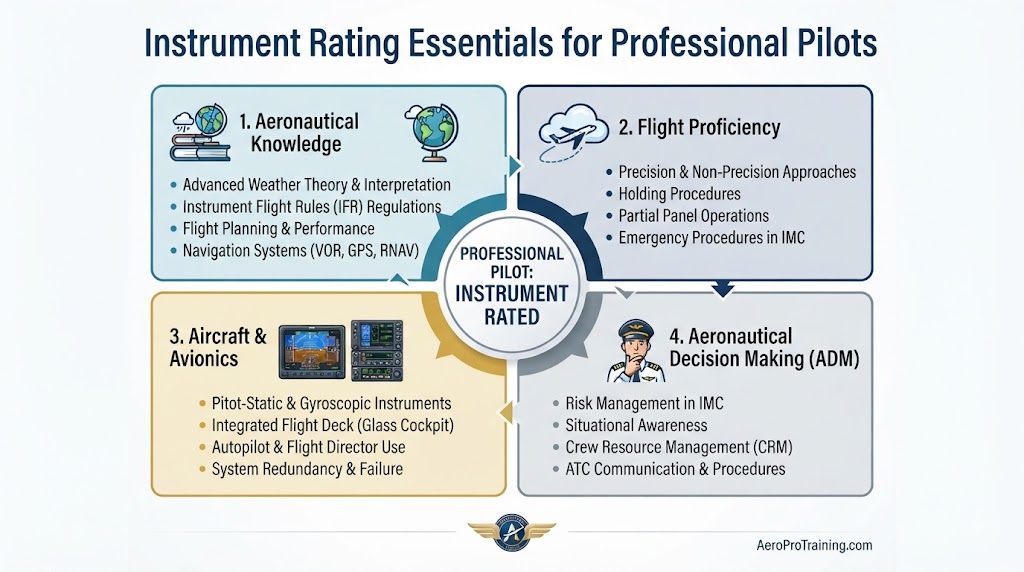
Introduction
Instrument flying is one of the most important skills a professional pilot can develop. Pilots may encounter reduced visibility, clouds, changing weather, complex airspace, and situations where outside visual references are limited. In these conditions, pilots must be able to maintain precise aircraft control while relying on instruments, navigation systems, procedures, and sound decision-making. Instrument training develops these abilities through structured ground and flight instruction. It also teaches pilots to manage workload, communicate effectively with air traffic control, interpret weather, and conduct instrument approaches. For pilots pursuing professional aviation careers, an instrument rating can be an important part of their overall training and operational development.
What Is an Instrument Rating?
An instrument rating is an additional pilot qualification that provides the privileges and capabilities associated with instrument flight when the applicable regulatory requirements are met.
Instead of relying primarily on outside visual references, instrument-rated pilots learn to control and navigate the aircraft using its flight instruments and approved navigation systems.
Instrument training generally involves both ground knowledge and practical flight skills. Pilots learn about:
- Instrument flight rules
- Aircraft instruments
- Navigation
- Weather
- Instrument approaches
- Air traffic control procedures
- Holding procedures
- Flight planning
- Emergency considerations
- Workload management
The exact certification requirements vary depending on the aviation authority and pilot certificate. Pilots should always verify current requirements with the applicable aviation authority and their flight instructor.
Why Instrument Rating Matters for Professional Pilots
Professional pilots often operate in environments where weather and scheduling can make visual flight more challenging.
An instrument rating helps pilots develop a structured approach to flying when visual references are limited.
Increased Operational Capability
Instrument training gives pilots additional knowledge and skills for conducting operations under applicable instrument flight rules.
Better Weather Decision-Making
Pilots learn to evaluate weather conditions before and during a flight and recognize situations that may require changes to the planned operation.
Improved Navigation Skills
Instrument training develops disciplined use of navigation systems, charts, procedures, and aircraft instruments.
Stronger Cockpit Discipline
Instrument flying requires consistent checklists, briefings, instrument monitoring, communication, and decision-making.
Better Workload Management
Pilots learn to manage aircraft control, navigation, communication, and other tasks simultaneously.
Professional Development
For many professional aviation career paths, instrument proficiency is an important component of a pilot’s overall skill set.
Core Instrument Rating Essentials
1. Understanding IFR Operations
Instrument flight rules, commonly called IFR, provide a structured framework for operating aircraft when visual flight conditions are not sufficient or when an operation is conducted under IFR requirements.
Pilots need to understand concepts such as:
- IFR flight plans
- ATC clearances
- Assigned altitudes
- Routes
- Navigation procedures
- Instrument approaches
- Communication requirements
- Weather considerations
Professional pilots should understand the reasoning behind IFR procedures rather than simply memorizing individual steps.
A strong understanding of IFR operations allows pilots to anticipate what comes next and manage cockpit workload more effectively.
2. Understanding Aircraft Instruments
Instrument-rated pilots need a strong understanding of the instruments used to control and monitor the aircraft.
Traditional flight instruments include:
- Attitude indicator
- Airspeed indicator
- Altimeter
- Heading indicator
- Vertical speed indicator
- Turn coordinator
- Magnetic compass
Modern aircraft may use integrated electronic flight displays and other digital systems.
Pilots should understand not only what each instrument displays but also its limitations, failure indications, and relationship to other instruments.
This knowledge becomes especially important when one instrument or system provides unexpected information.
3. Developing an Effective Instrument Scan
An effective instrument scan is a fundamental instrument flying skill.
Instead of staring at one instrument, pilots continuously cross-check multiple indications to maintain control of the aircraft.
A good scan helps pilots monitor:
- Attitude
- Altitude
- Airspeed
- Heading
- Vertical movement
- Navigation information
Instrument fixation can be dangerous because concentrating too heavily on one indication can cause the pilot to miss changes elsewhere.
Professional pilots therefore develop disciplined scanning habits through repeated practice.
4. Aircraft Control by Reference to Instruments
Instrument training teaches pilots to maintain aircraft control without depending entirely on outside visual references.
Pilots must learn to maintain:
- Pitch
- Bank
- Airspeed
- Altitude
- Heading
- Course
Small deviations should be identified and corrected before they become larger.
The objective is not to make constant large control movements. Instead, pilots learn to make measured corrections while continuously monitoring the aircraft’s response.
5. Navigation Systems
Navigation is a major part of instrument flying.
Depending on the aircraft and operation, pilots may use systems such as:
- VOR
- DME
- GPS/GNSS
- Area navigation systems
- Electronic navigation displays
- Approved navigation databases
Modern navigation technology can greatly improve situational awareness, but professional pilots must understand its limitations.
Pilots should know what information the system is providing, how the information is displayed, and what to do if the system becomes unavailable or unreliable.
Technology should support good pilot decision-making rather than replace it.
6. Understanding Instrument Approach Procedures
Instrument approaches allow pilots to transition from the en-route portion of a flight toward a runway using published procedures.
Before conducting an approach, pilots should understand the applicable chart and procedure.
Important concepts include:
- Initial approach segments
- Intermediate segments
- Final approach
- Minimum altitudes
- Navigation requirements
- Approach course
- Missed approach procedure
Approach briefings help pilots organize this information before workload increases.
A professional approach briefing should give the crew a clear understanding of what they expect to see and what actions may be required during the approach.
7. Precision and Non-Precision Approaches
Pilots should understand the basic differences between approaches that provide both lateral and vertical guidance and those that primarily provide lateral guidance.
Vertical guidance can provide additional information about the aircraft’s position relative to the intended descent path.
However, the exact capabilities and minimums vary between procedures and equipment.
Pilots must therefore review the actual published approach rather than assuming that every instrument approach operates in the same way.
8. Missed Approach Procedures
Not every instrument approach results in a landing.
A pilot may need to execute a missed approach when the required conditions for continuing to a landing are not met.
Pilots should understand:
- The published missed approach procedure
- Relevant navigation requirements
- Altitudes
- Communication
- Direction of flight
- Applicable ATC instructions
The missed approach should be briefed before beginning the approach.
Being prepared for a missed approach reduces workload when a decision must be made quickly.
9. Weather Knowledge
Weather knowledge is essential for professional instrument flying.
Pilots should understand and evaluate:
- Visibility
- Clouds
- Winds
- Turbulence
- Fronts
- Thunderstorms
- Icing
- Forecasts
- Weather observations
- Pilot reports
Weather conditions can change during a flight, so pilots should continue monitoring available information rather than treating the original forecast as permanent.
Good weather decision-making involves understanding both the aircraft’s capabilities and the limitations of the pilot, equipment, route, and available alternatives.
10. Icing Awareness
Icing is an important consideration during instrument operations.
Structural icing can affect aircraft performance and handling, while certain icing conditions may also affect engines, propellers, sensors, or other systems depending on the aircraft.
Pilots should understand:
- Where icing may occur
- Weather conditions associated with icing
- Aircraft limitations
- Available avoidance strategies
- Applicable anti-icing or de-icing systems
The correct response depends on the aircraft, operating environment, and applicable procedures.
Instrument training should therefore include strong weather awareness and conservative decision-making.
11. Air Traffic Control Communication
Professional instrument flying involves frequent communication with air traffic control.
Pilots may need to manage:
- IFR clearances
- Frequency changes
- Route amendments
- Altitude assignments
- Approach instructions
- Holding instructions
- Position information
Clear communication helps reduce misunderstandings.
Pilots should use appropriate phraseology, listen carefully, read back important instructions, and ask for clarification whenever an instruction is unclear.
Good radio communication is both a technical and workload-management skill.
12. Holding Procedures
Holding patterns allow aircraft to remain within a defined area while waiting for further clearance or other operational requirements.
Instrument training introduces pilots to concepts such as:
- Holding pattern structure
- Entries
- Timing
- Navigation
- Altitude control
- Communication
Holding can increase cockpit workload, especially when combined with weather, fuel, navigation, and ATC considerations.
Pilots should therefore practice holding procedures until they can manage them systematically rather than relying entirely on memory under pressure.
13. Instrument Flight Planning
Good instrument flying starts before the aircraft leaves the ground.
Professional pilots should consider:
- Route
- Weather
- Aircraft performance
- Fuel
- Alternate planning
- Navigation
- Airspace
- Approach availability
- Airport conditions
- NOTAMs and other operational information
Planning requirements depend on the specific flight and applicable regulations.
The goal is to identify potential problems before they become urgent during the flight.
14. Cockpit Resource Management
Instrument operations require pilots to manage several tasks at the same time.
Cockpit resource management involves making effective use of:
- People
- Procedures
- Checklists
- Aircraft systems
- Communication
- Available information
In multi-crew operations, clear task division and communication are particularly important.
Even during single-pilot operations, the same principles apply. Pilots must organize tasks, prioritize aircraft control, and avoid allowing secondary tasks to interfere with primary responsibilities.
15. Automation Management
Modern aircraft may include sophisticated autopilot, flight director, navigation, and flight management systems.
Automation can reduce workload, but pilots must understand what the system is doing.
Important concepts include:
- Automation modes
- Mode awareness
- System limitations
- Monitoring
- Appropriate use of automation
- Recognition of unexpected system behaviour
A professional pilot should always remain engaged with the flight.
Automation should support pilot workload management rather than replace situational awareness.
Common Instrument Training Challenges
Instrument training can be demanding because pilots must develop several skills simultaneously.
Maintaining Precise Altitude
Small changes in pitch and power can affect altitude. Consistent instrument monitoring is essential.
Maintaining Heading
Pilots must continuously monitor heading and make appropriate corrections rather than allowing deviations to develop.
Developing an Instrument Scan
New instrument students may focus too heavily on one instrument. Developing a balanced scan takes practice.
Reading Approach Charts
Approach charts contain a large amount of information. Pilots must learn how to quickly identify important altitudes, courses, frequencies, minimums, and missed approach information.
Managing Workload
Navigation, communication, aircraft control, and procedure management can become demanding during complex phases of flight.
Understanding Navigation Systems
Modern systems can be powerful but require pilots to understand their operation and limitations.
Flying Instrument Approaches
Approaches combine aircraft control, navigation, communication, chart interpretation, and decision-making.
Managing Weather
Pilots must constantly evaluate whether the actual conditions remain consistent with the planned operation.
Common Mistakes Instrument Rating Candidates Should Avoid
1. Memorizing Without Understanding
Memorization can help with certain procedures, but professional pilots need to understand why those procedures exist.
2. Neglecting Weather Knowledge
Instrument training should not focus only on instruments and approaches. Weather understanding is equally important.
3. Relying Too Heavily on Automation
Automation can reduce workload, but pilots must continue monitoring the aircraft and systems.
4. Poor Instrument Scanning
Fixating on one instrument can result in missed deviations elsewhere.
5. Failing to Brief Approaches Properly
A weak approach briefing can increase workload during the most demanding part of the flight.
6. Ignoring Aircraft Limitations
Instrument procedures must always be conducted within the aircraft’s capabilities and approved limitations.
7. Weak Radio Communication
Poor communication can create unnecessary confusion during IFR operations.
8. Poor Workload Management
Pilots should prioritize aircraft control and organize secondary tasks appropriately.
9. Inadequate Flight Planning
Good planning reduces the number of unexpected decisions required during the flight.
10. Failing to Maintain Proficiency
Earning an instrument rating does not automatically make a pilot continuously proficient. Regular practice and appropriate recurrent training remain important.
Building Instrument Proficiency
Instrument proficiency develops through repeated exposure to realistic flight situations.
Pilots can maintain and improve their skills through:
- Regular instrument practice
- Simulator training where appropriate
- Instrument approaches
- Navigation exercises
- Instrument scan practice
- Weather analysis
- Procedure briefings
- Instructor feedback
- Recurrent training
- Review of previous flight performance
A pilot should avoid treating instrument proficiency as something achieved only on the day of a practical test.
Real proficiency develops through continued practice and thoughtful review.
Instrument Rating Training Checklist
Before and during instrument training, pilots should work toward proficiency in the following areas:
- IFR concepts reviewed
- Aircraft instruments understood
- Instrument scan developed
- Aircraft control practiced
- Navigation systems understood
- Approach charts interpreted correctly
- Instrument approaches practiced
- Missed approaches understood
- Holding procedures practiced
- Weather knowledge reviewed
- ATC communication practiced
- Flight planning completed
- Automation systems understood
- Aircraft limitations reviewed
- Abnormal and emergency procedures understood
- Instrument proficiency maintained
This checklist should complement, not replace, the syllabus and guidance provided by a qualified flight instructor.
Instrument Rating vs Visual Flight Training
| Training Area | Visual Flight Training | Instrument Training |
|---|---|---|
| Primary reference | Outside visual references | Flight instruments and approved procedures |
| Weather considerations | Primarily visual conditions | Greater emphasis on IFR weather |
| Navigation | Visual references and navigation systems | Instrument-based navigation |
| Approach skills | Visual approaches | Instrument approaches |
| ATC interaction | Varies by operation | Greater emphasis on IFR clearances and procedures |
| Workload | Varies by flight | Often higher during complex IFR operations |
| Professional application | Foundation for many pilots | Important capability for many professional operations |
The two forms of training are complementary. Strong instrument skills are built on a solid foundation of basic aircraft control and sound visual flying habits.
Benefits of Instrument Training for Professional Pilots
Better Weather Decision-Making
Instrument training gives pilots a stronger framework for evaluating weather, visibility, and operational conditions.
Improved Navigation Skills
Pilots develop disciplined habits for using navigation systems, charts, and published procedures.
Greater Operational Capability
An appropriately qualified and current pilot can conduct operations under applicable instrument rules and conditions.
Stronger Cockpit Discipline
Instrument flying encourages consistent briefings, checklists, cross-checks, and communication.
Improved Workload Management
Pilots learn how to prioritize tasks and maintain aircraft control while handling navigation and communication requirements.
Professional Development
Instrument training is an important part of the skill development required for many professional pilot career paths.
Choosing an Instrument Training Program
Selecting an appropriate training environment can influence the overall learning experience.
Pilots evaluating an instrument training program should consider:
Qualified Instructors
Look for instructors who can explain technical concepts clearly and provide constructive feedback.
Aircraft Availability
Reliable access to suitable instrument-equipped aircraft can help maintain training continuity.
Simulator Access
Appropriately configured simulators can provide additional opportunities to practice procedures and workload management.
Training Structure
A well-organized syllabus can help students progress systematically.
Maintenance Support
Aircraft reliability is important for maintaining consistent training schedules.
Weather Flexibility
A program should have reasonable procedures for handling weather-related scheduling challenges.
Instructor Feedback
Regular feedback helps students identify weaknesses and track improvement.
Scheduling
Consistent training opportunities can help students develop skills more efficiently.
Pilots researching flight training and professional aviation education can also explore FLIGHTTRAININGUS.COM as a resource when comparing training-related information.
How to Prepare for Instrument Training
Preparation before flight lessons can make instrument training more productive.
Review Basic Instruments
Understand what each primary flight instrument displays and how the instruments relate to one another.
Study Weather
Become familiar with aviation weather reports, forecasts, clouds, winds, visibility, and hazards.
Learn Navigation Concepts
Review basic navigation principles before introducing more advanced instrument procedures.
Practice Reading Charts
Approach charts can initially seem complicated. Regular study helps pilots recognize important information more quickly.
Understand Aviation Terminology
Learning common IFR terminology makes communication and classroom instruction easier to follow.
Review Aircraft Systems
Know the aircraft’s basic instrument, electrical, navigation, and autopilot systems.
Develop Checklist Habits
Professional pilots should develop disciplined checklist habits from the beginning of training.
Study Before Flight
Pre-flight preparation allows more time during the lesson for practical skill development.
Ask Questions
A good instructor should be able to explain not only what to do but why a particular procedure matters.
Maintain Organized Training Records
Recording lessons, weaknesses, and areas for improvement can help both the pilot and instructor monitor progress.
Frequently Asked Questions
1. What is an instrument rating?
An instrument rating is an additional pilot qualification that provides the applicable privileges for instrument flight under the relevant aviation regulations.
2. Why is an instrument rating important for professional pilots?
It develops skills in instrument flight, navigation, weather assessment, procedures, communication, and workload management that are important in many professional aviation environments.
3. What do pilots learn during instrument training?
Training generally covers IFR operations, aircraft instruments, navigation, weather, instrument approaches, holding procedures, flight planning, ATC communication, and instrument flight skills.
4. How difficult is instrument flight training?
It can be challenging because pilots must learn to control the aircraft accurately while managing navigation, communication, procedures, and changing workloads. Consistent practice can make the learning process more manageable.
5. What is an instrument scan?
An instrument scan is the systematic process of cross-checking flight instruments to maintain aircraft attitude, altitude, airspeed, heading, and other important flight parameters.
6. Why are instrument approaches important?
Instrument approaches provide published procedures for transitioning toward an airport when visual conditions or other operational circumstances require instrument-based navigation.
7. Do professional pilots need instrument proficiency?
Many professional operations require pilots to maintain appropriate instrument qualifications and proficiency. Specific requirements depend on the pilot’s certificate, operation, aircraft, and applicable regulations.
8. How can pilots maintain instrument proficiency?
Regular practice, simulator training where appropriate, instrument approaches, recurrent training, instructor feedback, and continued study can help maintain proficiency.
9. What should pilots look for when choosing an instrument training program?
Pilots should consider instructor quality, aircraft availability, simulator access, training structure, maintenance support, scheduling, feedback, and the overall learning environment.
10. How can FLIGHTTRAININGUS.COM help pilots explore flight training options?
FLIGHTTRAININGUS.COM can serve as an informational resource for pilots researching flight training, instrument training, and professional aviation development.
Final Thoughts
Instrument training is about much more than learning to fly an aircraft without looking outside. It requires pilots to develop disciplined instrument scanning, precise aircraft control, navigation skills, weather awareness, communication, workload management, and sound decision-making.
For professional pilots, these skills can become an important part of day-to-day aviation operations. The ability to understand instrument procedures and manage changing conditions gives pilots a stronger foundation for operating in complex aviation environments.
