
Introduction
For many aviation enthusiasts, becoming a commercial pilot represents the fulfillment of a lifelong dream. Beyond the excitement of flying, a professional pilot is responsible for ensuring passenger safety, making sound decisions under pressure, communicating effectively, and operating complex aircraft in a highly regulated environment. Achieving this level of responsibility requires much more than learning how to take off and land an airplane—it requires comprehensive commercial pilot training.
Commercial pilot training is designed to transform enthusiastic student pilots into skilled aviation professionals capable of handling real-world flying operations. Through a combination of classroom education, simulator sessions where available, flight instruction, and practical experience, students develop the technical knowledge, confidence, discipline, and decision-making abilities needed for a wide range of aviation careers.
What Is Commercial Pilot Training?
Commercial pilot training is a structured educational program that prepares individuals to operate aircraft professionally while meeting applicable licensing and competency requirements established by the relevant aviation authority.
Unlike recreational flying, commercial training emphasizes precision, professionalism, operational safety, and decision-making. Students progress from basic flight skills to more advanced maneuvers, navigation, aircraft systems management, emergency procedures, and professional operating standards.
A comprehensive commercial pilot training program generally includes:
- Ground school instruction
- Practical flight training
- Aircraft systems education
- Aviation regulations
- Flight planning
- Navigation techniques
- Weather interpretation
- Risk management
- Emergency procedures
- Professional communication skills
The objective is not simply to teach students how to fly, but to prepare them to operate safely and confidently in professional aviation environments.
Why Professional Pilot Training Matters
Commercial aviation demands a high level of competence, consistency, and professionalism. Structured training helps students build these qualities over time.
Builds a Strong Safety Mindset
Safety is the foundation of aviation. Students learn to identify hazards, assess risks, and make informed decisions before and during every flight.
Develops Professional Standards
Professional pilots follow standardized procedures, maintain accurate records, and communicate effectively with air traffic control, crew members, and passengers.
Improves Decision-Making
Commercial pilot training teaches students how to evaluate weather, aircraft performance, fuel requirements, and operational risks before making critical decisions.
Increases Confidence
As students gain experience under instructor guidance, they become more confident handling different aircraft operations and flight scenarios.
Core Skills Developed During Commercial Pilot Training
Commercial pilot training focuses on building a broad range of technical and professional skills.
Aircraft Control
Students learn precise aircraft handling during takeoff, climb, cruise, descent, approach, and landing under varying operating conditions.
Flight Planning
Pilots are trained to prepare detailed flight plans by considering:
- Route selection
- Fuel planning
- Aircraft performance
- Weather conditions
- Alternate airports
- Airspace requirements
Navigation Skills
Students develop proficiency using visual references, aeronautical charts, navigation systems, and approved navigation procedures to reach their destinations safely and efficiently.
Radio Communication
Effective communication is essential in aviation. Students practice clear, concise radio communication with air traffic services and other aviation personnel while following standard aviation phraseology.
Weather Interpretation
Weather plays a significant role in flight operations. Students learn to interpret aviation weather reports, forecasts, and changing conditions to make sound operational decisions.
Emergency Procedures
Commercial pilot training prepares students to respond calmly and methodically to abnormal and emergency situations, reinforcing the importance of preparation and adherence to established procedures.
Aeronautical Decision-Making
Pilots continually evaluate information during flight. Training develops structured decision-making skills that support safe operations in changing conditions.
Risk Management
Students learn to identify operational risks, evaluate their impact, and implement appropriate mitigation strategies before and during flight.
Situational Awareness
Maintaining awareness of aircraft position, surrounding traffic, weather, terrain, and aircraft performance is a critical professional skill developed throughout training.
Crew Coordination
Many professional aviation operations involve teamwork. Students begin developing communication and coordination habits that support effective collaboration in multi-crew environments.
Flight Training Experience
Practical flight training allows students to apply classroom knowledge in real aircraft under the supervision of qualified instructors.
Training commonly includes:
Dual Instruction
Students receive one-on-one instruction while practicing aircraft handling, navigation, and operational procedures.
Solo Flights
As proficiency increases, students complete supervised solo flights that build confidence and independence.
Cross-Country Flying
Cross-country flights help students gain experience with navigation, flight planning, changing weather, and unfamiliar airports.
Night Operations
Where included in the training program and regulatory requirements, students learn the additional considerations involved in night flying.
Advanced Maneuvers
Students practice precision flying, aircraft control, emergency procedures, and performance management appropriate to commercial-level operations.
Ground School Education
Ground school provides the theoretical foundation necessary for safe and effective flight operations.
Topics typically include:
- Aerodynamics
- Aircraft systems
- Aviation regulations
- Meteorology
- Navigation
- Flight performance
- Weight and balance
- Human factors
- Aviation safety
- Operational procedures
Understanding these subjects helps students make informed decisions throughout their aviation careers.
Professional Habits Students Develop
Successful pilots rely on more than technical knowledge.
Commercial pilot training encourages habits such as:
- Professional communication
- Personal discipline
- Time management
- Continuous learning
- Attention to detail
- Responsibility
- Leadership
- Effective checklist usage
- Strong organizational skills
- Respect for safety procedures
These habits often become valuable throughout a pilot’s career.
Safety Culture in Commercial Pilot Training
Professional flight schools place safety at the center of every lesson.
Students learn the importance of:
- Following standard operating procedures
- Conducting thorough preflight inspections
- Assessing operational risks
- Monitoring aircraft performance
- Maintaining situational awareness
- Making conservative decisions when appropriate
- Learning from instructor feedback
Developing a safety-first mindset is one of the most valuable outcomes of commercial pilot training.
Building Confidence Through Experience
Confidence grows gradually through structured instruction and practical experience.
Students become more comfortable by:
- Completing increasingly challenging flights
- Practicing emergency scenarios
- Receiving constructive instructor feedback
- Improving flight precision
- Developing sound judgment
- Solving real-world operational challenges
Confidence built through preparation and experience supports safer decision-making throughout a pilot’s career.
Aviation Career Opportunities
Commercial pilot training can prepare graduates for a variety of aviation roles, depending on additional qualifications, experience, and applicable licensing requirements.
Potential career paths include:
Airline Pilot
Airline pilots operate scheduled passenger services and typically progress through additional experience and qualification requirements.
Corporate Pilot
Corporate pilots transport business executives and company personnel while emphasizing professionalism, flexibility, and customer service.
Charter Pilot
Charter pilots conduct on-demand flights for individuals, businesses, and organizations.
Flight Instructor
Many commercial pilots continue developing their experience by teaching new student pilots.
Cargo Pilot
Cargo operations involve transporting freight across domestic and international routes.
Aerial Survey Pilot
Survey pilots support mapping, photography, environmental monitoring, and infrastructure inspections.
Agricultural Aviation
Agricultural pilots perform specialized operations supporting farming and land management.
Air Ambulance Operations
Some pilots contribute to emergency medical transportation after obtaining the necessary qualifications and experience.
Government Aviation
Government agencies employ pilots for transportation, research, public safety, and other specialized missions.
Tourism and Scenic Flights
Tourism operators provide sightseeing flights in destinations around the world.
Challenges Students May Encounter
Commercial pilot training is rewarding but requires dedication.
Students commonly face:
- Academic study requirements
- Weather-related scheduling changes
- Building consistent flight proficiency
- Financial planning
- Maintaining confidence during challenging lessons
- Learning complex procedures
Persistence, preparation, and a positive attitude help students overcome these challenges.
Choosing the Right Flight School
Selecting the right training organization is an important decision.
Consider factors such as:
- Instructor experience
- Safety culture
- Aircraft maintenance standards
- Fleet availability
- Student support
- Scheduling flexibility
- Training facilities
- Career guidance
- Professional reputation
A quality learning environment contributes significantly to student success.
Tips for Success During Commercial Pilot Training
Students can maximize their training by:
- Studying consistently.
- Preparing before every lesson.
- Asking questions whenever unsure.
- Practicing good communication.
- Staying physically and mentally prepared.
- Learning from mistakes.
- Maintaining organized records.
- Developing professional habits early.
- Taking safety seriously.
- Remaining committed to continuous improvement.
Common Misconceptions About Commercial Pilot Training
“Flying is only about controlling the aircraft.”
Professional flying also involves planning, communication, weather evaluation, decision-making, and risk management.
“Ground school is less important than flight training.”
Classroom knowledge supports every decision made in the cockpit.
“Commercial pilots only work for airlines.”
Many pilots build rewarding careers in charter, corporate, cargo, instruction, government, and specialized aviation operations.
“Training ends after earning a license.”
Professional pilots continue learning throughout their careers through recurrent training, operational experience, and additional qualifications.
Private Pilot Training vs Commercial Pilot Training
| Feature | Private Pilot Training | Commercial Pilot Training |
|---|---|---|
| Primary Goal | Recreational and personal flying | Professional flying preparation |
| Flight Precision | Fundamental | Advanced |
| Decision-Making | Basic | Professional-level |
| Flight Planning | Introductory | Comprehensive |
| Navigation | Basic | Advanced |
| Communication | Standard | Professional |
| Emergency Training | Fundamental | Expanded |
| Aircraft Knowledge | Basic | In-depth |
| Regulations | Introductory | Advanced operational knowledge |
| Safety Focus | High | Comprehensive professional standards |
| Cross-Country Experience | Limited | Greater operational experience |
| Career Preparation | Not intended | Primary objective |
| Professionalism | Developing | Strong emphasis |
| Operational Complexity | Lower | Higher |
| Overall Outcome | Personal flying privileges | Foundation for professional aviation careers |
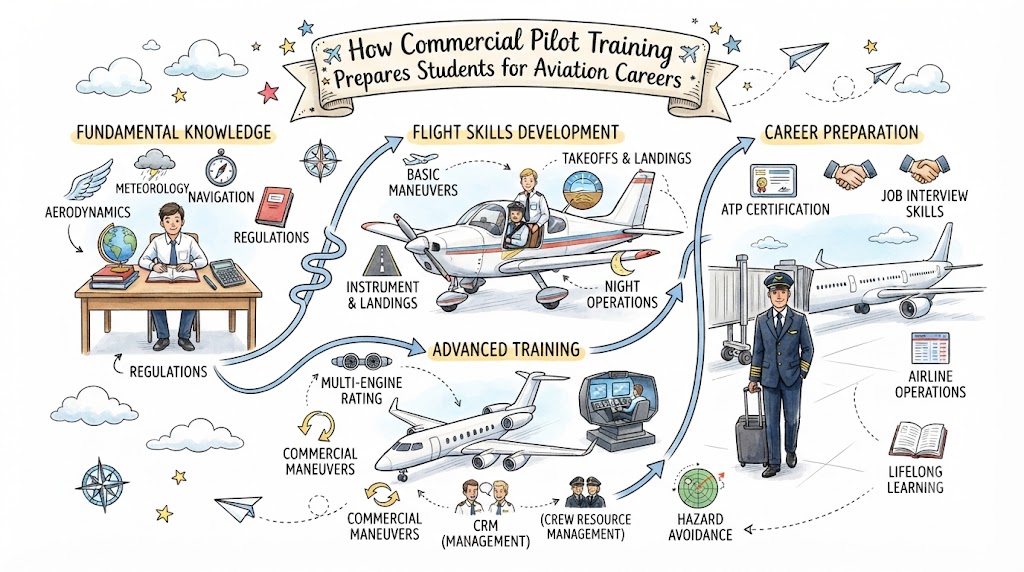
Sample Commercial Pilot Training Journey
- Discovery flight and career exploration.
- Enrollment in a structured flight training program.
- Ground school and aviation theory.
- Dual flight instruction.
- Supervised solo flying.
- Cross-country flight experience.
- Advanced commercial maneuvers.
- Practical preparation and evaluation.
- Continued skill development and career progression.
Frequently Asked Questions
1. What is commercial pilot training?
Commercial pilot training prepares students with the knowledge, skills, and practical experience needed to pursue professional flying opportunities while meeting applicable licensing requirements.
2. How is commercial training different from private pilot training?
Commercial training places greater emphasis on precision, professionalism, operational knowledge, advanced flight skills, and career preparation.
3. Is commercial pilot training difficult?
It is challenging, but consistent study, regular practice, and guidance from qualified instructors help students progress successfully.
4. Do students fly solo?
Yes. Under appropriate supervision and after demonstrating proficiency, students typically complete solo flight training as part of their development.
5. Why is ground school important?
Ground school provides the theoretical knowledge necessary for safe flight operations, effective planning, and sound decision-making.
6. What careers can commercial pilots pursue?
Commercial pilots may work in airlines, charter operations, corporate aviation, flight instruction, cargo services, government aviation, and several other aviation sectors, depending on their qualifications and experience.
7. How important is safety during training?
Safety is central to every aspect of professional pilot training and is reinforced throughout both classroom and flight instruction.
8. What qualities make a successful commercial pilot?
Professionalism, discipline, communication skills, sound judgment, adaptability, and a commitment to continuous learning are all important qualities.
9. Does training continue after earning a commercial license?
Yes. Pilots continue learning through recurrent training, additional ratings, operational experience, and ongoing professional development.
10. How do I choose the right flight school?
Evaluate instructor qualifications, safety culture, aircraft quality, maintenance standards, training resources, scheduling flexibility, and student support before making a decision.
Conclusion
Commercial pilot training is much more than learning how to fly an aircraft—it is a structured journey that develops technical expertise, sound judgment, professional discipline, and a safety-first mindset. Through a combination of classroom education, practical flight instruction, and real-world experience, students build the confidence and competencies needed to pursue a wide range of aviation careers. The habits formed during training, from effective communication to careful decision-making, continue to benefit pilots throughout their professional lives.
Choosing the right flight school plays an important role in this journey. A high-quality training environment provides experienced instructors, well-maintained aircraft, comprehensive ground education, and a culture that emphasizes safety and continuous improvement. FLIGHTTRAININGUS.COM is dedicated to helping aspiring pilots develop the knowledge, skills, and professionalism required to build successful and rewarding careers in aviation.
