
Introduction
A career as a commercial pilot is one of the most exciting and rewarding paths in the aviation industry. Commercial pilots are responsible for transporting passengers, cargo, medical supplies, and performing specialized aviation operations. Behind every successful commercial pilot is a strong foundation of professional flight training, aviation knowledge, and practical flying experience.
Commercial Pilot License (CPL) training is designed to transform aspiring aviators into skilled professionals capable of operating aircraft safely, efficiently, and confidently. The journey involves much more than learning to fly. Students gain expertise in aviation regulations, aircraft systems, navigation, weather analysis, emergency procedures, flight planning, aerodynamics, and decision-making under real-world conditions.
Whether your dream is to fly for a regional airline, become a corporate pilot, work in cargo aviation, or eventually captain large commercial aircraft, earning a Commercial Pilot License is one of the most important milestones in your aviation career.
What Is a Commercial Pilot License?
A Commercial Pilot License (CPL) is a professional aviation certification that allows qualified pilots to operate aircraft for compensation or hire. Unlike a Private Pilot License, which primarily permits recreational flying, a Commercial Pilot License enables pilots to pursue paid aviation careers across various sectors of the industry.
Commercial pilots undergo advanced flight training that focuses on precision flying, aircraft performance, operational safety, and professional decision-making. The training prepares pilots to handle more complex aircraft operations while meeting strict aviation safety standards.
A Commercial Pilot License also serves as the foundation for many advanced aviation careers, including airline transport, corporate aviation, flight instruction, aerial surveying, charter operations, and cargo transportation.
Difference Between a Private Pilot License and a Commercial Pilot License
Although both licenses allow individuals to fly aircraft, their purposes differ significantly.
A Private Pilot License allows pilots to fly for personal and recreational purposes without receiving compensation for their flying services.
A Commercial Pilot License, on the other hand, authorizes qualified pilots to receive payment for operating aircraft in approved commercial activities, provided they meet all applicable aviation regulations.
Commercial pilot training places greater emphasis on:
- Advanced aircraft handling
- Precision flight maneuvers
- Professional flight planning
- Complex aircraft systems
- Operational safety
- Risk management
- Commercial aviation regulations
Why Choose a Career as a Commercial Pilot?
Becoming a commercial pilot offers numerous professional and personal rewards.
Exciting Career Opportunities
Commercial pilots can work in multiple aviation sectors rather than following a single career path.
Possible roles include:
- Regional airline pilot
- Charter pilot
- Corporate pilot
- Cargo pilot
- Flight instructor
- Agricultural pilot
- Air ambulance pilot
- Aerial survey pilot
- Sightseeing tour pilot
- Ferry pilot
Travel Opportunities
Pilots often travel to new cities, states, and countries while gaining valuable professional experience.
Professional Growth
Commercial aviation provides continuous learning opportunities through additional certifications, aircraft type ratings, and advanced flight responsibilities.
Competitive Income
As pilots gain experience and additional qualifications, their earning potential generally increases along with career progression.
High Skill Development
Commercial pilot training develops valuable skills including:
- Leadership
- Communication
- Decision making
- Problem solving
- Situational awareness
- Time management
Eligibility Requirements for Commercial Pilot License Training
Before beginning Commercial Pilot License training, applicants must satisfy several eligibility requirements.
Typical requirements include:
- Meet the minimum age requirement
- Hold the appropriate medical certificate
- Demonstrate English language proficiency
- Possess a Private Pilot License
- Complete the required flight experience
- Meet aviation regulatory standards
- Maintain physical and mental fitness for flying
Flight schools may also have additional admission requirements depending on their training programs.
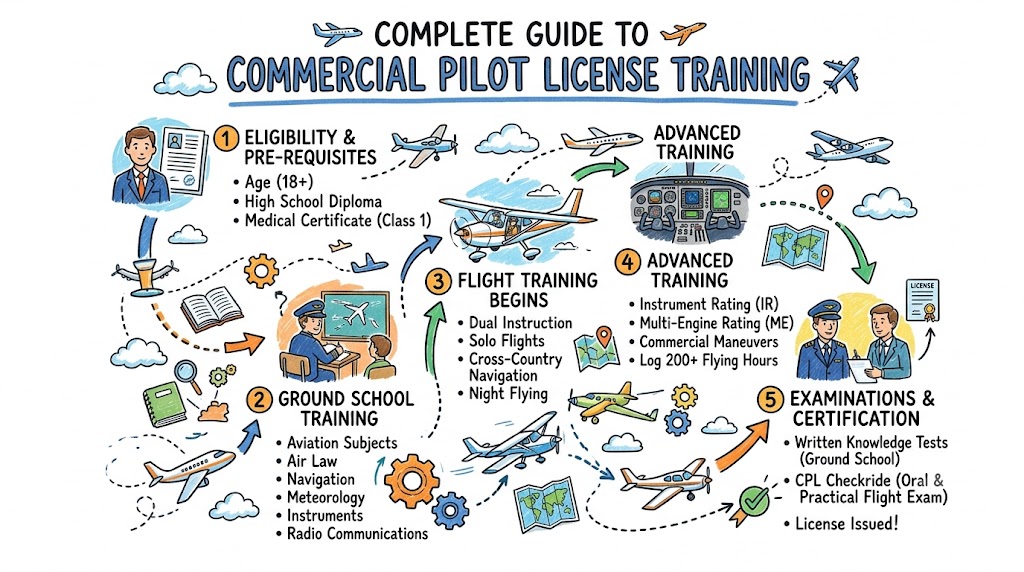
Step-by-Step Commercial Pilot License Training Process
Step 1: Meet the Eligibility Requirements
The first step involves confirming that you meet all regulatory and flight school admission requirements before enrolling in a commercial pilot program.
Step 2: Obtain the Required Medical Certificate
Commercial pilots must meet medical fitness standards to ensure they can safely operate aircraft.
Medical examinations typically evaluate:
- Vision
- Hearing
- Cardiovascular health
- Neurological condition
- Overall physical fitness
Maintaining medical certification is essential throughout a professional flying career.
Step 3: Complete Ground School
Ground school provides the theoretical knowledge required for professional flight operations.
Students learn both aviation fundamentals and advanced commercial concepts that prepare them for written examinations and real-world flying.
Step 4: Build the Required Flight Experience
Commercial pilot candidates must accumulate significant flight experience before qualifying for certification.
Training includes:
- Solo flights
- Dual instruction
- Cross-country flights
- Night operations
- Instrument flying
- Commercial maneuvers
Each flight builds confidence and practical experience.
Step 5: Learn Advanced Flight Maneuvers
Commercial pilots are expected to demonstrate greater aircraft control than private pilots.
Training commonly includes:
- Chandelles
- Lazy eights
- Steep spirals
- Eights on pylons
- Precision landings
- Emergency descents
- Short-field operations
- Soft-field operations
These maneuvers improve precision and aircraft handling skills.
Step 6: Pass the Written Knowledge Examination
Students must demonstrate their understanding of aviation theory through a comprehensive written examination covering numerous aviation subjects.
Preparation includes:
- Practice examinations
- Classroom instruction
- Self-study
- Instructor reviews
Step 7: Prepare for the Practical Flight Test
The practical examination evaluates both knowledge and flying ability.
Students review:
- Aircraft systems
- Regulations
- Flight planning
- Weather interpretation
- Emergency procedures
- Aircraft performance
Extensive practice helps reduce stress before the examination.
Step 8: Complete the Checkride
The final evaluation typically consists of:
- Oral examination
- Aircraft inspection
- Flight planning
- Practical flight demonstration
Successful completion leads to Commercial Pilot License certification.
Step 9: Begin Your Professional Aviation Career
After earning a Commercial Pilot License, pilots can begin building professional flight experience while pursuing additional ratings and career advancement opportunities.
Subjects Covered During Commercial Pilot Ground School
Ground school provides the academic foundation necessary for safe commercial aviation.
Major topics include:
Aerodynamics
Students learn how lift, drag, thrust, and weight affect aircraft performance under different flight conditions.
Aircraft Systems
Training covers:
- Engines
- Fuel systems
- Electrical systems
- Hydraulic systems
- Landing gear
- Flight controls
- Avionics
Aviation Weather
Weather education includes:
- Cloud formation
- Wind patterns
- Thunderstorms
- Icing
- Turbulence
- Weather reports
- Forecast interpretation
Navigation
Students master:
- Flight charts
- GPS navigation
- Radio navigation
- Cross-country planning
- Airspace navigation
Aviation Regulations
Commercial pilots must thoroughly understand aviation laws governing professional flight operations.
Aircraft Performance
Topics include:
- Weight and balance
- Performance calculations
- Takeoff performance
- Landing performance
- Fuel planning
Emergency Procedures
Students prepare for:
- Engine failures
- Electrical failures
- System malfunctions
- Emergency landings
- Fire procedures
Flight Skills Developed During Commercial Pilot Training
Commercial flight training emphasizes professional aircraft handling.
Pilots learn:
- Precision takeoffs
- Precision landings
- Advanced maneuvering
- Cross-country operations
- Night flying
- Instrument reference flying
- Emergency management
- Crew communication
- Risk assessment
- Decision making
These skills prepare pilots for professional aviation environments.
Flight Hour Requirements
Commercial Pilot License training includes a combination of different flight experiences.
Training generally involves:
- Total flight hours
- Pilot-in-command time
- Cross-country experience
- Night flight experience
- Instrument instruction
- Solo operations
- Dual instruction
- Practical training exercises
Every flight contributes to building confidence and professional competence.
How Long Does Commercial Pilot License Training Take?
Training duration varies depending on several factors.
These include:
- Full-time or part-time enrollment
- Student learning pace
- Aircraft availability
- Instructor scheduling
- Weather conditions
- Flight frequency
Students who train consistently often progress more efficiently than those with long breaks between lessons.
Commercial Pilot Training Costs
Training expenses vary depending on the flight school, aircraft type, and individual progress.
Typical cost categories include:
- Flight instruction
- Aircraft rental
- Ground school tuition
- Pilot supplies
- Aviation charts
- Headsets
- Books
- Examination fees
- Medical certification
- Checkride expenses
- Simulator training
Planning a training budget in advance helps reduce financial stress during the program.
Common Challenges During Commercial Pilot Training
Every aspiring commercial pilot faces challenges throughout training.
Common examples include:
Weather Delays
Poor weather may postpone flights and extend training timelines.
Advanced Flight Maneuvers
Commercial maneuvers require patience and repeated practice.
Managing Study Time
Ground school and flight training demand strong time-management skills.
Building Confidence
Students gradually develop confidence through experience and instructor guidance.
Preparing for Examinations
Written exams and practical tests require thorough preparation and consistent study habits.
Tips for Successfully Completing Commercial Pilot Training
Students can improve their chances of success by following practical strategies.
Train Consistently
Frequent flying improves skill retention and confidence.
Study Every Week
Regular review prevents information overload before examinations.
Listen to Instructor Feedback
Constructive feedback accelerates learning and improves performance.
Practice Flight Planning
Effective planning becomes easier with consistent practice.
Stay Physically Healthy
Adequate sleep, nutrition, and exercise support better decision-making and concentration.
Ask Questions
Never hesitate to clarify concepts during training.
Learn from Mistakes
Every flight provides opportunities for improvement.
Career Opportunities After Earning a Commercial Pilot License
A Commercial Pilot License opens the door to numerous aviation careers.
Potential opportunities include:
Flight Instructor
Many commercial pilots build experience by teaching new student pilots.
Charter Pilot
Operate private charter flights for individuals and businesses.
Corporate Pilot
Fly company executives using business aircraft.
Cargo Pilot
Transport freight and essential goods across regional or international routes.
Agricultural Pilot
Support farming operations through aerial application services.
Air Ambulance Pilot
Transport patients and medical teams during emergency operations.
Aerial Survey Pilot
Conduct mapping, photography, and infrastructure inspections.
Sightseeing Tour Pilot
Provide scenic flights for tourists in popular destinations.
Regional Airline Pilot
Many commercial pilots eventually transition into regional airline operations before advancing to larger airlines.
Choosing the Right Flight School
Selecting the right training organization significantly impacts your aviation journey.
Consider the following factors:
- Regulatory approval
- Experienced instructors
- Modern training aircraft
- Safety culture
- Aircraft maintenance quality
- Flexible scheduling
- Student support
- Graduation success rates
- Flight simulator availability
- Career guidance
A reputable school provides both quality education and professional mentorship.
Mistakes to Avoid During Commercial Pilot Training
Avoid these common mistakes:
- Flying too infrequently
- Ignoring ground school studies
- Poor financial planning
- Rushing through lessons
- Skipping practice sessions
- Not reviewing previous flights
- Underestimating written examinations
- Ignoring instructor recommendations
- Weak preparation before checkrides
- Failing to maintain medical fitness
Avoiding these pitfalls helps students progress more efficiently.
Frequently Asked Questions
1. What is a Commercial Pilot License?
A Commercial Pilot License is a professional certification that allows qualified pilots to operate aircraft for compensation or hire. It requires advanced flight training, aviation knowledge, practical experience, and successful completion of written and practical examinations. It serves as the foundation for many professional aviation careers.
2. How long does Commercial Pilot License training take?
Training duration varies based on individual progress, weather conditions, training frequency, aircraft availability, and scheduling. Students who train consistently often complete their programs more efficiently than those with extended gaps between lessons.
3. What flight experience is required before earning a Commercial Pilot License?
Commercial pilot candidates must complete specific flight experience requirements that include total flight time, pilot-in-command experience, cross-country flying, night operations, and advanced flight instruction. Exact requirements depend on applicable aviation regulations.
4. Do I need a Private Pilot License before beginning Commercial Pilot training?
Yes. In most cases, obtaining a Private Pilot License is an essential step before beginning Commercial Pilot License training. It provides the foundational flying skills and knowledge needed for more advanced commercial training.
5. Is Commercial Pilot training difficult?
Commercial Pilot training is challenging because it builds upon private pilot knowledge while introducing advanced maneuvers, regulations, aircraft systems, and professional flight operations. With dedication, regular practice, and guidance from experienced instructors, students can successfully complete the program.
6. What medical certificate is required for Commercial Pilot training?
Commercial pilots must meet specific aviation medical standards through an approved medical examination. Maintaining medical fitness is important throughout a professional flying career to ensure safe flight operations.
7. Can international students enroll in Commercial Pilot training?
Many flight schools accept international students who meet admission requirements and applicable aviation regulations. Students should verify documentation, language requirements, visa procedures, and licensing eligibility before applying.
8. What jobs can I pursue after earning a Commercial Pilot License?
Graduates may pursue careers as charter pilots, corporate pilots, flight instructors, cargo pilots, sightseeing pilots, agricultural pilots, aerial survey pilots, or continue building experience toward airline careers.
9. How should I prepare for the Commercial Pilot checkride?
Preparation includes reviewing aviation regulations, practicing flight maneuvers, studying aircraft systems, refining flight planning skills, conducting mock oral examinations, and flying regularly with an instructor to build confidence before the evaluation.
10. Is becoming a Commercial Pilot worth it?
For individuals who are passionate about aviation, becoming a commercial pilot can lead to an exciting and rewarding career. It offers opportunities for continuous learning, professional growth, diverse flying experiences, and the satisfaction of turning a passion for flight into a profession.
Conclusion
Earning a Commercial Pilot License is a major milestone for anyone pursuing a professional aviation career. The training combines classroom learning, practical flight experience, advanced aircraft handling, and a strong commitment to aviation safety. Every lesson, flight hour, and examination helps build the knowledge and confidence required to operate aircraft professionally.
Success in Commercial Pilot License training comes from consistency, discipline, and choosing a quality flight training program. By understanding the eligibility requirements, mastering ground school subjects, developing advanced flying skills, and preparing thoroughly for examinations, aspiring pilots can confidently progress toward their aviation goals.
Whether your ambition is to become a flight instructor, corporate pilot, cargo operator, charter pilot, or eventually fly for an airline, a Commercial Pilot License provides the essential foundation for long-term success. FLIGHTTRAININGUS.COM is dedicated to helping aspiring pilots understand every stage of professional flight training, empowering them to make informed decisions and take the next step toward a successful career in aviation.
