
Introduction
Enterprise IT environments today are highly distributed, multi-cloud, and constantly evolving. Traditional monitoring tools struggle to keep up with the scale, velocity, and complexity of modern systems.
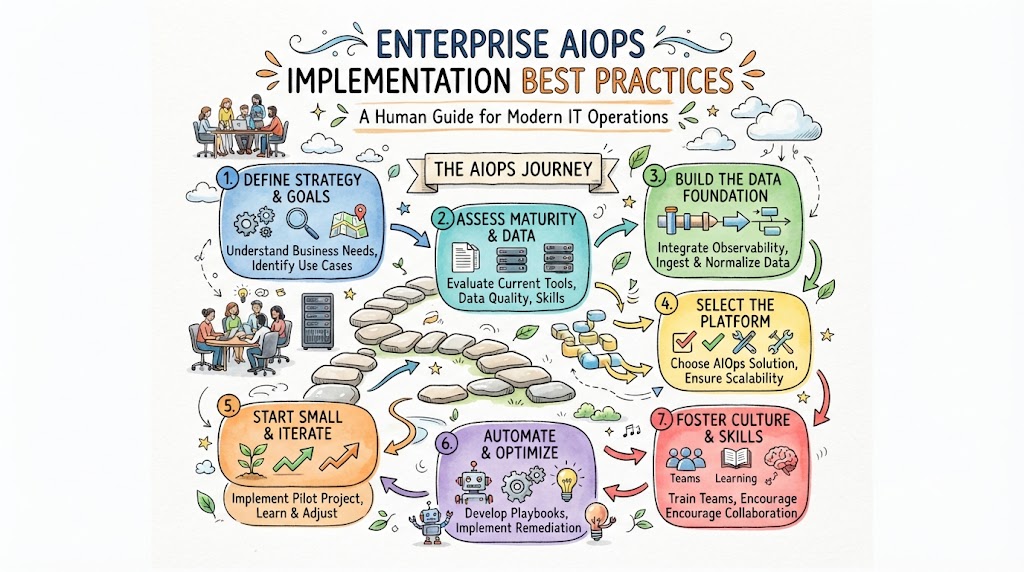
AIOps (Artificial Intelligence for IT Operations) addresses this challenge by combining machine learning, automation, and observability to improve incident detection, correlation, and resolution. However, successful enterprise adoption requires more than just tools—it requires a structured implementation strategy.
This guide outlines the most effective best practices for implementing AIOps in enterprise environments.
1. Start with Clear Business Objectives
AIOps implementation should always begin with defined outcomes rather than technology selection.
Common enterprise goals include:
- Reducing mean time to resolution (MTTR)
- Minimizing alert noise and false positives
- Improving system uptime and SLA compliance
- Enhancing incident response automation
- Increasing operational efficiency
Without clear objectives, AIOps initiatives often become fragmented tool deployments instead of strategic transformations.
2. Build a Strong Observability Foundation
AIOps depends heavily on high-quality telemetry data.
Enterprises must ensure complete visibility across:
- Logs
- Metrics
- Traces
- Events
Key best practices:
- Standardize data collection across systems
- Implement distributed tracing for microservices
- Use centralized logging pipelines
- Ensure consistent tagging and metadata standards
Poor observability leads to inaccurate AI insights and weak correlation results.
3. Unify Data Sources Across the Enterprise
One of the biggest challenges in AIOps is data silos.
Organizations should integrate:
- Cloud platforms (AWS, Azure, GCP)
- On-prem infrastructure
- Application performance monitoring tools
- Security and network monitoring systems
- DevOps and CI/CD pipelines
A unified data layer enables better event correlation and root cause analysis.
4. Prioritize Event Correlation Before Automation
Before introducing automation, enterprises should focus on intelligent event correlation.
This involves:
- Grouping related alerts into single incidents
- Eliminating duplicate and redundant alerts
- Identifying root-cause indicators
- Reducing alert fatigue for operations teams
Without strong correlation, automation can amplify errors instead of solving them.
5. Introduce AIOps in Phases
A phased rollout reduces risk and improves adoption.
Phase 1: Visibility
- Data collection
- Monitoring standardization
- Dashboard consolidation
Phase 2: Insight
- Anomaly detection
- Event correlation
- Alert prioritization
Phase 3: Action
- Automated remediation
- Incident workflows
- Self-healing systems
This staged approach ensures stability at each step.
6. Focus on High-Impact Use Cases First
Enterprises should avoid trying to automate everything at once.
Start with:
- High-frequency incidents
- Recurring infrastructure failures
- Application performance issues
- Cloud resource anomalies
Quick wins build stakeholder confidence and demonstrate measurable ROI.
7. Use Machine Learning Models Carefully
AIOps is not “plug and play AI.” Models must be trained and tuned for enterprise environments.
Best practices include:
- Continuously training models with real operational data
- Avoiding over-reliance on default vendor models
- Validating anomaly detection outputs
- Adjusting thresholds based on environment behavior
Human oversight remains critical in early stages.
8. Integrate AIOps with DevOps and SRE Workflows
AIOps should not operate in isolation.
It must integrate with:
- CI/CD pipelines
- Incident management tools
- On-call and alerting systems
- Change management processes
This ensures seamless collaboration between development and operations teams and supports faster remediation cycles.
9. Implement Strong Governance and Security Controls
Enterprise AIOps systems handle sensitive operational data.
Governance practices should include:
- Role-based access control
- Audit logging for automation actions
- Data privacy compliance
- Secure API integrations
- Controlled automation approval workflows
Security and compliance must be embedded from the start.
10. Continuously Optimize and Evolve
AIOps is not a one-time implementation—it is an ongoing journey.
Continuous improvement involves:
- Reviewing incident patterns regularly
- Refining correlation rules
- Updating ML models with new data
- Expanding automation coverage
- Measuring KPIs like MTTR, alert reduction, and system uptime
Mature AIOps environments evolve toward predictive and autonomous operations.
11. Build Cross-Functional Collaboration
Successful AIOps adoption requires alignment across:
- IT Operations teams
- DevOps engineers
- SRE teams
- Security teams
- Business stakeholders
Shared ownership ensures that AIOps insights translate into actionable improvements across the organization.
12. Invest in Skills and Training
Technology alone is not enough. Teams must be trained in:
- Observability engineering
- Incident response automation
- ML-driven monitoring concepts
- Cloud-native architectures
Platforms such as AIOpsSchool.com help enterprises build structured learning paths for AIOps adoption.
Conclusion
Enterprise AIOps implementation is most successful when approached as a gradual, structured transformation rather than a tool deployment exercise. Organizations that focus on observability, data integration, phased adoption, governance, and continuous improvement achieve the highest operational impact.
When implemented correctly, AIOps enables enterprises to move from reactive firefighting to predictive, automated, and intelligent IT operations—delivering faster resolution, higher reliability, and improved business continuity.
