
Introduction
As modern IT environments become increasingly complex, organizations are generating enormous volumes of operational data from applications, infrastructure, cloud platforms, networks, containers, and monitoring systems. Traditional IT operations teams often struggle to process this information efficiently, leading to alert fatigue, delayed incident resolution, and increased downtime.
This is where AIOps (Artificial Intelligence for IT Operations) comes into play. AIOps combines artificial intelligence, machine learning, big data analytics, and automation to help organizations monitor, analyze, predict, and resolve IT issues more effectively.
For IT professionals, learning AIOps has become an important career advancement opportunity. Organizations are actively seeking engineers who understand intelligent monitoring, event correlation, anomaly detection, root cause analysis, predictive operations, and automated remediation.
In this guide, we will explore AIOps fundamentals, training options, certification paths, practical use cases, enterprise applications, career opportunities, and the skills required to become an AIOps professional.
What is AIOps?
AIOps stands for Artificial Intelligence for IT Operations. It refers to the use of machine learning, artificial intelligence, analytics, and automation technologies to enhance IT operations management.
AIOps platforms collect data from multiple sources, including:
- Infrastructure monitoring systems
- Cloud platforms
- Application performance monitoring tools
- Log management systems
- Network monitoring tools
- Security monitoring solutions
- Service management platforms
The platform then analyzes the collected data to identify patterns, detect anomalies, correlate events, predict incidents, and automate responses.
The primary objective of AIOps is to improve operational efficiency while reducing manual intervention.
Why AIOps Matters Today
Organizations are rapidly adopting cloud-native architectures, microservices, containers, and hybrid cloud environments. These technologies generate vast amounts of operational data that traditional monitoring approaches cannot effectively manage.
Common challenges include:
- Thousands of daily alerts
- Complex distributed systems
- Longer troubleshooting times
- Increased operational costs
- Limited visibility across environments
- Difficulty identifying root causes
AIOps addresses these challenges by providing intelligent insights and automated decision-making capabilities.
Benefits include:
- Faster incident detection
- Reduced downtime
- Improved system reliability
- Better customer experiences
- Lower operational costs
- Enhanced IT productivity
Key Components of AIOps
Data Collection
AIOps platforms gather information from diverse IT systems.
Sources include:
- Logs
- Metrics
- Events
- Traces
- Performance data
- Security alerts
Machine Learning
Machine learning algorithms analyze historical and real-time data to identify patterns and anomalies.
Capabilities include:
- Trend analysis
- Predictive analytics
- Behavioral analysis
- Forecasting
Event Correlation
Modern environments can generate thousands of alerts for a single issue.
AIOps helps by:
- Grouping related alerts
- Eliminating duplicate notifications
- Identifying incident relationships
- Reducing alert noise
Root Cause Analysis
Instead of manually searching across systems, AIOps platforms help identify probable causes of incidents.
Benefits include:
- Faster troubleshooting
- Reduced Mean Time to Resolution (MTTR)
- Improved operational efficiency
Automation
AIOps platforms can automate routine operational tasks.
Examples include:
- Service restarts
- Resource scaling
- Ticket creation
- Workflow execution
- Incident response actions
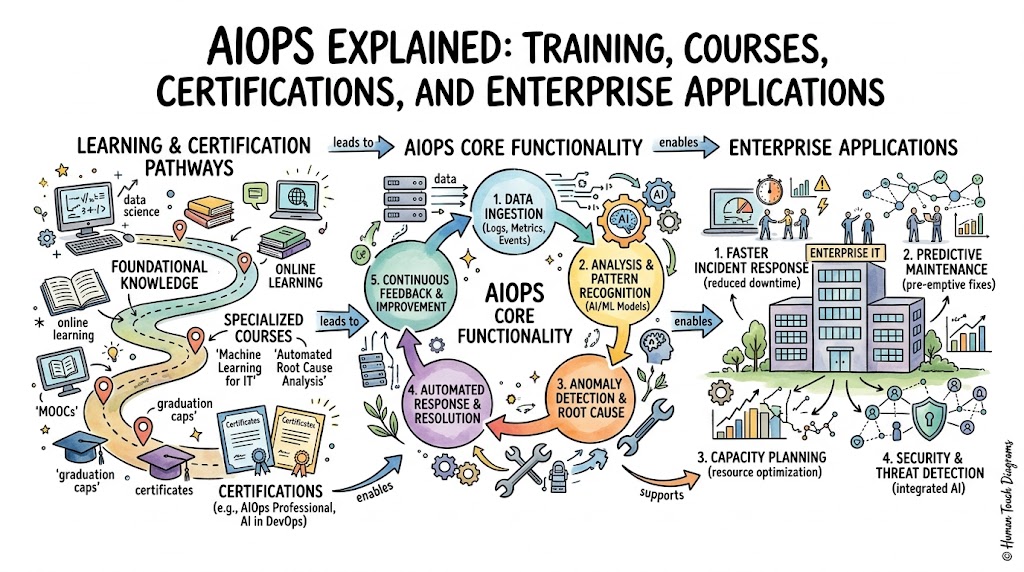
How AIOps Works
A typical AIOps workflow follows several stages.
Step 1: Data Ingestion
The platform gathers information from multiple IT sources.
Step 2: Data Normalization
Different data formats are standardized for analysis.
Step 3: Pattern Recognition
Machine learning models identify normal and abnormal behaviors.
Step 4: Event Correlation
Related alerts and events are grouped together.
Step 5: Root Cause Identification
The system determines the most likely cause of an issue.
Step 6: Automated Response
Predefined actions can be triggered automatically.
Step 7: Continuous Learning
Machine learning models improve over time using historical data.
AIOps Training: Why Professionals Should Learn It
The demand for intelligent IT operations is increasing rapidly.
Organizations need professionals who can:
- Manage modern monitoring platforms
- Analyze operational data
- Build automated workflows
- Implement observability strategies
- Support cloud-native environments
- Improve service reliability
AIOps training helps professionals develop these skills and stay relevant in a rapidly evolving technology landscape.
What You Learn in an AIOps Course
A comprehensive AIOps course typically covers the following topics.
AIOps Fundamentals
- Introduction to AIOps
- History and evolution
- Business value
- Industry adoption
Monitoring and Observability
- Metrics
- Logs
- Traces
- Distributed monitoring
- Service observability
Machine Learning Basics
- Pattern detection
- Predictive analytics
- Data processing
- Anomaly detection
Event Correlation
- Alert reduction
- Incident grouping
- Noise suppression
Root Cause Analysis
- Dependency mapping
- Service relationships
- Incident investigation
Automation and Orchestration
- Workflow automation
- Automated remediation
- Runbook automation
Cloud and Kubernetes Monitoring
- Container observability
- Kubernetes monitoring
- Cloud operations management
Enterprise Use Cases
- Incident management
- Capacity planning
- Performance optimization
- Security monitoring
AIOps Certifications
Certifications validate your understanding of AIOps principles and best practices.
Benefits include:
- Industry recognition
- Improved credibility
- Better career opportunities
- Higher earning potential
- Structured learning path
Popular certification areas include:
- AIOps Foundation
- AI for IT Operations
- Intelligent Monitoring
- IT Automation
- Observability Engineering
- Site Reliability Engineering
AIOps Foundation Certification
AIOps Foundation certifications are often considered the starting point for professionals entering the field.
Typical topics include:
- AIOps concepts
- Big data analytics
- Machine learning fundamentals
- Event correlation
- Anomaly detection
- Root cause analysis
- Automation frameworks
- Enterprise implementation strategies
The certification is suitable for:
- DevOps Engineers
- SRE Engineers
- Cloud Engineers
- IT Operations Professionals
- Platform Engineers
- Monitoring Specialists
- System Administrators
AIOps vs DevOps
Many professionals confuse AIOps with DevOps.
DevOps
Focuses on:
- Collaboration
- Continuous Integration
- Continuous Delivery
- Infrastructure Automation
- Software Development Lifecycle
AIOps
Focuses on:
- Intelligent Operations
- Monitoring
- Analytics
- Event Correlation
- Incident Prediction
- Automated Remediation
Relationship Between Them
DevOps accelerates software delivery, while AIOps helps maintain operational stability and reliability.
Together, they create a powerful framework for modern IT operations.
AIOps vs MLOps
Although both use AI technologies, their objectives differ.
MLOps
Focuses on:
- Machine learning model development
- Model deployment
- Model monitoring
- AI lifecycle management
AIOps
Focuses on:
- IT operations management
- Infrastructure monitoring
- Incident detection
- Operational automation
Key Difference
MLOps manages AI systems, while AIOps uses AI to manage IT systems.
Enterprise Applications of AIOps
Organizations across industries are implementing AIOps to improve operational efficiency.
Incident Management
AIOps helps detect incidents earlier and reduce response times.
Benefits include:
- Faster alerting
- Better prioritization
- Reduced downtime
Root Cause Analysis
Machine learning accelerates issue identification.
Benefits include:
- Faster troubleshooting
- Lower MTTR
- Improved service availability
Capacity Planning
AIOps predicts future resource requirements.
Examples include:
- Storage forecasting
- Compute forecasting
- Network capacity planning
Cloud Operations
Cloud environments generate enormous operational data.
AIOps supports:
- Resource optimization
- Cost management
- Cloud performance monitoring
Security Operations
Security teams use AIOps to:
- Detect anomalies
- Identify threats
- Correlate security events
- Improve response times
Network Operations
AIOps enhances:
- Network monitoring
- Fault detection
- Traffic analysis
- Performance optimization
AIOps for SRE Teams
Site Reliability Engineering teams increasingly rely on AIOps.
Benefits include:
- Reduced alert fatigue
- Faster root cause analysis
- Automated incident response
- Improved service reliability
- Better observability
AIOps allows SRE teams to focus on strategic improvements rather than repetitive operational tasks.
Popular AIOps Tools
Several platforms provide AIOps capabilities.
Common categories include:
Monitoring Platforms
- Datadog
- Dynatrace
- New Relic
Observability Platforms
- Splunk
- Elastic
- Grafana
IT Operations Platforms
- IBM Watson AIOps
- Moogsoft
- BigPanda
Cloud Monitoring Solutions
- Azure Monitor
- Amazon CloudWatch
- Google Cloud Operations Suite
These tools help organizations gain operational visibility and automate incident management processes.
Career Opportunities in AIOps
The growing adoption of AI-driven operations is creating numerous career opportunities.
Popular roles include:
AIOps Engineer
Responsible for implementing and managing AIOps platforms.
Site Reliability Engineer
Uses AIOps technologies to improve system reliability.
DevOps Engineer
Integrates monitoring, automation, and observability solutions.
Cloud Operations Engineer
Manages cloud infrastructure using intelligent operational tools.
Platform Engineer
Builds scalable operational platforms with automation and observability capabilities.
IT Operations Manager
Leads operational transformation initiatives involving AIOps adoption.
Skills Required for AIOps Professionals
Successful AIOps professionals typically possess skills in:
Technical Skills
- Linux
- Cloud Computing
- Monitoring Tools
- Kubernetes
- Automation
- Scripting
- Networking
- Databases
Analytical Skills
- Data Analysis
- Machine Learning Concepts
- Problem Solving
- Incident Investigation
Operational Skills
- Observability
- Reliability Engineering
- Capacity Planning
- Change Management
Future of AIOps
The future of AIOps is closely tied to advancements in artificial intelligence, cloud computing, and automation.
Emerging trends include:
- Autonomous Operations
- Self-Healing Systems
- Predictive Incident Prevention
- Generative AI Integration
- Intelligent Runbooks
- AI-Powered Observability
- Advanced Root Cause Analysis
- Autonomous Cloud Management
As enterprises continue to modernize their infrastructure, AIOps will play a central role in maintaining operational excellence.
Conclusion
AIOps represents the next evolution of IT operations, combining artificial intelligence, machine learning, analytics, and automation to manage increasingly complex technology environments. By enabling intelligent monitoring, event correlation, anomaly detection, predictive analytics, and automated remediation, AIOps helps organizations reduce downtime, improve reliability, and increase operational efficiency. For professionals seeking career growth, AIOps training and certification provide valuable knowledge in modern IT operations, observability, automation, cloud monitoring, and incident management. Whether you are a DevOps Engineer, SRE, Cloud Engineer, Platform Engineer, or IT Operations professional, learning AIOps can help you stay ahead in an industry that is rapidly embracing AI-driven operational excellence. As enterprise adoption continues to grow, AIOps skills will become increasingly important for building resilient, efficient, and intelligent IT environments.
